The Best Truck Tires: 5 Picks Compared for Towing, Snow and Daily Miles
Five truck tires compared on load range, size and snow rating, from a load range E towing set to a quiet highway pick, plus how to read your sidewall.

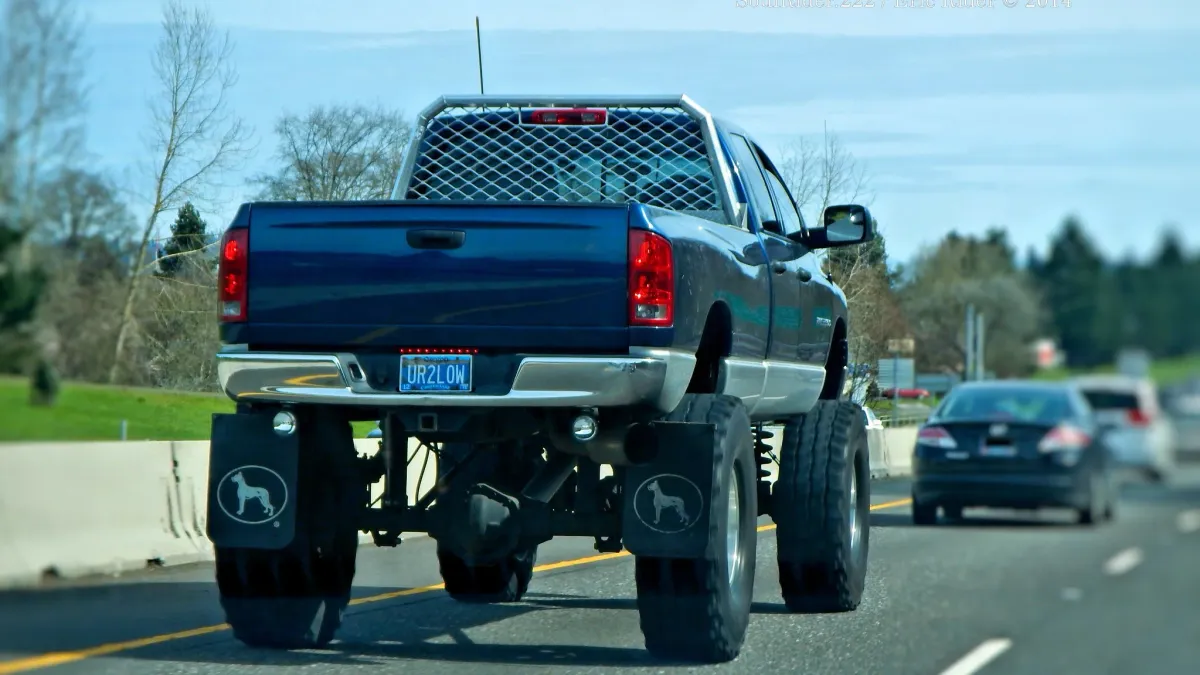
A truck tire has to do a job a car tire never does, which is carry weight. That one difference is why picking truck tires goes wrong so often. People shop by tread pattern and end up with a tire that looks right and is rated wrong. This guide compares five truck tires sold on Amazon in the United States, chosen to cover the real decisions rather than five versions of the same tread: the snowflake-rated Atturo Trail Blade ATS as the all-round pick, the load range E Travelstar Ecopath AT for towing and hauling, the Falken Wildpeak A/T4W as the mainstream brand upgrade, the Armstrong Tru-Trac AT with the longest stated treadwear warranty here, and the quiet P metric GT Radial Adventuro AT3 for trucks that mostly commute. One warning first. Every listing below is for one specific size. Read the numbers on your own sidewall and your door placard before you click anything, because a tire is bought by size and load rating, never by the name of your truck.
Table of contents
- Quick picks
- Load index of each tire as listed
- Comparison table
- Best Overall: Atturo Trail Blade ATS
- Best for Towing and Heavy Loads: Travelstar Ecopath AT
- Upgrade Pick: Falken Wildpeak A/T4W
- Best Value: Armstrong Tru-Trac AT
- Best for Highway Miles: GT Radial Adventuro AT3
- How we chose
- What to consider before buying
- Load range and ply rating, the number that decides whether you can tow
- LT versus P metric on a half ton truck
- Highway terrain versus all terrain for a truck that mostly commutes
- Final recommendation
- FAQ
Quick picks
Every pick wins a specific use case. Jump to the full review before you buy.
-
Best Overall
Atturo Trail Blade ATS
An all terrain truck tire that carries the three-peak snowflake rating and a 50,000 mile warranty at a mid-range price, sold here in one size you have to match to your own sidewall.
-
Best for Towing and Heavy Loads
Travelstar Ecopath AT
A load range E, 10 ply light truck tire sold as a set of four, built for people who actually put weight on the hitch or in the bed.
-
Upgrade Pick
Falken Wildpeak A/T4W
The recognized name in this guide and the most expensive single tire in it, described as an all terrain and all weather tire with reinforced sidewalls.
-
Best Value
Armstrong Tru-Trac AT
The longest stated treadwear warranty in this guide at the second lowest price, which makes it the sensible default for a truck that mostly drives on pavement.
-
Best for Highway Miles
GT Radial Adventuro AT3
A P metric all terrain tire tuned around noise and tread life rather than off-road grip, and the cheapest single tire in this guide.
Compare every pick
| Product | Award | Tire type | Listed size | Best for | Where to buy |
|---|---|---|---|---|---|
| Atturo Trail Blade ATS | Best Overall | All terrain radial for trucks, SUVs and crossovers | 275/60R20 116T | A half ton truck or SUV owner who drives mostly on pavement, hits gravel and dirt regularly, and wants one tire that handles winter without a second set. | Check price for Atturo Trail Blade ATS at Amazon (affiliate link) |
| Travelstar Ecopath AT | Best for Towing and Heavy Loads | All terrain light truck tire | LT275/65R20 126/123S | Someone towing a trailer or hauling in the bed on a truck that came with LT275/65R20 tires and needs the load rating to match the door placard. | Check price for Travelstar Ecopath AT at Amazon (affiliate link) |
| Falken Wildpeak A/T4W | Upgrade Pick | All terrain and all weather light truck tire | 265/70R17 115T | A truck or SUV owner who wants a mainstream brand with a real dealer network behind it and is willing to pay roughly twice the budget price for it. | Check price for Falken Wildpeak A/T4W at Amazon (affiliate link) |
| Armstrong Tru-Trac AT | Best Value | All terrain tire for trucks and SUVs | 265/70R17 116T | A half ton truck or SUV owner who commutes on pavement, wants an all terrain look and tread, and cares more about cost per mile than about brand. | Check price for Armstrong Tru-Trac AT at Amazon (affiliate link) |
| GT Radial Adventuro AT3 | Best for Highway Miles | All terrain P metric tire with outlined white lettering | P235/75R15 105S | An older truck or compact SUV owner who commutes on pavement, hits a gravel road at the weekend, and wants a quiet tire that lasts. | Check price for GT Radial Adventuro AT3 at Amazon (affiliate link) |
Swipe sideways to compare every column.
Best Overall
Atturo Trail Blade ATS
by Atturo
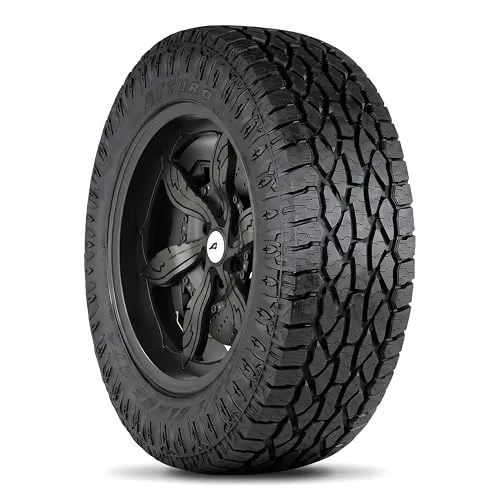
An all terrain truck tire that carries the three-peak snowflake rating and a 50,000 mile warranty at a mid-range price, sold here in one size you have to match to your own sidewall.
What we like
- Carries the three-peak mountain snowflake certification on 2024 and newer production, which most all terrain tires in this price range do not
- Tie bars link the shoulder blocks to the center blocks, which is aimed at both road noise and even wear
- The three-dimensional sipes widen as the tread wears, so grip does not fall off a cliff halfway through the tire's life
- Backed by a 50,000 mile treadwear warranty, and the listing states a UTQG rating of 540 A B in passenger sizes
What we don't
- The snowflake certification applies to 2024 and newer production only, so an older stock tire may not carry it
- This listing is a single 275/60R20 tire on an XL load range, which is not enough tire for a heavy towing setup
- The aggressive tread pattern costs you some fuel economy and some road noise against a plain highway tire
| Tire type | All terrain radial for trucks, SUVs and crossovers |
|---|---|
| Listed size | 275/60R20 116T |
| Load range | XL extra load, 4 ply rated |
| Severe snow rated | Yes, three-peak mountain snowflake on 2024 and newer production |
| Tread warranty | 50,000 miles |
| Price bracket | $$ |
Check your sidewall before you check anything else. This listing is one Atturo Trail Blade ATS in 275/60R20 116T, load range XL. Atturo says the model is made in sizes from 16 inch to 26 inch rims, including LT sizes up to 12 ply, so if your numbers are different the tire probably exists for you. It is just not this page. Buy a tire by the numbers stamped on the rubber, never by the name of your truck.
The reason this one takes Best Overall is the snowflake. Atturo states that 2024 and newer Trail Blade ATS production carries the three-peak mountain snowflake certification. That is a passed snow traction test, not a marketing line, and it is unusual on an all terrain tire at this price. For a truck owner in a state that gets six or eight weeks of real winter, it means you can run one set of tires all year instead of storing a second set.
The construction details are the other half. Tie bars are small bridges of rubber between the shoulder blocks and the center blocks. They stop the outer blocks from flexing independently, which is where all terrain howl comes from, and they also spread wear across the face of the tire instead of letting the shoulders scrub away first. The sipes are three-dimensional and Atturo says they widen through the life of the tread, which is the same idea as the layered siping on good winter tires.
Two honest limits. First, the snowflake rating is tied to production date, so if a seller is clearing older stock you may not get it. Ask, or look for the symbol on the sidewall when the tire arrives. Second, this is an XL passenger-rated size, not a load range E light truck tire. It is a fine tire under an unloaded half ton. It is the wrong tire under a loaded trailer.
Research-based pick: this recommendation is based on product data, owner feedback and comparison with products we have tested, not on direct hands-on testing.
Buy it if: A half ton truck or SUV owner who drives mostly on pavement, hits gravel and dirt regularly, and wants one tire that handles winter without a second set.
Skip it if: You tow near your truck's rated limit, in which case you want the load range E Travelstar Ecopath AT instead.
Best for Towing and Heavy Loads
Travelstar Ecopath AT
by Travelstar
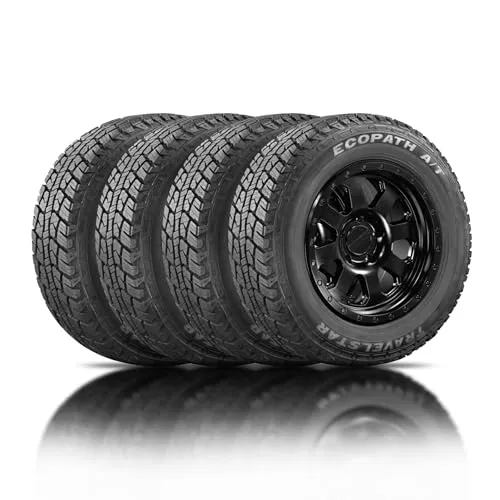
A load range E, 10 ply light truck tire sold as a set of four, built for people who actually put weight on the hitch or in the bed.
What we like
- Load range E with a 10 ply rating and a load index of 126/123, rated to 3,750 lbs per tire in single fitment
- Runs up to 80 psi max pressure, which is what lets a stiff sidewall carry weight without rolling over in a corner
- The listing covers a full set of four tires, so you are not doing the mental arithmetic on a single-tire price
- Comes with a 50,000 mile limited treadwear warranty plus a three-year road hazard warranty
What we don't
- At 52 lbs each these are heavy tires, and unsprung weight like that costs you fuel economy on every mile you drive unloaded
- The listing does not state a three-peak snowflake rating, so treat the light snow claim as light snow only
- This listing is a single size, LT275/65R20, on a 20 inch wheel, and stock was down to one set when we checked
| Tire type | All terrain light truck tire |
|---|---|
| Listed size | LT275/65R20 126/123S |
| Listing covers | Set of four tires |
| Load range | E, 10 ply |
| Load index | 126/123 |
| Price bracket | $$$ |
The size here is LT275/65R20 and the listing sells four of them. Start by confirming that string against your own sidewall, because a 20 inch LT tire is a specific fitment and this page is not a universal answer. Your door placard also lists the load index your truck needs, and that number is the one that matters most on a towing tire.
This is the heavy duty pick, and the numbers say why. Load range E, 10 ply rated, a load index of 126/123, and a maximum pressure of 80 psi. In plain terms, each tire is rated to carry 3,750 lbs on its own or 3,415 lbs in a dual rear wheel setup. A standard load passenger tire is often rated near half that. When you hook up a trailer, the tongue weight lands on the rear axle and the tires either have the capacity or they do not. There is no middle ground and no way to drive around it.
The stiff sidewall does something else you feel immediately, which is that the truck stops leaning on the tires under load. A soft-walled tire squirms when a trailer pushes it in a corner, and that squirm is what makes towing feel vague. Travelstar also claims reduced road noise and highway comfort from the all-season tread design, and the tread is open enough for gravel and dirt.
Now the cost. Each of these weighs about 52 lbs. That is rotating, unsprung mass, and it is the single most expensive kind of weight to add to a vehicle. If your truck tows on weekends and commutes the rest of the week, you burn fuel carrying that capacity around empty for five days out of seven. That trade is worth making if you tow. It is a bad deal if you do not.
Research-based pick: this recommendation is based on product data, owner feedback and comparison with products we have tested, not on direct hands-on testing.
Buy it if: Someone towing a trailer or hauling in the bed on a truck that came with LT275/65R20 tires and needs the load rating to match the door placard.
Skip it if: Your truck spends its life empty on the commute, because you will pay for the load rating in fuel and ride quality without ever using it.
Upgrade Pick
Falken Wildpeak A/T4W
by Falken
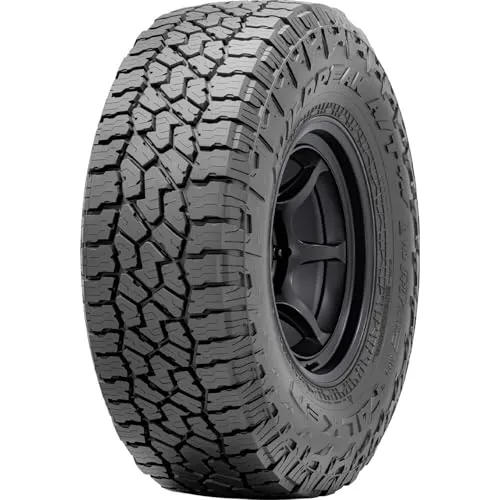
The recognized name in this guide and the most expensive single tire in it, described as an all terrain and all weather tire with reinforced sidewalls.
What we like
- Falken calls this an all terrain and all weather tire, so it is built to work in heat and in snow rather than being tuned for one season
- Durable sidewalls are called out specifically, which is the part of a truck tire that gets cut on rock and gravel
- Increased tread depth means more rubber to wear through, which usually shows up as a longer service life
- The Wildpeak line is a widely stocked mainstream range, so replacing one damaged tire later is easier than with an off-brand
What we don't
- The Amazon listing is unusually thin, giving no load range, no ply rating, no treadwear warranty and no snowflake certification
- At roughly $237 per tire this is close to double the Armstrong Tru-Trac AT, and you need four of them
- The listed size, 265/70R17 115T, is a standard load index, so this page is not the heavy towing option even at this price
| Tire type | All terrain and all weather light truck tire |
|---|---|
| Listed size | 265/70R17 115T |
| Listing covers | One tire |
| Load index | 115 |
| Severe snow rated | Not stated in this listing |
| Price bracket | $$$ |
This is one tire in 265/70R17 115T. Same rule as every other pick in this guide. Read your sidewall, match the numbers, and ignore any claim that a tire fits a named vehicle. The Wildpeak range covers many sizes, so a mismatch here does not rule out the model.
Falken is the brand most people in the market for truck tires have actually heard of, and that is worth something practical rather than emotional. Widely stocked lines are easier to replace one at a time. If you kill a tire on a construction site eighteen months from now, a shop is far more likely to have a matching Wildpeak on the shelf than a matching off-brand. Mismatched tread depth on an axle is a real problem on four wheel drive trucks, so replacement availability is a specification of its own.
The listing itself describes an all terrain and all weather tire with durable sidewalls and increased tread depth, built to work from mud and gravel to rocky ground and back onto the highway. Sidewall toughness is the honest headline there. Most truck tires do not die from worn tread. They die from a sidewall cut on a rock or a curb, and that damage cannot be repaired.
Here is the uncomfortable part, and we are not going to dress it up. This is the most expensive tire in the guide and it is also the listing that tells you the least. There is no load range, no ply rating, no treadwear warranty figure and no mention of the three-peak snowflake symbol. The Armstrong page states a 60,000 mile treadwear warranty and a UTQG rating for roughly half the money. If your decision hinges on confirmed numbers, look at the Atturo Trail Blade ATS or the Armstrong Tru-Trac AT before you spend here on the strength of the badge.
Research-based pick: this recommendation is based on product data, owner feedback and comparison with products we have tested, not on direct hands-on testing.
Buy it if: A truck or SUV owner who wants a mainstream brand with a real dealer network behind it and is willing to pay roughly twice the budget price for it.
Skip it if: You need the specifications confirmed before you buy, because this listing does not publish the load range, the ply rating or a warranty figure.
Best Value
Armstrong Tru-Trac AT
by Armstrong
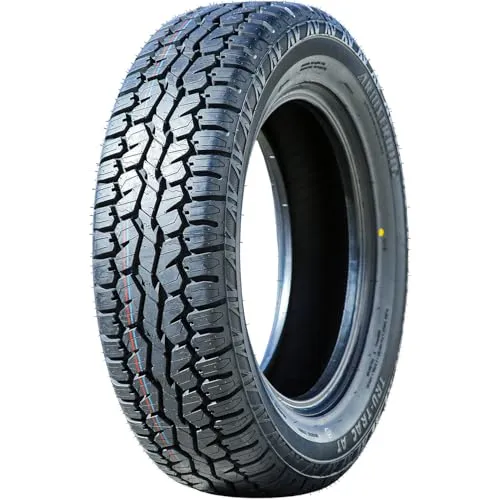
The longest stated treadwear warranty in this guide at the second lowest price, which makes it the sensible default for a truck that mostly drives on pavement.
What we like
- A 60,000 mile treadwear rating, 10,000 miles more than any other pick here states
- Published UTQG rating of 560 A B, so you can compare its wear and grip grades against other tires rather than guessing
- XL extra load construction with a load index of 116, rated to 2,756 lbs per tire
- Around $113 per tire keeps a full set of four in reach, which matters far more than which single tire is best
What we don't
- The listing says all season traction but never states the three-peak snowflake certification, so this is not a winter answer
- XL is still a passenger-rated construction, so it does not replace a load range E tire for towing near your truck's limit
- Armstrong is a value brand with thinner dealer coverage, so a single replacement tire may take longer to source
| Tire type | All terrain tire for trucks and SUVs |
|---|---|
| Listed size | 265/70R17 116T |
| Load range | XL extra load, 4 ply rated |
| Load index | 116 |
| Tread warranty | 60,000 miles |
| Price bracket | $$ |
The listed size is 265/70R17 116T and the page covers one tire. Check that against your sidewall. 265/70R17 is one of the most common truck sizes in the country, which is part of why this pick is easy to recommend, but common is not the same as universal.
The number that earns this the value award is 60,000 miles. That is the stated limited treadwear rating, and it is 10,000 miles more than the Atturo, the Travelstar and every other pick in this guide states. Divide the price by the mileage and this is the cheapest tire here to actually run, not just the cheapest to buy. Armstrong also publishes a UTQG rating of 560 A B, which is the standardized treadwear, traction and temperature grading. Two of the five picks here publish no grading at all, so being able to compare on paper is a genuine advantage.
Construction is XL extra load, 4 ply rated, with a load index of 116 and a speed rating of T. Each tire is rated to 2,756 lbs. That is enough for an unloaded half ton truck or a full size SUV with a family and luggage in it. It is not a towing tire, and Armstrong does not claim it is.
The gap is winter. The listing describes all season traction and nothing more. No three-peak snowflake symbol, no severe snow service claim. If you live somewhere with real winter and you want one set of tires for the whole year, that missing symbol is the reason to pay the extra for the Atturo Trail Blade ATS instead. If your winter is rain and cold pavement, this tire is the honest answer and the money saved buys the set of four.
Research-based pick: this recommendation is based on product data, owner feedback and comparison with products we have tested, not on direct hands-on testing.
Buy it if: A half ton truck or SUV owner who commutes on pavement, wants an all terrain look and tread, and cares more about cost per mile than about brand.
Skip it if: You drive on snow and ice for months, in which case the snowflake-rated Atturo Trail Blade ATS is the better single-set answer.
Best for Highway Miles
GT Radial Adventuro AT3
by GT Radial
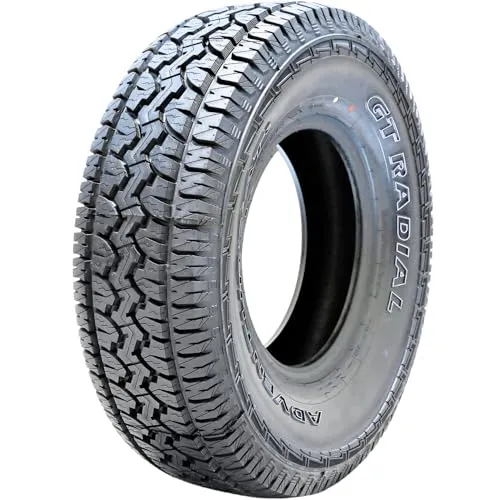
A P metric all terrain tire tuned around noise and tread life rather than off-road grip, and the cheapest single tire in this guide.
What we like
- Five-pitch pattern technology varies the size of the tread blocks around the tire, which is the standard engineering fix for all terrain drone
- The S-shaped central rib and interlocked tread blocks are aimed at highway stability, so the steering stays settled at speed
- Enhanced tread compound is stated to improve tread life plus cut and chip resistance, the two things gravel does to a road tire
- Chamfered 3D grooves are designed to eject stones instead of holding them, which reduces stone drilling into the tread base
What we don't
- This is a P metric tire, so on a truck it derates by about ten percent for load and cannot substitute for an LT tire
- The listing states no load range, no ply rating, no treadwear warranty and no snowflake certification
- P235/75R15 is a 15 inch size, which suits older trucks and small SUVs rather than most current half tons
| Tire type | All terrain P metric tire with outlined white lettering |
|---|---|
| Listed size | P235/75R15 105S |
| Listing covers | One tire |
| Load index | 105 |
| Load range | Not stated in this listing |
| Price bracket | $$ |
Look at the size on this one carefully, because the letter in front matters. It is P235/75R15 105S. That P means P metric, a passenger car construction, and it is the only pick in this guide with that prefix. It is also a 15 inch tire, so it belongs on an older truck or a compact SUV rather than a current half ton on 18 inch or 20 inch wheels. Check your sidewall.
What GT Radial has built here is the closest thing in this candidate pool to a highway tire wearing an all terrain tread. Five-pitch pattern technology means the tread blocks are not all the same size around the circumference of the tire. Uniform blocks hit the road at one frequency and produce the hum that makes people hate all terrain tires. Varying the pitch spreads that energy across frequencies so it reads as background noise instead of a tone. It is the single most effective thing a manufacturer can do about tire drone.
The rest of the design points the same direction. An S-shaped central rib and interlocked blocks give the tire a continuous strip of rubber down the middle, which is what keeps steering feel crisp on the highway. The chamfered 3D grooves are shaped to spit stones back out rather than trap them, and the compound is stated to resist cuts and chips. Those are gravel road problems solved without giving up pavement manners.
The catch is load. A P metric tire fitted to a truck or SUV is derated by roughly ten percent against its stated capacity, which is standard industry practice because trucks load their tires differently than cars do. Index 105 is already modest. Take ten percent off and this is a commuting tire, full stop. Do not put it under a trailer.
Research-based pick: this recommendation is based on product data, owner feedback and comparison with products we have tested, not on direct hands-on testing.
Buy it if: An older truck or compact SUV owner who commutes on pavement, hits a gravel road at the weekend, and wants a quiet tire that lasts.
Skip it if: You carry weight or tow, because a P metric tire on a truck loses roughly ten percent of its stated load capacity the moment it goes on.
How we chose#
This is a research-based guide, not a hands-on tire test. We started with truck tires actually in stock on Amazon in the United States, then read every listing for the specifications that separate one truck tire from another: the listed size, the load range and ply rating, the load index and speed rating, whether the tire states a three-peak snowflake certification, and how many tires the listing covers.
Then we picked for spread rather than for five near-identical all terrain tires. That gave us a snowflake-rated tire for people who want one set all year, a load range E set of four for towing, a mainstream brand at roughly double the budget price, a value tire with the longest stated treadwear warranty in the group, and a P metric tire tuned for quiet highway miles.
One honest note about the candidate pool. It did not contain a dedicated highway-terrain tire with a rib tread pattern, which is genuinely the best choice for a truck that only tows on pavement. Every pick here wears some version of an all terrain tread. We say so plainly in the sections below rather than pretending the all terrain tires are something they are not. If you want a deeper look at that category on its own, we cover it in our guide to all terrain tires.
We also did not match tires to vehicles. Each listing is a single size, and we name that size in every review so you can check it against your sidewall.
What to consider before buying#
Start with the load, not the look. Open the driver’s door and read the placard. It gives you the factory size and the load index the truck needs. Your new tires have to meet or beat that index. If you tow, add the tongue weight to what is already on the rear axle and be honest about the total. Almost every truck tire failure story starts with a tire that was never rated for the weight on it.
Then decide how much of your driving is off pavement. Not how much you want it to be. How much it is. For most truck owners the answer is a gravel driveway and a few dirt roads a year, and that reality should drive the tread choice.
Buy four. A worn pair and a new pair on a four wheel drive truck causes drivetrain wear, not just uneven grip. If four good tires are out of budget, buy four cheaper tires instead of two expensive ones. This is the same rule that applies to winter tires, and it is not close.
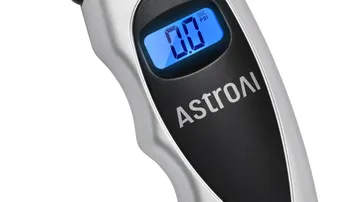
Finally, check the pressures once the tires are on. Load range E tires run much higher pressure than the passenger tires you may be replacing, and the correct number comes from your placard, not from the max pressure printed on the sidewall. A decent tire pressure gauge pays for itself in tread life.
Load range and ply rating, the number that decides whether you can tow#
Load range is a letter, and it is the most misunderstood marking on a truck tire. It tells you how much air pressure the tire is built to hold. More pressure means more air supporting the load, so the letter is really a weight rating in disguise.
The old system counted actual layers of cotton ply in the carcass. Modern tires use far fewer, far stronger layers, so the ply numbers you see today are equivalents rather than counts. Load range C is 6 ply equivalent. D is 8 ply. E is 10 ply, usually good for 80 psi, and it is where most three quarter ton and heavy half ton truck tires live. The Travelstar Ecopath AT in this guide is load range E, rated to 3,750 lbs per tire.
XL is a different scale entirely. It stands for extra load and it is a passenger tire rating, not a light truck rating. The Atturo Trail Blade ATS and the Armstrong Tru-Trac AT are both XL, 4 ply rated, and their load indexes of 116 work out to roughly 2,700 lbs per tire. That is a big drop from the E rated tire, and the tread pattern gives you no clue that it happened.
Here is the failure mode. A tire carrying more than its rating builds heat in the sidewall. Heat separates the belts from the rubber. That separation is what a highway blowout is, and it usually happens on a hot day with a loaded trailer, which is exactly when you can least afford it. Getting the load index right is not caution. It is the whole job.
LT versus P metric on a half ton truck#
The letter in front of the size does real work. P235/75R15 is a passenger tire. LT275/65R20 is a light truck tire. They are built differently under the tread.
An LT tire has a stiffer, thicker sidewall, higher pressure capacity and a heavier carcass. A P metric tire is built lighter for ride comfort and rolling resistance. That is why a P metric tire rides better on an empty truck and why the GT Radial Adventuro AT3 is the quiet, comfortable pick here.
The catch is the derate. Standard industry practice is to reduce a P metric tire’s stated load capacity by about ten percent when it is fitted to a truck or SUV. The reason is that trucks put loads on tires that passenger construction was never designed around, including trailer tongue weight that pushes down on one axle while the body rocks. So a load index of 105 on a P metric tire does not give you index 105 of usable capacity on a truck.
For a half ton pickup that commutes empty, P metric is a legitimate and often better choice. It rides better, it is quieter, and it costs less. The moment you regularly put weight in the bed or a trailer on the hitch, you want LT, and you want the load range that matches. A weight distribution hitch helps spread trailer load between axles, but it does not raise the rating of a tire that is already at its limit.
Highway terrain versus all terrain for a truck that mostly commutes#
Here is the part of this guide most likely to annoy people. Buying an aggressive tire for a truck that tows on the highway is a downgrade in every measurable way except looks.
The list of things you give up is not short. Aggressive tread has less rubber touching the pavement, so wet and dry braking distances get longer. Big open blocks flex, and flex becomes heat and noise, so you get more drone and shorter tread life. Void space between blocks means the tread can squirm under a trailer, which makes the truck feel less settled at highway speed. And the extra weight and rolling resistance cost you fuel on every mile.
A highway-terrain tire fixes all of that with a rib pattern, more continuous rubber on the road and a lighter carcass. If your truck’s job is pulling a trailer down an interstate, that is the correct tire, and no all terrain tire in this guide is a better answer for that specific job.
So why does anyone buy all terrain tires? Because most trucks do meet gravel, mud and snow often enough that the trade is worth it, and because sidewall toughness matters on rough surfaces in a way it never does on pavement. Just make the trade with your eyes open. If you genuinely drive pavement to pavement, the closest thing to a highway tire here is the GT Radial Adventuro AT3, with its five-pitch noise pattern and its continuous S-shaped central rib.
The fuel cost is worth putting a number to. The Travelstar Ecopath AT weighs about 52 lbs per tire. The lightest all terrain tire in this candidate pool weighs about 29 lbs. That is 92 lbs of difference across four corners, and it is rotating, unsprung weight, the most expensive kind to add. You pay for it every time you accelerate and every time you brake, whether or not there is anything in the bed.
Final recommendation#
Most truck and SUV owners should buy the Atturo Trail Blade ATS, as long as the 275/60R20 size in that listing matches their sidewall. It is the only pick here that states the three-peak snowflake certification, which means one set of tires can cover the whole year in most of the country. If you tow or haul, none of that matters and the Travelstar Ecopath AT is the pick, because load range E and a 126/123 load index are things the other tires here simply do not have. Buyers who want a mainstream brand with real replacement availability should take the Falken Wildpeak A/T4W and accept that its listing publishes very little, which is a fair complaint at that price. If the money matters and your winters are wet rather than white, the Armstrong Tru-Trac AT gives you a 60,000 mile treadwear rating and a published UTQG grade for around half the Falken’s price. And if your truck is an older one on 15 inch wheels that never leaves the pavement, the GT Radial Adventuro AT3 is the quiet, cheap, sensible answer, provided you never ask it to carry a load.
Frequently asked questions
How do I find the right truck tire size?
Two places. The sidewall of the tires on your truck now shows something like LT275/65R20 126/123S. The placard inside the driver's door shows the size the truck left the factory with plus the load index it needs. Buy that size unless a tire shop has told you otherwise. Every listing in this guide covers one size, so the Travelstar link is an LT275/65R20 and the GT Radial link is a P235/75R15. If the numbers do not match, search the model name plus your own size.
What does load range E actually mean?
Load range is a letter that tells you how much air pressure a tire is built to hold, and therefore how much weight it can carry. E is a common heavy duty truck rating, equal to the old 10 ply rating, and it typically runs to 80 psi. The Travelstar Ecopath AT here is load range E and is rated to 3,750 lbs per tire. XL, which the Atturo and the Armstrong use, is a passenger extra load rating and carries far less. If you tow, the letter matters more than the tread.
Do I need LT tires or will P metric do?
P metric tires are built on passenger car construction. When you fit one to a truck or SUV, the industry standard is to derate its stated load capacity by about ten percent, because trucks load their tires harder than cars do. LT tires have stiffer sidewalls and higher pressure ratings and take no derate. For an empty commuter truck, P metric like the GT Radial Adventuro AT3 rides better and costs less. For anything with weight in the bed or on the hitch, LT is the answer.
Will all terrain tires hurt my fuel economy?
Yes, and by more than most people expect. There are two causes. Heavier tires take more energy to spin up every time you accelerate, and the Travelstar Ecopath AT weighs about 52 lbs each against roughly 29 lbs for a small all terrain tire. The other cause is rolling resistance, because chunky tread blocks flex more and turn that flex into heat. A quieter, lighter design like the GT Radial Adventuro AT3 gives some of that back.
What is the three-peak mountain snowflake symbol?
It is a certification that a tire passed a standardized snow traction test, and it means the tire is approved for severe snow service. The older M+S marking is not a test result. A maker can stamp M+S based on the shape of the tread grooves alone, which is why nearly every all terrain tire has it. Among these picks only the Atturo Trail Blade ATS states the snowflake, and only on production from 2024 onward. Check the sidewall for the small mountain symbol yourself.
Can I mix tire sizes or brands across the four corners?
Not on a four wheel drive or all wheel drive truck. Different tread depths mean different rolling diameters, and the drivetrain reads that as constant slip, which wears out differentials and transfer cases. Even on two wheel drive, mismatched tires across an axle upset braking and stability control. Replace in fours where you can and in pairs across an axle at minimum. This is also why buying a widely stocked line like the Falken Wildpeak A/T4W is worth something if you damage one tire.
About the author

Dale Harper Lead Gear Editor
Dale is a longtime truck owner and former accessory-shop tech who builds these guides from manufacturer fit data, aggregated owner feedback and direct spec comparison. Research-based picks are always labelled as such.
Daily driver: 2022 Ford F-150 XLT SuperCrew
- Tonneau covers and bed accessories
- Seat covers and interior protection
- Lift kits and suspension