The Best Tires for an F-150: 5 Picks Compared by Size, Load and Snow Rating
Five F-150 tires compared on listed size, load range and snow rating, plus why trims run different stock sizes and why your door placard decides.

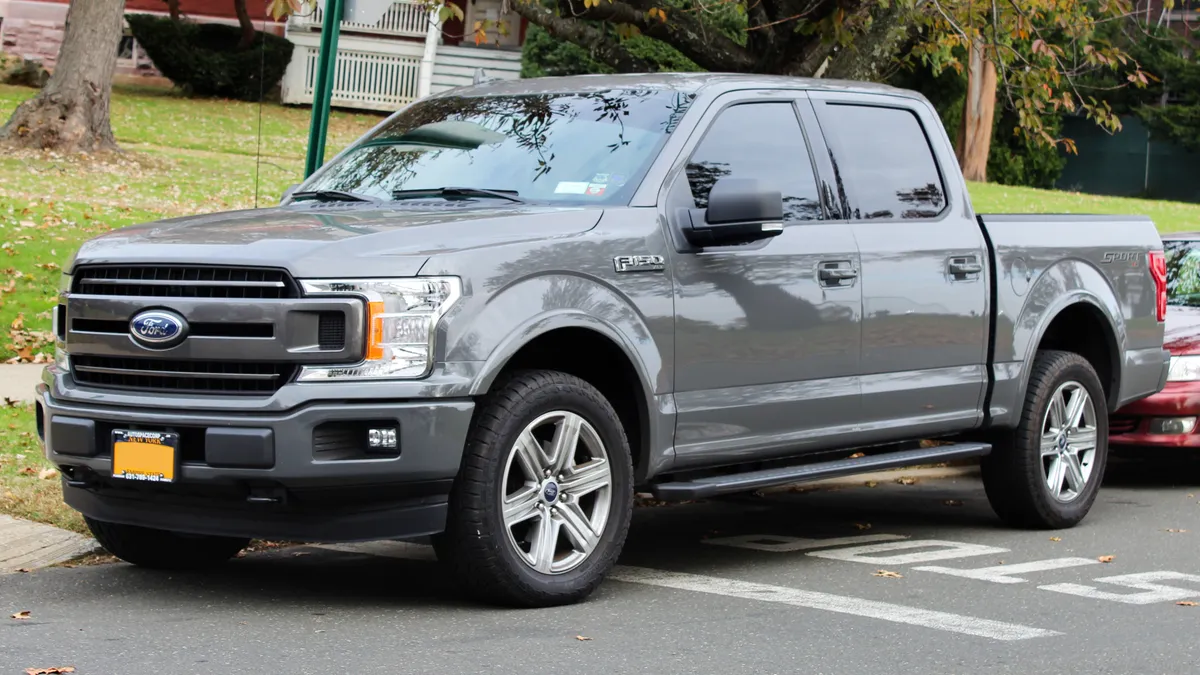
There is no such thing as an F-150 tire size. That sounds like a technicality until you order four tires that do not fit. A base XL on 17 inch steel wheels, an XLT on 18s and a Lariat on 20s all leave the factory on different sizes, and a previous owner may have changed the wheels again. So this guide does something a little different. It compares five all terrain tires sold on Amazon in the United States, each one in a size that shows up on some F-150s, and it names the exact size in every review so you can hold it against your own sidewall. The picks are the mainstream-brand Pirelli Scorpion All Terrain Plus, the load range E BFGoodrich All-Terrain T/A KO3 for towing, the snowflake-certified Crosswind Trail Traxx, the four-tire Finalist Terreno A/T for value, and the aggressive-looking Mastertrack Badlands AT. Read the placard inside your driver's door before you click any of them.
Table of contents
- Quick picks
- Load index of each tire as listed
- Comparison table
- Best Overall: Pirelli Scorpion All Terrain Plus
- Best for Towing and Hauling: BFGoodrich All-Terrain T/A KO3
- Best for Winter Driving: Crosswind Trail Traxx
- Best Value: Finalist Terreno A/T
- Best for Aggressive Looks: Mastertrack Badlands AT
- How we chose
- What to consider before buying
- Common F-150 stock sizes across trims, and why your neighbour’s size may not be yours
- Load range on a half ton, when standard load is enough and when you want E
- Payload and towing, matching tire capacity to the sticker in your door jamb
- How a taller tire changes your speedometer
- Final recommendation
- FAQ
Quick picks
Every pick wins a specific use case. Jump to the full review before you buy.
-
Best Overall
Pirelli Scorpion All Terrain Plus
A mainstream-brand all terrain tire sold here in one 20 inch size, which is the wheel size a lot of newer F-150 trims run, but you still have to match the exact numbers on your own sidewall.
-
Best for Towing and Hauling
BFGoodrich All-Terrain T/A KO3
The only load range E light truck tire in this guide, sold in one LT265/70R17 size, for F-150 owners who actually put weight on the hitch and can confirm that size on their placard.
-
Best for Winter Driving
Crosswind Trail Traxx
A snowflake-certified all terrain tire in a 265/70R18 size at a low price, for F-150 owners who want one set of tires to cover the whole year.
-
Best Value
Finalist Terreno A/T
A full set of four all terrain tires in 265/70R17 for under six hundred dollars, with the load index and load range actually published, for owners on a budget who checked their placard first.
-
Best for Aggressive Looks
Mastertrack Badlands AT
A set of four chunky-looking all terrain tires in 275/55R20 for owners who want the rugged stance on a 20 inch wheel and understand they are buying appearance more than capability.
Compare every pick
| Product | Award | Listed size | Common f150 fitment | Best for | Where to buy |
|---|---|---|---|---|---|
| Pirelli Scorpion All Terrain Plus | Best Overall | 275/60R20 115T | 20 inch wheel size. Read the placard in your door jamb before ordering | An F-150 owner on 20 inch wheels whose door placard calls for 275/60R20 and who wants a name-brand tire that any shop can source again. | Check price for Pirelli Scorpion All Terrain Plus at Amazon (affiliate link) |
| BFGoodrich All-Terrain T/A KO3 | Best for Towing and Hauling | LT265/70R17/E 123/120S | 17 inch wheel size. Read the placard in your door jamb before ordering | An F-150 owner who tows a trailer or carries real weight in the bed and whose door placard calls for an LT265/70R17. | Check price for BFGoodrich All-Terrain T/A KO3 at Amazon (affiliate link) |
| Crosswind Trail Traxx | Best for Winter Driving | 265/70R18 116T | 18 inch wheel size. Read the placard in your door jamb before ordering | An F-150 owner in a state with real winter who wants one snowflake-rated set instead of swapping to a second set of winter tires each year. | Check price for Crosswind Trail Traxx at Amazon (affiliate link) |
| Finalist Terreno A/T | Best Value | 265/70R17 115T | 17 inch wheel size. Read the placard in your door jamb before ordering | An F-150 owner who needs four tires now, drives mostly on pavement and gravel, and whose placard calls for a 265/70R17. | Check price for Finalist Terreno A/T at Amazon (affiliate link) |
| Mastertrack Badlands AT | Best for Aggressive Looks | 275/55R20 113T | 20 inch wheel size. Read the placard in your door jamb before ordering | An F-150 owner on factory 20 inch wheels who wants a tougher-looking truck, drives mostly on pavement and has confirmed 275/55R20 on the door placard. | Check price for Mastertrack Badlands AT at Amazon (affiliate link) |
Swipe sideways to compare every column.
Best Overall
Pirelli Scorpion All Terrain Plus
by Pirelli
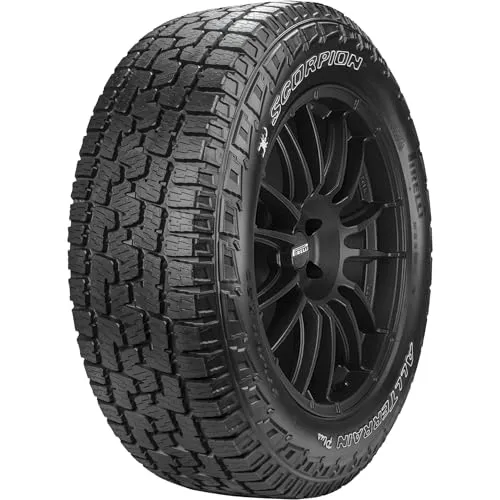
A mainstream-brand all terrain tire sold here in one 20 inch size, which is the wheel size a lot of newer F-150 trims run, but you still have to match the exact numbers on your own sidewall.
What we like
- Comes from a major tire maker, so replacing a single damaged tire years from now is realistic
- The listed 275/60R20 is one of the sizes that shows up on 20 inch F-150 wheels, which makes it worth checking your placard against
- A load index of 115 is a normal half ton figure and covers most unloaded F-150 use
- Sold as a single tire, so you can buy one at a time or replace one that failed
What we don't
- The Amazon listing publishes almost nothing beyond the size, the country of manufacture and a 46.96 lb package weight
- No load range letter and no snow certification are stated, so you cannot confirm either from the listing
- Costs roughly double the cheapest all terrain tire in this guide for a size that other brands also make
| Tire type | All terrain radial for light trucks and SUVs |
|---|---|
| Listed size | 275/60R20 115T |
| Listing covers | One tire |
| Load index | 115 |
| Common f150 fitment | 20 inch wheel size. Read the placard in your door jamb before ordering |
| Price bracket | $$$ |
Start at your door jamb, not at this listing. This page is one Pirelli Scorpion All Terrain Plus in 275/60R20 with a 115T load index and speed rating. That size does appear on some 20 inch F-150 wheels, but F-150 trims run several different stock sizes and a previous owner may have changed the wheels entirely. The placard inside the driver’s door is the authority. If the numbers there are different, search this model name plus your own size instead of clicking this one.
The reason it takes the top spot is the badge on the sidewall. Pirelli is a full-line maker with real distribution, which matters more than people expect. Tires do not get replaced four at a time when a pothole splits one at 14,000 miles. If you need a single matching tire in three years, a mainstream line is far easier to find than a house brand that a marketplace seller imported in one batch.
The listing itself is thin, and that is a fair complaint. Pirelli’s Amazon page gives you the size, that the tire is made in Brazil, the package dimensions and a 46.96 lb package weight. There is no load range letter, no UTQG grade, no treadwear warranty figure and no snow certification. Everything else on this page you would have to get from a dealer. For a tire at this price, that is less information than the cheap sets further down the guide publish.
What the load index does tell you is useful. 115 is a normal half ton number and it covers a stock F-150 doing normal work. It is not a heavy hauling figure, and it says nothing about how the carcass is built, which is the part that matters when a loaded trailer is pushing down on the hitch on a hot day.
Buy this one if your placard says 275/60R20 and you value a brand you can get again. If it says anything else, this is not your tire, no matter how good the tire is.
Research-based pick: this recommendation is based on product data, owner feedback and comparison with products we have tested, not on direct hands-on testing.
Buy it if: An F-150 owner on 20 inch wheels whose door placard calls for 275/60R20 and who wants a name-brand tire that any shop can source again.
Skip it if: You tow near your truck's rated limit, because this listing never states a load range letter and the load range E BFGoodrich does.
Best for Towing and Hauling
BFGoodrich All-Terrain T/A KO3
by BFGoodrich
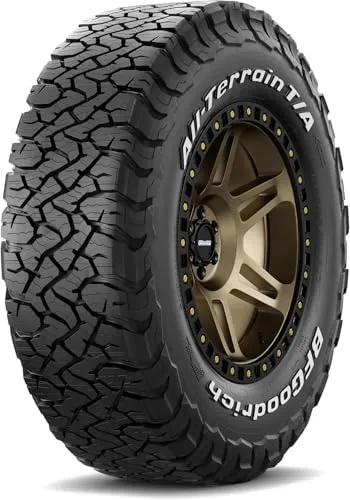
The only load range E light truck tire in this guide, sold in one LT265/70R17 size, for F-150 owners who actually put weight on the hitch and can confirm that size on their placard.
What we like
- Load range E construction with a 123/120 load index, which is far more carrying capacity than any standard load tire here
- CoreGard sidewall technology came out of Baja racing and targets the exact failure mode that ends off-road days, which is a split sidewall
- Backed by a 50,000 mile treadwear limited warranty and a 6 year standard limited warranty
- Serrated shoulder blocks and mud-phobic bars are a real design answer to mud packing into the tread
What we don't
- The most expensive tire per unit in this guide, and this listing covers one tire only
- Load range E carcasses are heavy and stiff, so an empty F-150 rides harder and uses more fuel than it would on a standard load tire
- The listing does not state a three-peak snowflake certification, so do not assume it is severe snow approved
| Tire type | Light truck all terrain radial for trucks, SUVs and crossovers |
|---|---|
| Listed size | LT265/70R17/E 123/120S |
| Load range | E, light truck construction |
| Load index | 123 single, 120 dual |
| Common f150 fitment | 17 inch wheel size. Read the placard in your door jamb before ordering |
| Price bracket | $$$ |
Read the LT in front of the size before anything else. This listing is one BFGoodrich All-Terrain T/A KO3 in LT265/70R17, load range E, load index 123 single and 120 dual. That LT prefix means light truck construction, and the E means the carcass is built to hold high pressure and carry heavy loads. It is not the same thing as the P metric and standard load tires elsewhere in this guide, and it is not what every F-150 leaves the factory with. Check your placard.
This is the towing pick because load range E is the only honest answer to weight. A tire fails when it carries more than it is rated for, because the sidewall flexes, the flexing makes heat, and heat separates the belts from the rubber. That separation is what a highway blowout is. It usually happens on a hot day with a loaded trailer. Load index 123 buys you margin against exactly that, and none of the standard load tires in this guide can offer it.
The sidewall engineering is the other half of the argument. BFGoodrich’s CoreGard technology came out of desert racing, and the Advanced Deflection Design is shaped to push sticks and rocks away from the sidewall instead of letting them catch and cut. Tread depth protects the part of the tire you can see. Sidewall design protects the part that actually strands you.
The trade-offs are real and worth saying plainly. A load range E tire has a thick, stiff carcass. On an empty F-150 that shows up as a firmer ride over expansion joints and more effort to get moving, because a heavy tire is rotating weight and rotating weight costs fuel every time you accelerate. You also pay the most per tire here, and this page sells one tire, not four.
One more caution. The listing talks about mud and snow traction, but it does not state a three-peak mountain snowflake certification. If severe snow approval matters where you live, look for the small mountain symbol on the sidewall yourself, or take the Crosswind Trail Traxx instead.
Research-based pick: this recommendation is based on product data, owner feedback and comparison with products we have tested, not on direct hands-on testing.
Buy it if: An F-150 owner who tows a trailer or carries real weight in the bed and whose door placard calls for an LT265/70R17.
Skip it if: Your truck commutes empty, because you will pay for load range E stiffness in ride quality and fuel every day and get nothing back.
Best for Winter Driving
Crosswind Trail Traxx
by Crosswind
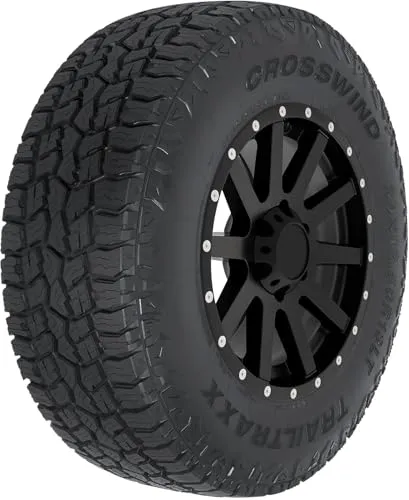
A snowflake-certified all terrain tire in a 265/70R18 size at a low price, for F-150 owners who want one set of tires to cover the whole year.
What we like
- Three-peak mountain snowflake certified, which is a passed snow traction test rather than a marketing claim
- Carries a 55,000 mile limited treadwear warranty, the longest stated figure in this guide
- Extra sipes across the tread give more biting edges for wet and snowy roads
- The cheapest per-tire price here by a wide margin, so a full set stays affordable
What we don't
- The listing states no load range letter, so you cannot confirm carrying capacity beyond the 116 load index
- Sales rank is very low compared with the other picks, which suggests thin availability if you need a matching replacement later
- Snow certification is not the same as a dedicated winter tire, and this tread will still fall short on ice
| Tire type | All terrain radial for light trucks, SUVs and Jeeps |
|---|---|
| Listed size | 265/70R18 116T |
| Severe snow rated | Yes, three-peak mountain snowflake certified |
| Load index | 116 |
| Common f150 fitment | 18 inch wheel size. Read the placard in your door jamb before ordering |
| Price bracket | $$ |
The size on this page is 265/70R18 with a 116T rating, and it is one tire. The listing names the Ford F-150 among the vehicles it is designed for, along with the Silverado, the Durango and several others. Treat that as a hint, not as a fitment answer. F-150 trims run different stock sizes depending on wheel diameter and package, and 18 inch wheels alone do not tell you the tire size. Open the driver’s door and read the placard.
What earns this tire its award is the three-peak mountain snowflake symbol. That certification means the tire passed a standardized snow traction test. It is a measured result. The older M+S marking is not. A maker can stamp M+S on a tire based on the shape of the tread grooves, which is why almost every all terrain tire carries it and why it tells you nothing. Among the picks in this guide, this is the only one whose listing states the snowflake.
The siping backs it up. Sipes are the small slits cut across the tread blocks, and each one is another edge that can bite into packed snow. Crosswind says it added extra sipes for wet and snowy weather, which is the same idea good winter tires use, applied to an all terrain pattern.
Two things hold it back from a higher spot. The listing never states a load range letter, so all you get is the 116 load index. That is fine under an empty half ton and not enough information if you tow. And the sales rank on this listing is far weaker than the other picks, which is a practical problem rather than a quality one. If you cut a sidewall in two years, a slow-moving line is harder to match.
Be clear about what the snowflake buys you. It means approved for severe snow service. It does not mean this tire matches a dedicated winter tire on ice, because a winter compound stays soft in the cold in a way an all terrain compound does not. For most of the country, one snowflake-rated set is the right compromise. In a place with long, hard winters, a second set still wins.
Research-based pick: this recommendation is based on product data, owner feedback and comparison with products we have tested, not on direct hands-on testing.
Buy it if: An F-150 owner in a state with real winter who wants one snowflake-rated set instead of swapping to a second set of winter tires each year.
Skip it if: You need a documented load range for towing, because this listing never states one.
Best Value
Finalist Terreno A/T
by Finalist
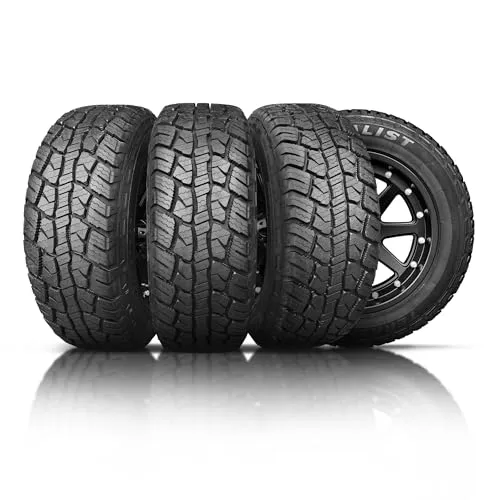
A full set of four all terrain tires in 265/70R17 for under six hundred dollars, with the load index and load range actually published, for owners on a budget who checked their placard first.
What we like
- The listing covers four tires, so you can replace a whole axle set at once, which is the correct way to buy
- Publishes real numbers the pricier picks do not, including load index 115 at 2,679 lbs per tire, 51 psi max pressure and a 38.78 lb tire weight
- Backed by a 50,000 mile limited treadwear warranty and a 3 year road hazard warranty
- Step-down tread blocks with 3D siping are a modern design, not a copy of a twenty year old pattern
What we don't
- SL standard load construction means this is not a towing tire, whatever the tread looks like
- A 51 psi max pressure is passenger-grade, well short of the 80 psi a load range E truck tire holds
- Finalist is a value brand with limited distribution, so matching one tire later may mean buying another set
| Listed size | 265/70R17 115T |
|---|---|
| Listing covers | Set of four tires |
| Load range | SL, standard load |
| Load index | 115, rated to 2,679 lbs per tire |
| Common f150 fitment | 17 inch wheel size. Read the placard in your door jamb before ordering |
| Price bracket | $$$ |
This listing is four tires in 265/70R17, load index 115, speed rating T, load range SL. That is the whole set for less than the price of two of the BFGoodrich tires higher up this page. Before that number does anything for you, check that 265/70R17 is what your door placard calls for. Some F-150s run 17 inch wheels and some do not, and the wheel diameter on your truck is only half the answer.
Value here does not mean the listing hides things. It is the opposite. Finalist publishes the load index in pounds, the maximum pressure, the speed rating, the load range letter, the tread warranty and even the weight of a single tire at 38.78 lbs. The Pirelli listing at more than four times the per-tire price publishes none of that. When you are comparing tires you cannot touch, published numbers are worth a lot.
Buying four at once is the other reason this pick matters. Mixing tread depths across a four wheel drive truck is not just uneven grip. Different tread depths mean different rolling diameters, and the drivetrain reads that as constant slip, which wears out transfer cases and differentials. If a full set of cheaper tires is what the budget allows, that is a better outcome than two expensive tires and two worn ones.
Now the honest limit. SL means standard load, and the 51 psi maximum pressure is a passenger-tire figure. A load range E light truck tire runs to around 80 psi, and that pressure is what carries weight. This tire is a fine choice under an F-150 that hauls groceries, bikes and the occasional load of mulch. It is the wrong choice under a travel trailer, and the aggressive-looking tread will not tell you that.
The last risk is availability. Value brands come and go, and a line that is here this year may not be stocked next year. If you damage one tire at 20,000 miles, the realistic outcome is buying four again rather than one.
Research-based pick: this recommendation is based on product data, owner feedback and comparison with products we have tested, not on direct hands-on testing.
Buy it if: An F-150 owner who needs four tires now, drives mostly on pavement and gravel, and whose placard calls for a 265/70R17.
Skip it if: You put a trailer on the hitch regularly, because standard load construction at 51 psi has no margin for that.
Best for Aggressive Looks
Mastertrack Badlands AT
by Mastertrack
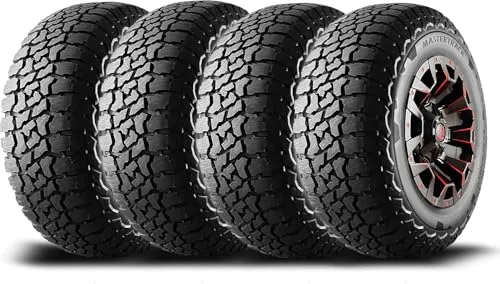
A set of four chunky-looking all terrain tires in 275/55R20 for owners who want the rugged stance on a 20 inch wheel and understand they are buying appearance more than capability.
What we like
- Covers four tires in one listing, in a low-profile 275/55R20 that suits factory 20 inch wheels
- Self-cleaning shoulder design is aimed at ejecting rocks and mud, which is a genuine problem with deep tread
- Deep circumferential grooves move standing water out of the contact patch and cut hydroplaning risk
- Carries a 50,000 mile limited treadwear warranty and a 3 year road hazard warranty
What we don't
- No load range letter and no snow certification are stated, so both the carrying capacity and the winter ability are unknown
- The 113 load index is the lowest in this guide, which is the opposite of what the rugged tread implies
- A low-profile 55 series sidewall gives you less cushion against potholes than the taller sizes here
- Aggressive tread costs fuel and adds road noise, and you pay that every mile whether or not you leave pavement
| Tire type | All terrain radial for SUVs and light trucks |
|---|---|
| Listed size | 275/55R20 113T |
| Listing covers | Set of four tires |
| Tread pattern | Aggressive self-cleaning shoulders with deep circumferential grooves |
| Common f150 fitment | 20 inch wheel size. Read the placard in your door jamb before ordering |
| Price bracket | $$$ |
The listing is four tires in 275/55R20 with a 113T rating. That 55 is the aspect ratio, meaning the sidewall height is 55 percent of the tread width, which makes this a shorter sidewall than most of the tires in this guide. It is a size that suits a factory 20 inch wheel, and plenty of F-150s wear 20 inch wheels. Plenty of others do not, and even among 20 inch trucks the correct size varies. Your placard settles it.
Mastertrack is honest about what this tire is selling. Its own listing says the bold tread pattern gives your truck a serious stance, and that is the first thing most buyers in this category are actually shopping for. There is nothing wrong with wanting that. The mistake is thinking the look comes with capability attached.
Some of the design work is real. Self-cleaning shoulders matter because deep tread blocks pack with mud and stones and then behave like a slick tire, so a pattern that throws debris out as the tire rotates is solving a genuine problem. The deep circumferential grooves are the water channels, and they are the reason a chunky tire can still stop reasonably well in rain.
The numbers are where it gets uncomfortable. The load index of 113 is the lowest of the five picks here. There is no load range letter published and no three-peak snowflake claim. So the tire that looks the most capable in this guide is the one whose listing supports the fewest capability claims. That gap between how a tire looks and what it is rated for is the single most common way people get truck tires wrong.
Add the running costs. An aggressive tread has more open space and fewer square inches of rubber on the road, so braking distances stretch, tread blocks flex and turn that flex into heat and noise, and the extra rolling resistance shows up in your fuel economy. Buy this one because you like how it looks and you know what you are trading away.
Research-based pick: this recommendation is based on product data, owner feedback and comparison with products we have tested, not on direct hands-on testing.
Buy it if: An F-150 owner on factory 20 inch wheels who wants a tougher-looking truck, drives mostly on pavement and has confirmed 275/55R20 on the door placard.
Skip it if: You want capability rather than appearance, because the 113 load index is the weakest here and nothing about snow or load range is published.
How we chose#
This is a research-based guide, not a hands-on tire test. We started with all terrain tires in stock on Amazon in the United States in sizes that turn up on F-150s, then read every listing for the details that separate one truck tire from another. That means the listed size, the load range letter, the load index, whether the listing states a three-peak snowflake certification, the tread design, and how many tires the listing covers. That last one catches people out, because some of these pages sell one tire and some sell four.
Then we picked for spread instead of five versions of the same tire. That gave us a mainstream brand on a 20 inch size, a load range E light truck tire for towing, a snowflake-certified tire for one-set-all-year buyers, a four-tire value set, and an aggressive-looking set for owners who want the stance.
The candidate pool had no highway-terrain tire with a rib tread pattern, which is genuinely the best choice for an F-150 that tows on pavement and never leaves it. Every pick below wears some version of an all terrain tread. Our guide to all terrain tires explains what you give up.
We also did not match tires to trucks. Never buy a tire because it fits someone else’s F-150. Trim, wheel size and package all change the correct size, and the door placard is the authority.
What to consider before buying#
Open the driver’s door first. The placard on the door jamb gives you the factory tire size, the load index the truck needs and the cold inflation pressures front and rear. Everything else in this guide is secondary to that sticker. If your truck has aftermarket wheels, the placard size may no longer apply, and the sidewall of the tires on the truck now is your starting point instead.
Be honest about how the truck gets used. Not how you picture it. If the answer is a gravel driveway, a few dirt roads a year and a lot of commuting, a mild tread will serve you better than a chunky one. If the answer includes a trailer most weekends, load range moves to the top of the list and tread pattern drops to the bottom.
Count the tires in the listing. Two picks here sell one tire and three sell four, and the sticker price means nothing until you know which. Buying four at once is also the right thing to do mechanically on a four wheel drive truck, so a cheap set of four often beats an expensive pair. The same rule runs through our wider guide to truck tires.
Check pressures once the tires are on, and use the number on your placard rather than the maximum printed on the sidewall. Those are different numbers doing different jobs. A tire pressure gauge that reads accurately pays for itself in tread life.
Common F-150 stock sizes across trims, and why your neighbour’s size may not be yours#
The F-150 is not one truck. Ford builds it with several wheel diameters across the trim range, and each diameter comes with its own tire size. A work-spec truck on 17 inch wheels, a mid-trim on 18s and a loaded trim on 20s are all F-150s and none of them takes the same tire. That is before you count option packages and dealer-fitted wheels, which change the answer again.
This is why the picks here span four different sizes. The BFGoodrich listing is a 17 inch LT size. The Finalist set is a 17 inch standard load size. The Crosswind is an 18. The Pirelli and the Mastertrack are both 20 inch tires and still not the same size as each other, because one is a 275/60R20 and the other is a 275/55R20. Same wheel diameter, different sidewall height, different rolling diameter.
Here is how to read the numbers. In 265/70R17, the 265 is the tread width in millimetres. The 70 is the aspect ratio, so the sidewall height is 70 percent of that width. The R means radial construction. The 17 is the wheel diameter in inches. Change any one of those and you change how the tire fits, how tall the truck sits and what the speedometer reads. The failure mode is buying from a recommendation instead of from your own truck. Someone says a size transformed their F-150, you order it, and it rubs the fender at full lock. Read the placard, read the sidewall of what is on the truck now, and match those numbers.
Load range on a half ton, when standard load is enough and when you want E#
Load range is a letter, and it is the most misread marking on a truck tire. It tells you how much air pressure the carcass is built to hold. More pressure means more air holding the load up, so the letter is a weight rating wearing a disguise.
The old system counted actual plies of fabric. Modern tires use fewer, stronger layers, so today’s ply numbers are equivalents rather than counts. Load range C is 6 ply equivalent. D is 8 ply. E is 10 ply, usually good for around 80 psi, and it is where heavy-duty half ton tires live. The BFGoodrich All-Terrain T/A KO3 is load range E with a 123 load index.
SL means standard load, and it is passenger-grade construction on a different scale entirely. The Finalist Terreno A/T is SL with a maximum pressure of 51 psi and a load index of 115, which the listing states as 2,679 lbs per tire. That is a large drop from an E rated tire, and nothing about the tread pattern tells you it happened.
For a stock F-150 that commutes, carries tools and tows a small utility trailer a few times a year, standard load is genuinely enough and it rides better. The moment you are towing near the truck’s rated capacity, you want load range E. A leveling kit or bigger wheels does not change any of this, and neither does an aggressive tread.
Payload and towing, matching tire capacity to the sticker in your door jamb#
Your F-150 has a payload sticker as well as a tire placard. Payload is everything the truck carries, including passengers, cargo, accessories and the tongue weight of any trailer. Tongue weight is usually ten to fifteen percent of the trailer’s total weight, and it lands almost entirely on the rear axle.
Do the arithmetic before you shop. Take the rear axle weight rating, subtract what the truck already weighs at the back, and divide what is left across two rear tires. That is the minimum capacity each one needs. Load index is a code on a lookup table, not a weight in pounds. The Finalist listing does the conversion for you at 2,679 lbs per tire for index 115. The Mastertrack is a 113. The BFGoodrich is a 123 single, which is a lot higher.
The failure mode is why this matters. An overloaded tire flexes more in the sidewall than it was designed to. Flexing generates heat. Sustained heat weakens the bond between the steel belts and the rubber, and eventually the belt separates. That separation is what a highway blowout is, and it tends to happen on a hot day with a loaded trailer.
How a taller tire changes your speedometer#
Fitting a taller tire is the most common F-150 modification after wheels, and almost nobody recalibrates afterwards. Your speedometer does not measure speed directly. It counts how fast the wheels turn and multiplies by a rolling circumference figure programmed in at the factory. Put a taller tire on and every rotation covers more ground than the truck thinks, so the dash reads low and you are going faster than it says. A tire around three percent taller shows about 68 mph when you are doing 70. Your odometer under-counts by the same percentage, which quietly stretches your oil change intervals.
The knock-on effects go further. Cruise control holds a slightly different speed than you set, anti-lock braking and stability control both work from wheel speed data, and transmission shift points are tied to road speed. The fix is a reprogram of the vehicle’s module to the new size, which most shops and many handheld tuners can do in minutes. It cuts both ways too, because a shorter tire like a 275/55R20 in place of a taller factory size shifts the reading the other direction.
Final recommendation#
If your door placard calls for a 275/60R20, the Pirelli Scorpion All Terrain Plus is the pick, mostly because a mainstream brand is one you can still match in three years when a pothole ruins one tire. Its listing publishes very little, which is a fair complaint at that price. If you tow, stop reading tread patterns and take the BFGoodrich All-Terrain T/A KO3, because load range E and a 123 load index are things the other four tires simply do not have. Owners who want one set for the whole year should look at the Crosswind Trail Traxx, the only pick that states a three-peak snowflake certification, as long as 265/70R18 matches your placard. If money is tight, the Finalist Terreno A/T gives you four tires and published numbers for less than two BFGoodrich tires cost, provided you accept that standard load is not a towing answer. And if you mainly want your truck to look tougher on its factory 20s, the Mastertrack Badlands AT does that, with the lowest load index in the group as the price of admission. Check the placard first. The tire that fits someone else’s F-150 is not evidence about yours.
Frequently asked questions
What size tires does a Ford F-150 take?
There is no single answer, and that is the whole point of this guide. The size depends on the trim, the wheel diameter and the option package your truck was built with. Common factory sizes run across 17, 18 and 20 inch wheels, which is why the picks here span a 265/70R17, a 265/70R18 and two different 20 inch sizes. The placard inside your driver's door lists the size your truck left the factory with plus the load index it needs. That placard is the authority, not a forum post and not your neighbour's truck.
Do I need LT tires on an F-150 or will standard load do?
It depends entirely on what you put on the truck. LT means light truck construction, with a stiffer sidewall and a much higher pressure rating. The BFGoodrich All-Terrain T/A KO3 here is an LT265/70R17 in load range E, and it is the only pick that can honestly claim towing capacity. Standard load tires like the Finalist Terreno A/T top out around 51 psi and are built for passenger-style use. For an F-150 that commutes empty and hauls light loads, standard load rides better and costs less. Put a trailer on the hitch and you want LT.
Will bigger tires mess up my speedometer?
Yes, and the error goes in the direction that gets you a ticket. Your speedometer counts wheel rotations and multiplies by a rolling circumference the factory programmed in. Fit a taller tire and each rotation covers more ground, so the truck is going faster than the dash says. A tire about three percent taller shows roughly 68 mph when you are doing 70. Your odometer under-counts by the same margin, which quietly stretches your service intervals. A shop can reprogram the module to match the new size.
Which of these tires is best for towing a trailer?
The BFGoodrich All-Terrain T/A KO3, and it is not close. It is the only pick built on light truck construction in load range E, with a load index of 123 for a single fitment. Everything else here is standard load or does not state a load range at all. Load range is really a pressure rating, and pressure is what holds weight up. A tire carrying more than its rating builds heat in the sidewall, and heat is what separates belts. That is the failure mode behind most loaded-trailer blowouts.
Are all terrain tires a good idea if I mostly drive on pavement?
Honestly, no. An aggressive tread has less rubber touching the road, so wet and dry braking distances get longer. The open blocks flex, and that flex becomes heat, noise and shorter tread life. The extra weight and rolling resistance cost you fuel on every mile. A highway-terrain rib tire is the correct choice for a truck that only sees pavement, and none of the picks here are that. We cover the category more broadly in our guide to [truck tires](/tires/best-truck-tires/). Buy all terrain because you meet gravel and snow, not because it looks right.
Can I replace just two tires on my F-150?
On a four wheel drive F-150, try not to. Different tread depths mean different rolling diameters, and the drivetrain reads that mismatch as constant slip, which wears out the transfer case and differentials over time. Even on a two wheel drive truck, mismatched tires across an axle upset braking and stability control. Replace in fours where you can, and in pairs across a full axle at minimum. That is a good argument for the four-tire Finalist Terreno A/T set if the budget is tight.
About the author

Dale Harper Lead Gear Editor
Dale is a longtime truck owner and former accessory-shop tech who builds these guides from manufacturer fit data, aggregated owner feedback and direct spec comparison. Research-based picks are always labelled as such.
Daily driver: 2022 Ford F-150 XLT SuperCrew
- Tonneau covers and bed accessories
- Seat covers and interior protection
- Lift kits and suspension