The Best Snow Chains: 5 Tire Chain Sets Compared for Cars and Trucks
Five real snow chains and tire chains compared, from a Class S link chain and a cheap cable set to a heavy duty truck chain and a textile snow sock.

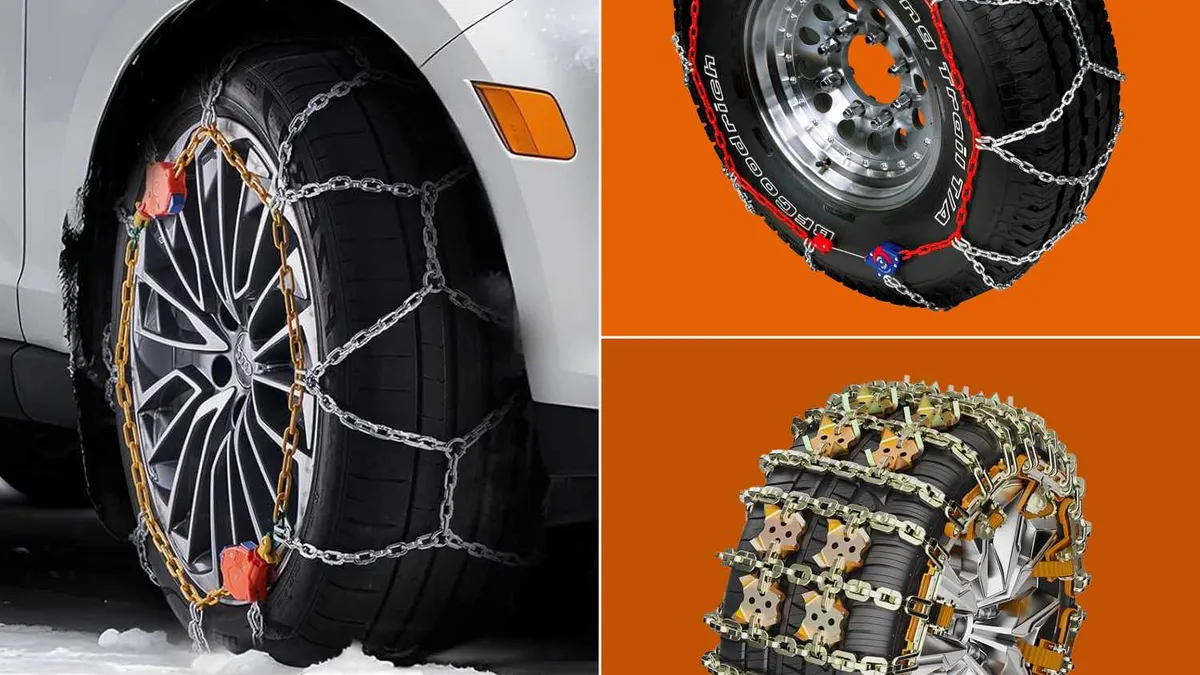
Snow chains are one of the few car accessories where buying the wrong thing is worse than buying nothing, because a chain that does not fit your wheel well can tear up a brake line. Almost every problem starts in the same place, which is sizing. Chains are sold for one tire size or one narrow range, and the answer is printed on your sidewall. This guide compares five sets sold on Amazon that each solve a different version of the problem: the SCC Auto-Trac 0232805, a Class S rated diamond pattern link chain with self-tightening ratchets, the low cost SCC SC1040 cable chain for cars with tight clearance, the SCITOO QG2228CAM that is sold by tire width and fits fast, the thick 4.5 mm DEDC KS1619 for pickups and off-road SUVs, and the AutoSock HP697 textile snow sock for people who cannot fit steel at all. We compared them on chain type, listed sizes, fitting system, self-tensioning and clearance rating.
Table of contents
- Quick picks
- Comparison table
- Best Overall: SCC Auto-Trac 0232805 Light Truck and SUV Tire Traction Chain, Set of 2
- Best Value: SCC SC1040 Radial Chain Cable Traction Tire Chain, Set of 2
- Best for Quick Fitting: SCITOO QG2228CAM Snow Chains for Car, Pickup, Truck and SUV, Set of 2
- Best for Heavy Duty Use: DEDC KS1619 Auto Lock Snow Tire Chains, 4.5 mm Manganese Steel
- Best Chain Alternative: AutoSock HP697 Snow Socks for Passenger Vehicles, Pack of 2
- How we chose
- What to consider before buying
- Class S clearance, and why many cars cannot take a link chain
- How to size chains from your sidewall
- Which wheels get chains, and why AWD is not an exception
- The speed limit, the law, and practicing in the driveway
- Final recommendation
- FAQ
Quick picks
Every pick wins a specific use case. Jump to the full review before you buy.
-
Best Overall
SCC Auto-Trac 0232805 Light Truck and SUV Tire Traction Chain, Set of 2
A diamond pattern steel link chain with self-tightening ratchets that meets Class S clearance, which makes it the safest default for most light trucks and SUVs.
-
Best Value
SCC SC1040 Radial Chain Cable Traction Tire Chain, Set of 2
The cheapest pick here and a cable chain rather than a link chain, built for cars with very little room around the drive tires.
-
Best for Quick Fitting
SCITOO QG2228CAM Snow Chains for Car, Pickup, Truck and SUV, Set of 2
A manganese steel link chain sold by tire width rather than stock number, with a self-tightening ratchet and mechanical tensioners for a fast roadside fit.
-
Best for Heavy Duty Use
DEDC KS1619 Auto Lock Snow Tire Chains, 4.5 mm Manganese Steel
A thick 4.5 mm manganese steel chain listed for the big tire sizes that most passenger chains do not cover, aimed at pickups and off-road SUVs.
-
Best Chain Alternative
AutoSock HP697 Snow Socks for Passenger Vehicles, Pack of 2
A textile snow sock that pulls over the tire in three steps, made for drivers who cannot fit steel chains or will not manage them in a storm.
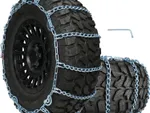
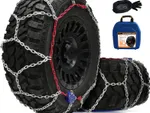
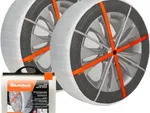
Compare every pick
| Product | Award | Chain type | Listed tire sizes | Self tensioning | Best for | Where to buy |
|---|---|---|---|---|---|---|
| SCC Auto-Trac 0232805 Light Truck and SUV Tire Traction Chain, Set of 2 | Best Overall | Steel link chain with a diamond pattern cross chain | Sold by stock number, listed as Series 2300 part 232805; match the fitment chart to your sidewall | Yes, self-tightening ratchets tighten and center the chain for you | Light truck and SUV owners who want a proper steel chain that tightens itself and still clears the suspension. | Check price for SCC Auto-Trac 0232805 Light Truck and SUV Tire Traction Chain, Set of 2 at Amazon (affiliate link) |
| SCC SC1040 Radial Chain Cable Traction Tire Chain, Set of 2 | Best Value | Cable chain with steel traction coils on the cross cables | Sold by stock number SC1040; match the fitment chart to your sidewall | No, and the listing says chain tighteners should not be used with it | Car and small SUV drivers who need a legal traction device for a couple of mountain trips a year and cannot fit a link chain. | Check price for SCC SC1040 Radial Chain Cable Traction Tire Chain, Set of 2 at Amazon (affiliate link) |
| SCITOO QG2228CAM Snow Chains for Car, Pickup, Truck and SUV, Set of 2 | Best for Quick Fitting | Alloy manganese steel link chain with mechanical tensioners | Listed for tire widths 225, 235, 245, 255, 265, 275, 285 and 295 mm as part QG2228CAM | Yes, self-tightening ratchets with an automatic tightening and centering device | Drivers who want a steel chain they can order confidently from the tire width on their sidewall and fit quickly in bad weather. | Check price for SCITOO QG2228CAM Snow Chains for Car, Pickup, Truck and SUV, Set of 2 at Amazon (affiliate link) |
| DEDC KS1619 Auto Lock Snow Tire Chains, 4.5 mm Manganese Steel | Best for Heavy Duty Use | Heavy duty link chain built from 4.5 mm alloy manganese steel | Listed for large sizes such as 275/70 R16, 285/65 R18, 295/70 R17 and 33x12.5 R20 as part KS1619 | Yes, the listing calls it an auto lock design | Pickup and off-road SUV owners on 33 inch or wide light truck tires who need traction that holds up to repeated use. | Check price for DEDC KS1619 Auto Lock Snow Tire Chains, 4.5 mm Manganese Steel at Amazon (affiliate link) |
| AutoSock HP697 Snow Socks for Passenger Vehicles, Pack of 2 | Best Chain Alternative | Textile snow sock, a fabric cover instead of steel links | Listed for a long size range including 215/65 R17, 225/70 R16, 235/75 R16, 245/70 R16 and 265/50 R19 as part HP697 | Not applicable, the fabric stretches over the tire and stays put on its own | Drivers of low clearance cars, and anyone who wants a traction device they can actually fit in the dark with cold hands. | Check price for AutoSock HP697 Snow Socks for Passenger Vehicles, Pack of 2 at Amazon (affiliate link) |
Swipe sideways to compare every column.
Best Overall
SCC Auto-Trac 0232805 Light Truck and SUV Tire Traction Chain, Set of 2
by SCC
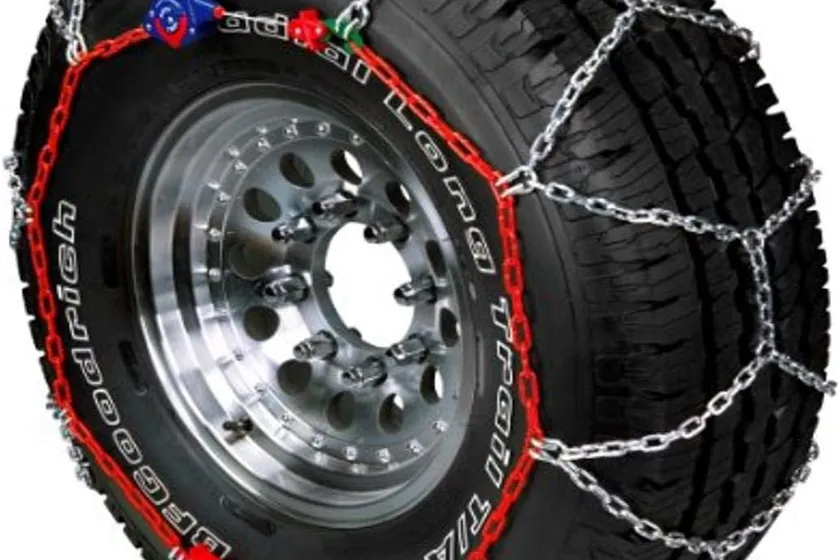
A diamond pattern steel link chain with self-tightening ratchets that meets Class S clearance, which makes it the safest default for most light trucks and SUVs.
What we like
- Self-tightening ratchets pull the chain snug and center it as you drive, so you do not have to stop and retighten
- The diamond pattern cross chain keeps steel on the road in more places at once, which smooths out the ride and helps on ice
- Meets Class S clearance requirements even in light truck sizes, so it fits vehicles that cannot take a bulkier chain
- Sold as a set of two with a stock number system that maps to a published fitment chart
What we don't
- Hard 30 mph speed limit, and going faster is how people break a chain and damage a fender
- Steel links are heavy and noisy compared with the cable and textile picks here
- Sold by SCC stock number rather than by tire size, so the wrong number means a chain that will not close
| Chain type | Steel link chain with a diamond pattern cross chain |
|---|---|
| Listed tire sizes | Sold by stock number, listed as Series 2300 part 232805; match the fitment chart to your sidewall |
| Install style | Lay out, drape over the tire and connect, listed as install and removal in minutes |
| Self tensioning | Yes, self-tightening ratchets tighten and center the chain for you |
| Class srated | Yes, the listing states it meets Class "S" clearance requirements, even in light truck sizes |
| Price bracket | $$ |
The SCC Auto-Trac 0232805 takes Best Overall because it solves the part of chain ownership people actually hate. On a plain chain you drape it, drive a few feet, get out in the snow and tighten it again. The Auto-Trac has ratchets built into the sidewall chain that do that work for you. You fit it, you drive, and the chain pulls itself snug and centers on the tire.
The tread pattern matters too. This is a diamond pattern cross chain, which means the steel crosses the tread face at angles rather than in straight bars. There is always metal touching the road, so the ride is less jumpy and the chain grips when you turn, not only when you go straight. Straight ladder patterns tend to thump.
The clearance claim is the other reason it leads this guide. SCC lists the Auto-Trac as meeting Class S clearance requirements, even in the light truck sizes. Class S is the standard carmakers point to when they say a vehicle can take chains at all. Plenty of modern trucks and SUVs have tight wheel wells, and a chain that meets Class S is far less likely to rub a brake line or a fender liner.
The trade is the same one every steel chain asks for. It is heavy, it is loud, and the listing is clear that you must not exceed 30 mph with it fitted. That limit is not a suggestion. A chain that comes loose at speed can wrap a wheel well and take out a brake hose.
One buying note. SCC sells these by stock number, not by tire size, so 0232805 is one specific fitment inside the Series 2300 family. Read your sidewall, then check the number against the fitment chart before you order.
Research-based pick: this recommendation is based on product data, owner feedback and comparison with products we have tested, not on direct hands-on testing.
Buy it if: Light truck and SUV owners who want a proper steel chain that tightens itself and still clears the suspension.
Skip it if: Your car has almost no gap between the tire and the strut, where a cable chain or a snow sock is the only safe choice.
Best Value
SCC SC1040 Radial Chain Cable Traction Tire Chain, Set of 2
by SCC
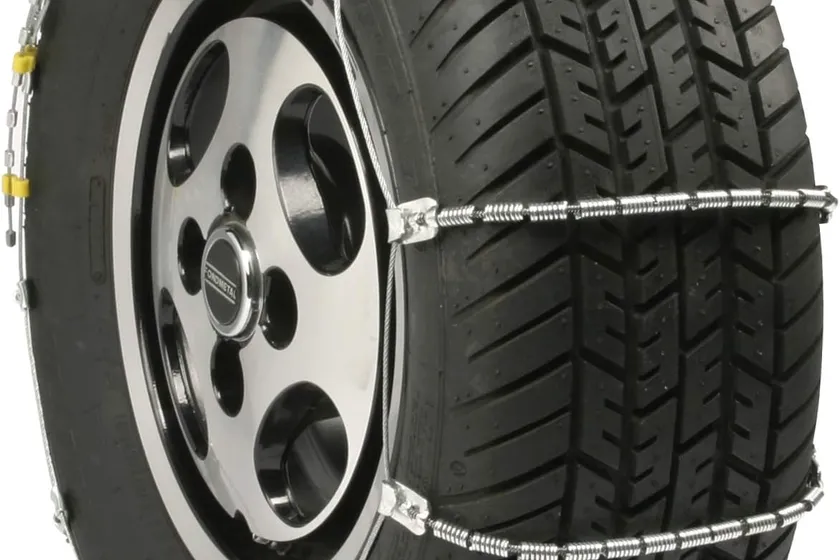
The cheapest pick here and a cable chain rather than a link chain, built for cars with very little room around the drive tires.
What we like
- Lowest price of the five picks, which makes a set worth keeping in the trunk even if you rarely need it
- Cable chains are much thinner than link chains, so they fit wheel wells that a steel link set would rub
- Light enough to lift and fit with cold hands, which matters more than it sounds at the side of a road
- Uses steel traction coils on the cross cables instead of the roller sleeves that flatten out over time
What we don't
- No self-tensioning system, and the listing specifically says chain tighteners should not be used with it
- Cables put less metal on the road than a diamond pattern link chain, so grip in deep snow is weaker
- Sold by SCC stock number only, with no tire sizes printed in the listing
| Chain type | Cable chain with steel traction coils on the cross cables |
|---|---|
| Listed tire sizes | Sold by stock number SC1040; match the fitment chart to your sidewall |
| Vehicle fit | Cars and small SUVs with little room around the drive tires |
| Self tensioning | No, and the listing says chain tighteners should not be used with it |
| Material finish | Silver all steel construction |
| Price bracket | $$ |
The SC1040 is the pick for people who want the cheapest set that still counts as tire chains. It is a cable chain, which is a different animal from the link chains in this guide. Instead of thick steel links, it uses steel aircraft-style cable across the tread with hardened coils wound around it. That build is thin, and thin is what lets it fit cars with almost no gap between the tire and the strut.
SCC points out that this design uses traction coils rather than the traditional steel rollers found on older cable chains. Rollers flatten with use and stop biting. Coils keep their shape longer, which is a small detail that decides whether a set survives a second winter.
There are real limits. A cable chain has less steel touching the road than a diamond pattern link chain, so it helps you start, stop and corner on packed snow and ice but it is not the tool for a foot of fresh powder. And there is no ratchet system. SCC says plainly that chain tighteners should not be used with the SC1040, so you fit it carefully, drive a short distance and check it by hand.
The fitment warning applies here as well. The product is sold as SC1040 with no tire sizes in the listing, so the stock number has to be matched against SCC’s chart using the numbers on your sidewall.
For a driver who crosses a chain control checkpoint twice a winter, this is enough chain, and the price means the set lives in the trunk instead of the garage shelf.
Research-based pick: this recommendation is based on product data, owner feedback and comparison with products we have tested, not on direct hands-on testing.
Buy it if: Car and small SUV drivers who need a legal traction device for a couple of mountain trips a year and cannot fit a link chain.
Skip it if: You drive a heavy truck or you spend real time in deep unplowed snow, where a thick link chain does more work.
Best for Quick Fitting
SCITOO QG2228CAM Snow Chains for Car, Pickup, Truck and SUV, Set of 2
by SCITOO
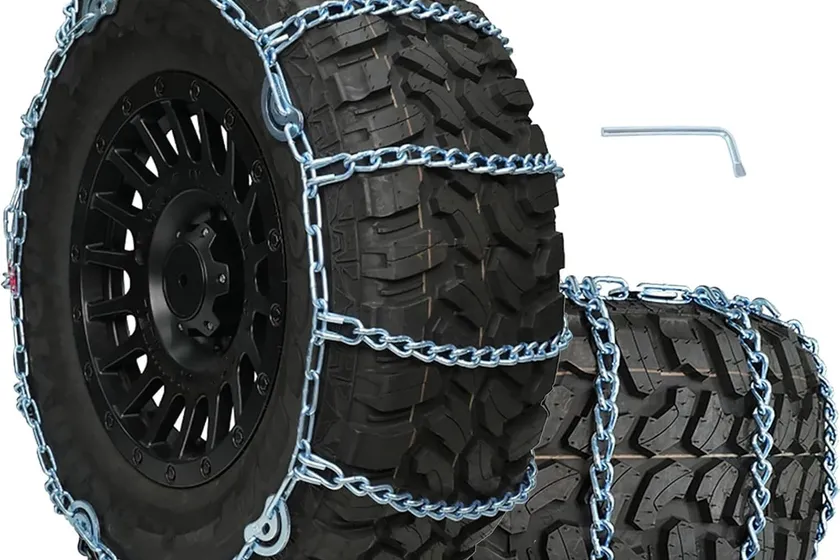
A manganese steel link chain sold by tire width rather than stock number, with a self-tightening ratchet and mechanical tensioners for a fast roadside fit.
What we like
- Listed by tire width from 225 mm to 295 mm, which is far easier to match than a stock number
- Fits without moving the vehicle, so you are not shuffling forward on a shoulder in traffic
- Self-tightening ratchets plus separate mechanical tensioners keep the chain pulled in against the tire
- Thick alloy manganese steel links, which is the same material family used on the heavy duty truck pick here
What we don't
- The listing gives a speed limit of 40 km/h, which is only about 25 mph, lower than the 30 mph on the SCC Auto-Trac
- No Class S clearance claim in the listing, so it is a risk on cars with tight wheel wells
- A width range this wide means the fit at the ends of the range will be looser than a size-specific chain
| Chain type | Alloy manganese steel link chain with mechanical tensioners |
|---|---|
| Listed tire sizes | Listed for tire widths 225, 235, 245, 255, 265, 275, 285 and 295 mm as part QG2228CAM |
| Install style | Fit without moving the vehicle, listed as about a one minute install per wheel |
| Self tensioning | Yes, self-tightening ratchets with an automatic tightening and centering device |
| Class srated | Not stated in the listing |
| Price bracket | $$ |
Most chain returns come down to one thing. The buyer could not work out which of forty stock numbers matched their tire. The SCITOO QG2228CAM sidesteps that by listing itself against tire width instead, covering 225, 235, 245, 255, 265, 275, 285 and 295 mm. The first three digits on your sidewall are the tire width in millimeters, so the match is direct.
The fitting system is the other selling point. There is a self-tightening ratchet that pulls the chain in and centers it, and separate mechanical tensioners that add extra pull once it is on. SCITOO says the chain goes on without moving the vehicle, which is the difference between a job you can do on a narrow shoulder and one you cannot.
The material is thick alloy manganese steel. That is a harder, tougher steel than plain carbon, and it is what you want on a chain that will be dragged across bare asphalt patches between snow.
Two things hold it back from the top spot. The listing gives a speed limit of 40 km/h, which is roughly 25 mph, so it is slower than the SCC Auto-Trac. And there is no Class S clearance claim anywhere in the listing. If your owner manual says Class S chains only, that silence matters, because a link chain that is thicker than the manual allows can contact a strut or a brake line at full steering lock.
Wide-range chains also fit best in the middle of their range. On a 225 tire the slack has to go somewhere. Fit it in the driveway once before you rely on it, and see where it sits.
Research-based pick: this recommendation is based on product data, owner feedback and comparison with products we have tested, not on direct hands-on testing.
Buy it if: Drivers who want a steel chain they can order confidently from the tire width on their sidewall and fit quickly in bad weather.
Skip it if: Your owner manual limits you to Class S chains, since SCITOO does not make that claim for this set.
Best for Heavy Duty Use
DEDC KS1619 Auto Lock Snow Tire Chains, 4.5 mm Manganese Steel
by DEDC
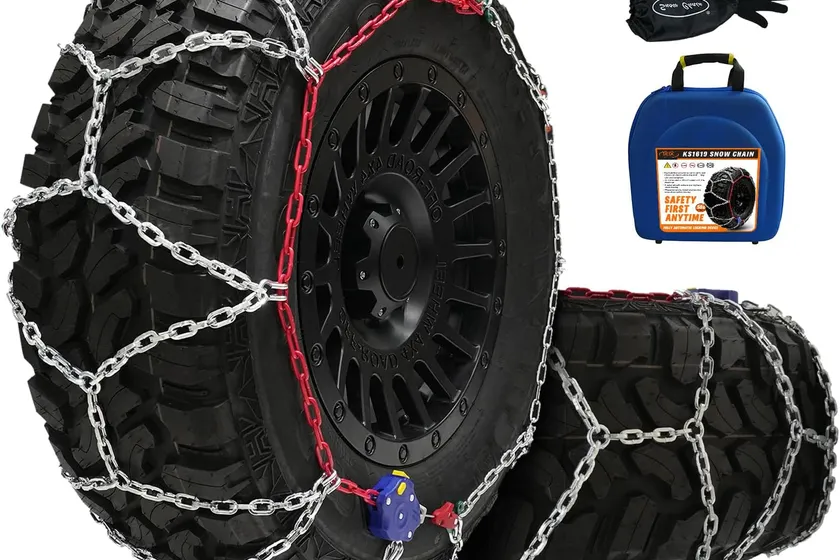
A thick 4.5 mm manganese steel chain listed for the big tire sizes that most passenger chains do not cover, aimed at pickups and off-road SUVs.
What we like
- 4.5 mm link diameter is noticeably thicker than typical passenger car chain, so it survives contact with bare road better
- Fitment list runs to genuinely large sizes including 285/65 R18, 295/70 R17 and 33x12.5 R20
- Auto lock design tightens the chain without a separate tensioning step
- Built to lay out without tangling, which saves several cold minutes before you even start fitting
What we don't
- The most expensive pick here, and overkill for a car that sees snow a few times a year
- No Class S clearance claim, and thick links are exactly what a tight wheel well cannot accept
- Heavy to lift and awkward to store compared with the AutoSock HP697 or the SC1040 cable chain
| Chain type | Heavy duty link chain built from 4.5 mm alloy manganese steel |
|---|---|
| Listed tire sizes | Listed for large sizes such as 275/70 R16, 285/65 R18, 295/70 R17 and 33x12.5 R20 as part KS1619 |
| Vehicle fit | Pickup trucks and off-road SUVs |
| Self tensioning | Yes, the listing calls it an auto lock design |
| Material finish | Thick alloy manganese steel, 4.5 mm link diameter |
| Price bracket | $$ |
Truck owners run into a wall when they shop for chains. Most sets stop at passenger car sizes, and a 33x12.5 R20 or a 285/65 R18 is simply not on the list. The DEDC KS1619 is here because its published fitment covers those sizes, along with 275/70 R16, 285/75 R16, 295/70 R17 and a long run of other light truck and off-road fitments.
The build backs that up. The links are 4.5 mm in diameter, which is thicker than what you find on a chain sold for a sedan. Chain thickness is the single best predictor of how long a set lasts, because chains do not usually wear out in snow. They wear out on the bare pavement between snow, where every rotation drags steel across asphalt. Thicker links have more metal to give away.
DEDC also uses an auto lock system, so the chain pulls itself tight rather than needing a separate rubber tensioner over the top. Combined with a layout designed not to tangle, the fitting process is quicker than the price and weight suggest.
The drawbacks are the honest ones for a heavy chain. It costs the most in this guide. It is heavy to handle. And there is no Class S clearance claim, which on a lifted truck is usually fine and on a tight modern SUV is not. Check the gap between your tire and the nearest suspension part at full lock before buying.
For a work truck, a plow truck or a rig that lives at elevation, this is the right kind of chain. For a commuter that sees three snow days, it is more chain than the job needs.
Research-based pick: this recommendation is based on product data, owner feedback and comparison with products we have tested, not on direct hands-on testing.
Buy it if: Pickup and off-road SUV owners on 33 inch or wide light truck tires who need traction that holds up to repeated use.
Skip it if: You drive a normal car or crossover, where thinner chains fit better and cost far less.
Best Chain Alternative
AutoSock HP697 Snow Socks for Passenger Vehicles, Pack of 2
by AUTOSOCK
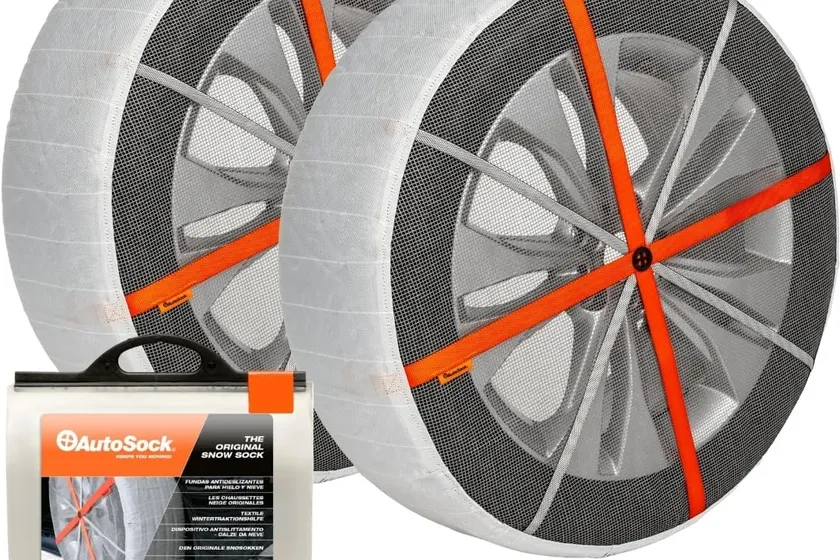
A textile snow sock that pulls over the tire in three steps, made for drivers who cannot fit steel chains or will not manage them in a storm.
What we like
- Goes on in three steps with no ratchets, hooks or tensioners to work out in the cold
- Fabric adds almost no thickness, so it suits cars where a steel chain would rub the suspension
- Folds flat and reuses, so a set lives in the trunk without taking a corner of it
- The listing covers a very long size range, from 195/55 R20 through common SUV sizes like 235/70 R16
What we don't
- Textile wears fast on bare asphalt, so a long dry stretch between snow patches costs you real life
- Less bite than steel in deep snow, ice ruts or on a steep unplowed grade
- Costs more than the SC1040 cable chain while giving up the steel that does the gripping
| Chain type | Textile snow sock, a fabric cover instead of steel links |
|---|---|
| Listed tire sizes | Listed for a long size range including 215/65 R17, 225/70 R16, 235/75 R16, 245/70 R16 and 265/50 R19 as part HP697 |
| Install style | Three step fit, pull the sock over the top of the tire then roll the car forward to finish |
| Self tensioning | Not applicable, the fabric stretches over the tire and stays put on its own |
| Material finish | Woven textile, white, folds flat for storage |
| Price bracket | $$ |
The AutoSock HP697 is not a chain at all. It is a woven fabric cover that stretches over the tire, and the grip comes from the textile itself pulling water off the ice surface so the fabric can hold. It sounds unlikely and it works, which is why snow socks are accepted in many places where chains are required.
The reason to buy one is simple. Steel chains beat snow socks on grip, but only if you get them on. Fitting a link chain for the first time, in the dark, in a storm, on the shoulder of a mountain road, defeats a lot of people. AutoSock is a three step job. Pull it over the top of the tire, roll the car forward a few feet, pull the rest over. There is nothing to tension and nothing to hook.
The second reason is clearance. The fabric adds almost nothing to the tire’s outer dimension, so it works on cars with tight wheel wells that cannot take a link chain. AutoSock lists this HP697 size across a long range of fitments, from 195/55 R20 up through common crossover sizes.
The cost is durability. Fabric against bare asphalt wears quickly, so a snow sock is a device for getting through a snow-covered section, not for driving on all winter. Use it where the road is white, take it off where the road is black, and it will last a surprising number of trips. Ignore that and a set can be worn through in one drive.
Grip in deep snow is the other gap. On a steep unplowed climb, a diamond pattern steel chain like the SCC Auto-Trac does more.
Research-based pick: this recommendation is based on product data, owner feedback and comparison with products we have tested, not on direct hands-on testing.
Buy it if: Drivers of low clearance cars, and anyone who wants a traction device they can actually fit in the dark with cold hands.
Skip it if: You need traction for long snow-covered drives or steep grades, where the steel picks here do more work and last longer.
How we chose#
This is a research-based guide, not a hands-on winter test. We started with the chains that sell in real volume on Amazon, then read each listing for the facts that decide whether a set is safe on a given vehicle: chain type, the published fitment list, the fitting system, whether the chain tensions itself, link thickness and any clearance rating.
We picked deliberately across chain types rather than lining up five near-identical link chains. That gives a Class S rated link chain, a thin cable chain for tight wheel wells, a link chain sold by tire width for easy ordering, a thick chain that covers big truck sizes, and a textile snow sock for cars and drivers that cannot manage steel. Sets with no published fitment data did not make the list.
We did not use star ratings or review counts anywhere in this guide, because the product data we pull does not include them reliably. Where a claim appears here, it comes from the maker’s listing.
What to consider before buying#
Start with clearance, because it can rule out four of these five picks on its own. Turn your steering to full lock and look at the gap between the tire and the strut, the brake line and the fender liner. If that gap is small, you need a Class S chain, a cable chain or a snow sock, and no amount of extra grip makes a thicker chain acceptable.
Then decide how often you will actually fit them. A person who crosses one chain control checkpoint a year should buy something cheap and easy, like the SC1040 or the AutoSock. A person who drives a plow route or lives at elevation should buy thick steel and expect to fit it in the dark.
Think about what you are driving on, too. Chains help most on packed snow, ice and unplowed roads. On slush and cold wet pavement, a set of proper winter tires does more for you than chains ever will, and chains are the thing you add on top for the worst days.
Last, buy the set before the storm. Chains sell out at gas stations near ski areas, and the roadside price is roughly double. While you are at it, check your cold tire pressures with a decent tire pressure gauge, because a soft tire changes how a chain sits on the tread.
Class S clearance, and why many cars cannot take a link chain#
Class S is a clearance standard. It describes how much space a traction device is allowed to take up beyond the tire, and carmakers use it as the line between a chain that fits their suspension and one that does not. When the SCC Auto-Trac 0232805 says it meets Class S requirements even in light truck sizes, that is the claim worth paying for.
The reason it matters is what sits behind your tire. On a lot of modern cars the strut, the brake hose and the plastic wheel liner are a couple of centimeters from the tread shoulder at full steering lock. A chain that is thicker than the manual allows will contact those parts every time you turn hard. That is how people end up with a cut brake line or a shredded liner in a parking lot, not on a mountain pass.
Check the manual first. If it says chains are not permitted at all, take that seriously, and buy a snow sock or better tires instead.
How to size chains from your sidewall#
Every chain decision starts with three numbers molded into the rubber. A tire marked 235/70 R16 is 235 mm wide, has a sidewall height that is 70 percent of that width, and fits a 16 inch wheel. Chains are sized to the whole package, not just the width, because the rolling circumference decides how much chain is needed to go around.
Some makers sell by width, which is easier. The SCITOO QG2228CAM lists widths from 225 to 295 mm, so a 245/65 R17 owner reads the 245 and orders. Others sell by stock number. The SCC Auto-Trac 0232805 and the SC1040 both work that way, so you look your exact size up in SCC’s chart and buy the number it gives you.
Two traps catch people. First, plenty of drivers no longer run the factory tire size, so read the actual sidewall rather than a spec sheet. Second, fitment can be affected by tire age, brand and tread depth, which SCC says outright in its own listing. A brand new aggressive all-terrain tire is physically bigger than a worn highway tire of the same size.
Which wheels get chains, and why AWD is not an exception#
Chains go on the driven wheels. Front wheel drive means the front, rear wheel drive means the rear. If you fit them to the wrong axle you get a car that turns or brakes better but cannot pull itself forward, which is the worst of both.
All wheel drive and four wheel drive vehicles do not get a pass. AWD is a traction system for accelerating. It sends torque to the wheels that still have grip, and that is genuinely useful for getting moving. It does nothing at all for stopping distance or for steering grip, because all four brakes work the same way they do on any car. An AWD SUV on all-season tires stops no faster on ice than a front wheel drive sedan on the same tires.
Most AWD manuals name a specific axle for chains, and some require four. Follow the manual, since fitting chains to one axle on a full-time AWD system can put uneven drag through the center differential.
The speed limit, the law, and practicing in the driveway#
The speed limit with chains fitted is low and it is not negotiable. SCC prints 30 mph on the Auto-Trac listing. SCITOO prints 40 km/h, which is about 25 mph. Above that, the chain moves in ways it was not built for and the failure is loud and expensive. A broken link at speed can take out a brake hose, a fuel line or a wheel arch.
The legal side is messier, and this is the part most guides skip. Chain rules in the United States are set state by state and often road by road. Some mountain routes require chains during declared conditions and will turn you around without them. Other states restrict or ban studded and metal traction devices outright, or allow them only between set dates. A chain that is required in one state can be illegal a few hours down the same interstate, so check the rules for the states you are driving through, not just the one you live in.
The other uncomfortable truth is about fitting. Reading the instructions in a warm kitchen is easy. Doing it for the first time on a shoulder in a blizzard, in the dark, with numb fingers and a truck passing three feet away, is genuinely hard. Fit your chains once in the driveway before winter. Time it. Learn which side goes out and how the ratchet closes. It takes twenty minutes on a dry Saturday and it is the single most useful thing you can do with a new set. Keep them with the rest of your winter emergency gear so they are not buried under groceries when you need them.
Final recommendation#
Most light truck and SUV drivers should buy the SCC Auto-Trac 0232805. It is a proper diamond pattern steel chain, it tightens itself as you drive, and the Class S claim means it fits vehicles that a thicker chain would damage. If your car is low or your manual is strict about clearance, the SCC SC1040 cable chain is the cheapest safe answer and small enough to forget about in the trunk. Buy the SCITOO QG2228CAM if you would rather order by the width on your sidewall than decode a stock number chart, and you accept the lower 25 mph limit. Pickup and off-road SUV owners running 33 inch or wide light truck tires should go straight to the 4.5 mm DEDC KS1619, because thin chains in those sizes barely exist and thicker links last longer. And if you know you will never wrestle steel onto a wheel in a storm, the AutoSock HP697 is the honest choice, as long as you take it off the moment the pavement turns black.
Frequently asked questions
What size snow chains do I need?
Read the sidewall of your tire. You will see something like 235/70 R16, which is the width in millimeters, the aspect ratio and the wheel diameter in inches. All three numbers matter. Some chains are sold against those numbers directly, like the SCITOO QG2228CAM which lists tire widths from 225 to 295 mm. Others, including the SCC Auto-Trac 0232805 and the SC1040, are sold by stock number, so you look your size up in the maker's fitment chart and order that number. Never guess. A chain one size out either will not close or will sit loose enough to come off.
Are snow chains and tire chains the same thing?
Yes. Best tire chains and best snow chains describe the same product, and makers use both names on the same listing. What actually differs is the construction. A link chain uses thick steel links across the tread, a cable chain uses steel cable wrapped with traction coils and is much thinner, and a snow sock like the AutoSock HP697 uses fabric instead of metal. The word chain covers all three in normal use, but the fitment charts, the clearance requirements and the grip are different, so compare by type rather than by name.
Which wheels do the chains go on?
The driven wheels, always. Front wheel drive cars get chains on the front, rear wheel drive cars and most pickups get them on the rear. Four wheel drive and all wheel drive vehicles are not exempt, and the owner manual usually names one axle. AWD moves power to whichever wheel has grip, but it does nothing extra for braking or steering, so an AWD crossover with no chains still slides at a stop sign. If a road has a chain requirement, it applies to your vehicle unless the sign says otherwise.
How fast can I drive with snow chains on?
Slowly. The SCC Auto-Trac 0232805 listing sets a hard limit of 30 mph, and the SCITOO QG2228CAM lists 40 km/h, which is about 25 mph. Treat 25 to 30 mph as the rule for any chain. Above that the chain flexes more than it was designed to, and a link that lets go at speed can wrap the wheel well and cut a brake hose or a fender liner. Speed also destroys the chain itself. Slow down before a bump, and take chains off as soon as the road is clear pavement.
Will chains fit my car, or do I need Class S?
Check the owner manual first. Many modern cars have very little space between the tire and the strut or fender liner, and the manual will either forbid chains or restrict you to Class S, which is the low clearance standard. The SCC Auto-Trac 0232805 states it meets Class S clearance requirements even in light truck sizes. The SCITOO and DEDC sets make no Class S claim in their listings. If your manual asks for Class S, a thin cable chain such as the SC1040 or a textile snow sock like the AutoSock HP697 is the safer path.
How long do snow chains last?
It depends almost entirely on how much bare road you drive on. Chains wear on asphalt, not on snow, so a driver who fits chains at the start of a snow section and pulls them off at the end can get many seasons out of a set. Thicker links last longer, which is why the 4.5 mm DEDC KS1619 outlives a light passenger chain. Textile socks are the opposite. The AutoSock HP697 wears quickly on dry pavement and can be damaged in a single long dry drive.
About the author

Dale Harper Lead Gear Editor
Dale is a longtime truck owner and former accessory-shop tech who builds these guides from manufacturer fit data, aggregated owner feedback and direct spec comparison. Research-based picks are always labelled as such.
Daily driver: 2022 Ford F-150 XLT SuperCrew
- Tonneau covers and bed accessories
- Seat covers and interior protection
- Lift kits and suspension