The Best Mud Tires: 5 M/T Tires Compared for Trucks and SUVs
Five mud terrain tires compared for trucks and SUVs, what void ratio really buys you, and the honest cost of running an M/T on wet pavement.

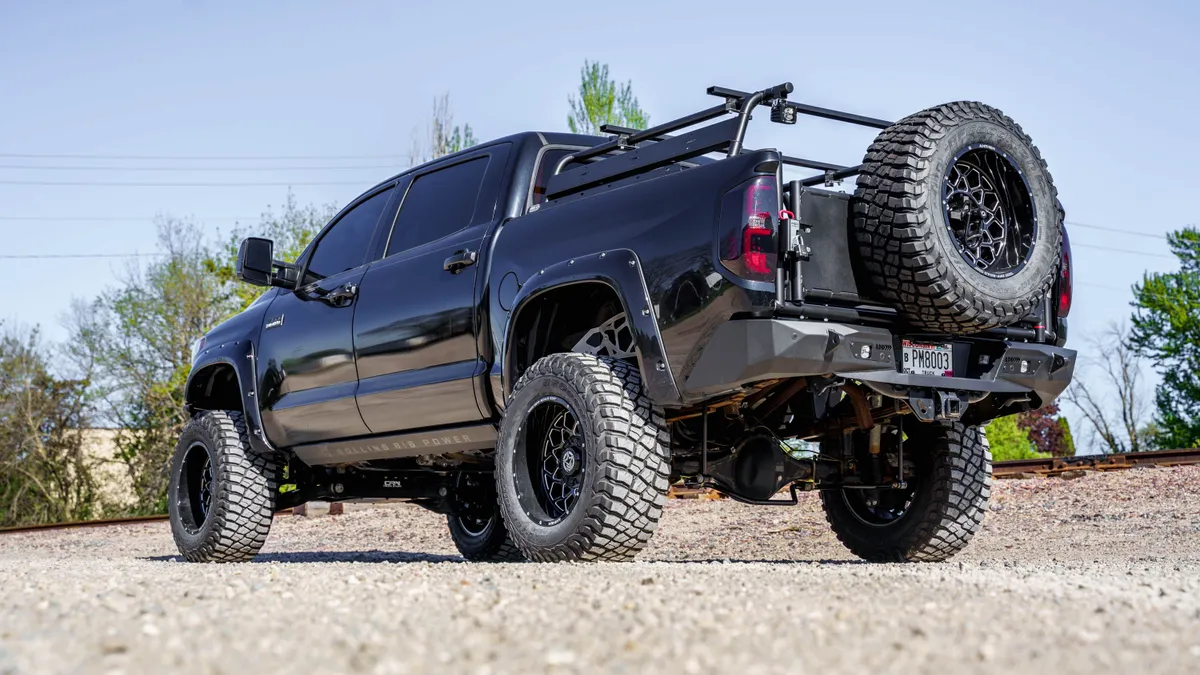
A mud terrain tire is a specialist tool, and this guide treats it like one. The huge blocks and wide gaps that make an M/T work in soft ground are the same things that make it loud, thirsty and slower to stop in the rain. That is the trade, and there is no version of a mud tire that avoids it. We compare five mud terrains sold on Amazon in the United States: the Finalist Terreno M/T with a reinforced three-ply sidewall and a written warranty, the Aplus Shredder M/T with the most open tread and stone ejectors, the Kanati Mud Hog M/T for newer trucks stuck on 20 inch wheels, the 35 inch Zeetex MT1000 for lifted rigs, and the low cost Accelera M/T-01 that makes four matching tires affordable. One warning before you read on. Every listing is one exact size. Read the numbers on your own sidewall, because a tire is bought by size, never by vehicle name.
Table of contents
- Quick picks
- Load index of each mud tire as listed
- Comparison table
- Best Overall: Finalist Terreno M/T
- Best for Deep Mud: Aplus Shredder M/T
- Best for Late Model Trucks: Kanati Mud Hog M/T
- Best for Lifted Trucks: Zeetex MT1000
- Best Value: Accelera M/T-01
- How we chose
- What to consider before buying
- Void ratio, and why a mud tire clears instead of packs
- Three ply sidewalls, and what actually ends an off-road day
- The real costs on pavement
- Final recommendation
- FAQ
Quick picks
Every pick wins a specific use case. Jump to the full review before you buy.
-
Best Overall
Finalist Terreno M/T
A load range E mud terrain with a reinforced three-ply sidewall and a written warranty, sold as a set of four in one LT size you have to match against your own sidewall.
-
Best for Deep Mud
Aplus Shredder M/T
The most openly mud-focused tread here, with a high void ratio and stone ejectors, sold as a single tire in a 31 inch size for 15 inch wheels.
-
Best for Late Model Trucks
Kanati Mud Hog M/T
A load range E mud terrain in a low profile 20 inch size, sold as a set of four, for the newer truck that came from the factory on big wheels.
-
Best for Lifted Trucks
Zeetex MT1000
A 35 inch load range E mud terrain sold one tire at a time, for a lifted truck that already has the clearance and the gearing to run it.
-
Best Value
Accelera M/T-01
The cheapest way into a real mud terrain here, a load range C tire in a common 15 inch size, sold one at a time and offered across four sizes.
Compare every pick
| Product | Award | Tire type | Listed size | Load range | Best for | Where to buy |
|---|---|---|---|---|---|---|
| Finalist Terreno M/T | Best Overall | Mud terrain (M/T) tire for light trucks | LT285/70R17 121/118Q | E, 10 ply rated | Someone with a three quarter ton or heavily loaded half ton truck who drives real trails and wants a written warranty behind a budget-brand mud tire. | Check price for Finalist Terreno M/T at Amazon (affiliate link) |
| Aplus Shredder M/T | Best for Deep Mud | Mud terrain (M/T) tire for light trucks | LT31/10.50R15 109Q | C in the listing title, while the feature text claims heavy duty 10 ply construction | Someone running a lifted rig on 15 inch wheels whose ground is genuinely soft, and who values getting through over getting there quietly. | Check price for Aplus Shredder M/T at Amazon (affiliate link) |
| Kanati Mud Hog M/T | Best for Late Model Trucks | Mud terrain (M/T) tire for light trucks | LT275/60R20 123/120Q | E, 10 ply rated | An owner of a newer half ton or three quarter ton truck on factory 20 inch wheels who wants a mud terrain look and capability without buying smaller wheels. | Check price for Kanati Mud Hog M/T at Amazon (affiliate link) |
| Zeetex MT1000 | Best for Lifted Trucks | Mud terrain (M/T) tire for light trucks | 35X12.50R17 125Q | E, 10 ply rated | A driver who already runs a lifted truck with the fender clearance and axle gearing for 35s and wants a load range E tire without paying premium brand money. | Check price for Zeetex MT1000 at Amazon (affiliate link) |
| Accelera M/T-01 | Best Value | Mud terrain (M/T) tire for light trucks | LT235/75R15 104/101Q | C, 6 ply rated | An owner of an older, lighter truck or a small SUV who needs four matching mud tires now and cannot justify spending several hundred dollars more. | Check price for Accelera M/T-01 at Amazon (affiliate link) |
Swipe sideways to compare every column.
Best Overall
Finalist Terreno M/T
by Finalist
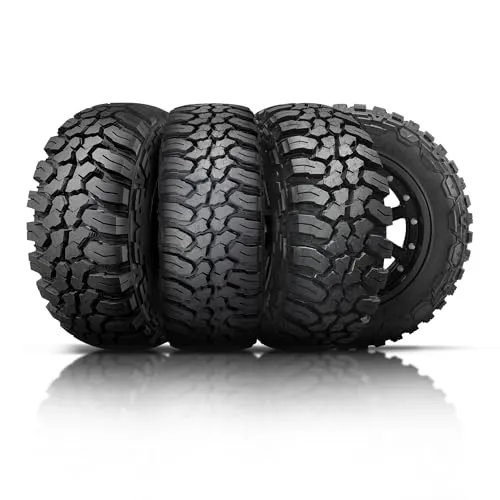
A load range E mud terrain with a reinforced three-ply sidewall and a written warranty, sold as a set of four in one LT size you have to match against your own sidewall.
What we like
- Reinforced three-ply sidewall construction, which is the part of a mud tire that fails first on rock and sharp gravel
- Load range E, 10 ply rated, with a 121/118 load index, so it suits a truck that carries weight rather than a lifted daily driver
- Backed by a 5 year warranty and a 3 year road hazard warranty covering bulges, air leaks and blowouts, which almost no budget M/T states at all
- Sold as a matched set of four, so you are not hunting for a fourth tire from a different production batch
What we don't
- The most expensive listing in this guide, and the price is for the set, so there is no cheap way to try one
- The road hazard cover only applies within the first 4/32 of an inch of wear, which is a small window on a fast wearing mud tire
- Marked M+S but the listing never claims three-peak snowflake certification, so treat it as a poor winter tire
| Tire type | Mud terrain (M/T) tire for light trucks |
|---|---|
| Listed size | LT285/70R17 121/118Q |
| Load range | E, 10 ply rated |
| Sidewall construction | Reinforced three-ply sidewall |
| Sold as | Set of four tires, wheels not included |
| Price bracket | $$$ |
Start with the size. This listing is four Finalist Terreno M/T tires in LT285/70R17, 121/118Q, load range E. The listing gives the mounted dimensions as roughly 33 inches tall and 11.5 inches wide, and each tire weighs about 55.8 pounds. Read the numbers on your own sidewall and buy that size. The same model is also listed in LT285/75R16, and if neither matches, search the model name plus your size instead of guessing.
The reason this one leads the guide is the casing. Finalist states a reinforced three-ply sidewall built to resist cuts, punctures and impacts. On a mud tire that is not marketing filler. The tread can be plugged if you pick up a nail. A sliced sidewall cannot, and it ends the day. Anyone who has aired down and rubbed a sidewall along a rock ledge knows which failure actually strands people.
The load numbers back that up. A 121/118 load index at load range E is genuine light truck construction, not a passenger tire with an aggressive pattern printed on it. That is the right choice if you tow, carry a tray or run a diesel. It is the wrong choice if your truck is empty every day, because a stiff 10 ply casing rides hard and adds unsprung weight for no gain.
The warranty is unusual at this price. Five years of cover plus three years of road hazard cover on bulges, air leaks and blowouts is more than most budget mud tires offer, which is usually nothing. Read the limit though. Road hazard cover stops once the tire has worn 4/32 of an inch. Mud tires wear fast on pavement, so that window can close inside a year of highway commuting.
Finalist also claims stable highway handling and wide shoulder grooves that push water out. Take that as a relative claim. It means stable for a mud terrain, not stable next to an all-terrain.
Research-based pick: this recommendation is based on product data, owner feedback and comparison with products we have tested, not on direct hands-on testing.
Buy it if: Someone with a three quarter ton or heavily loaded half ton truck who drives real trails and wants a written warranty behind a budget-brand mud tire.
Skip it if: Your truck lives on pavement and never carries a load, where a load range E mud tire gives you a hard ride, more noise and nothing back.
Best for Deep Mud
Aplus Shredder M/T
by Aplus
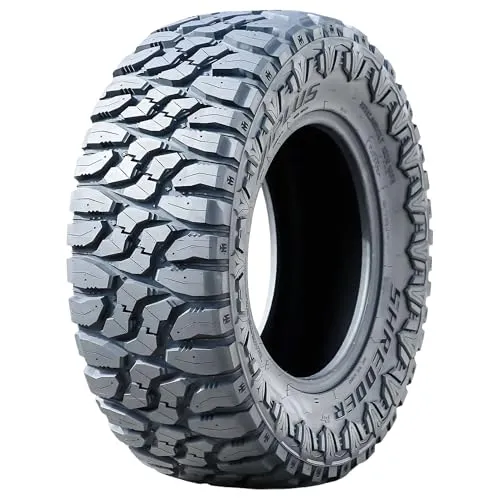
The most openly mud-focused tread here, with a high void ratio and stone ejectors, sold as a single tire in a 31 inch size for 15 inch wheels.
What we like
- High void ratio with stone ejectors, which is the specific combination that lets a tread clear itself instead of packing solid
- Massive open tread blocks give the most biting edges here for mud and rock crawling
- Studdable tread elements, so it can be prepared for ice in a way most mud tires cannot
- Sold one tire at a time, so you can replace a single damaged tire without buying a full set
What we don't
- The listing title says load range C while the feature text claims heavy duty 10 ply construction, so confirm the actual load range before you order four
- The most open tread in this guide, which means the worst highway noise and the longest wet stopping distances of the five
- Only listed in 31 and 33 inch sizes, so there is nothing here for a stock half ton on 18 or 20 inch wheels
| Tire type | Mud terrain (M/T) tire for light trucks |
|---|---|
| Listed size | LT31/10.50R15 109Q |
| Load range | C in the listing title, while the feature text claims heavy duty 10 ply construction |
| Load index | 109 |
| Listing covers | This size only. The same model is also listed in LT33/12.50R15, LT33/12.50R17 and LT33/12.50R20. |
| Price bracket | $$ |
Check the size first. This listing is one Aplus Shredder M/T in LT31/10.50R15, 109Q. That is a 31 inch tall tire on a 15 inch wheel, which is an older truck and Jeep fitment. The same model is also listed in LT33/12.50R15, LT33/12.50R17 and LT33/12.50R20. Match the numbers on your own sidewall, because a tire is bought by size, never by vehicle name.
The tread description is the reason this one is here. Aplus states massive open tread blocks, high void ratios and stone ejectors. Void ratio is the share of the tread face that is empty space rather than rubber. In mud, that empty space is the working part of the tire. The blocks push material sideways and out, and the rotation flings it clear so a fresh edge can bite on the next turn. A closed tread just fills up and turns into a smooth drum.
Stone ejectors matter more than people expect. They are the small raised ribs sitting in the bottom of the grooves. Their job is to stop gravel wedging in and staying there. A stone that sits in a groove for a thousand miles drills its way toward the belts, and it also blocks the groove from clearing mud.
The studdable claim is worth noting. It means the tread has moulded pockets that a shop can fit metal studs into. That is a real answer for packed ice, in the places where studs are legal. It is not a substitute for a winter tire on cold pavement.
One thing to sort out before ordering. The title says load range C and the feature text says heavy duty 10 ply construction. Those two do not normally go together, since 10 ply rated usually means load range E. Ask the seller which is correct if your load index has to meet a placard number.
Research-based pick: this recommendation is based on product data, owner feedback and comparison with products we have tested, not on direct hands-on testing.
Buy it if: Someone running a lifted rig on 15 inch wheels whose ground is genuinely soft, and who values getting through over getting there quietly.
Skip it if: You want one set of tires for commuting and weekend trails, where a milder mud terrain or an all-terrain will be far easier to live with.
Best for Late Model Trucks
Kanati Mud Hog M/T
by Kanati
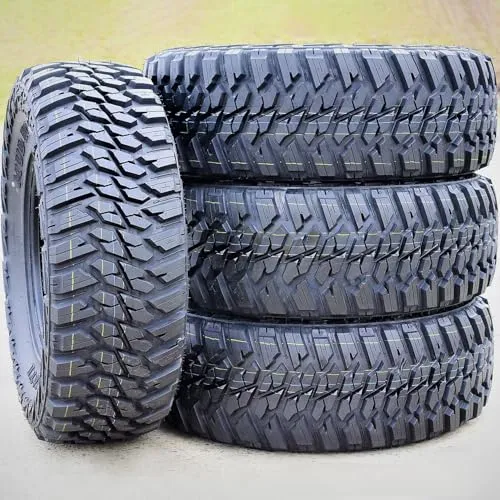
A load range E mud terrain in a low profile 20 inch size, sold as a set of four, for the newer truck that came from the factory on big wheels.
What we like
- The only 20 inch fitment here, which is what most trucks built in the last decade actually roll on
- Load range E with a 123/120 load index, rated to carry up to 3,417 pounds per tire
- A 60 series sidewall is shorter than the others here, so steering stays sharper and the tire rolls less in corners
- Sold as a matched set of four with a Q speed rating certified to 99 mph
What we don't
- The shortest sidewall in this guide, so there is very little rubber to protect a 20 inch wheel from a rock or a pothole
- A short sidewall also airs down poorly, which is exactly what you want to do in sand and on rock
- The listing gives no tread pattern detail, no ply construction detail and no treadwear figure at all
| Tire type | Mud terrain (M/T) tire for light trucks |
|---|---|
| Listed size | LT275/60R20 123/120Q |
| Load range | E, 10 ply rated |
| Load index | 123/120 |
| Sold as | Set of four tires, wheels not included |
| Price bracket | $$$ |
The size is the whole point of this pick. This listing is four Kanati Mud Hog M/T tires in LT275/60R20, 123/120Q, load range E, 10 ply rated. Look at your own sidewall and confirm it says the same thing before you order. This listing is one size and one size only.
Most mud tires are sold for 15, 16 and 17 inch wheels, because that is what the off-road world runs. Trucks sold in showrooms went the other way. A modern half ton often leaves the lot on 20 inch wheels, and the owner who wants an aggressive tire either buys a second set of smaller wheels or finds a mud terrain in a 20 inch size. This is that tire.
Understand the trade you are making by staying on 20s. The 60 in 275/60R20 means the sidewall height is 60 percent of the 275 millimetre section width, which works out around 6.5 inches. That is short. Short sidewalls flex less, so on-road steering feels tighter and the truck leans less in a corner. Off pavement, that same stiffness works against you. There is less rubber standing between a rock and the wheel rim, and airing down to spread the footprint does much less on a short sidewall than a tall one.
The load numbers are honest working truck figures. Load index 123 supports up to 3,417 pounds per tire and the speed rating Q is certified to 99 mph. Q is normal for a mud terrain, and it is worth knowing that you are giving up rated speed compared with a highway tire.
What the listing does not give you is any detail on the tread. There is no void ratio claim, no sidewall ply description and no treadwear number. Buy this one for the size and the load rating, not for a spec sheet.
Research-based pick: this recommendation is based on product data, owner feedback and comparison with products we have tested, not on direct hands-on testing.
Buy it if: An owner of a newer half ton or three quarter ton truck on factory 20 inch wheels who wants a mud terrain look and capability without buying smaller wheels.
Skip it if: You do serious rock work, where a taller sidewall on a 16 or 17 inch wheel gives you more protection and lets you air down properly.
Best for Lifted Trucks
Zeetex MT1000
by Zeetex
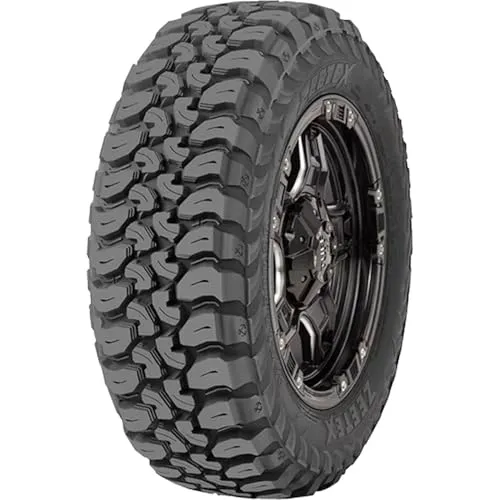
A 35 inch load range E mud terrain sold one tire at a time, for a lifted truck that already has the clearance and the gearing to run it.
What we like
- A true 35 inch tire, which is the size most lifted trucks and built Jeeps are aiming at
- Load index 125 supports up to 3,638 pounds per tire, the highest per-tire figure in this guide
- Load range E, 10 ply rated construction, which is what a tire this tall needs to stay stable under load
- Sold individually, so a spare or a single replacement does not mean buying four
What we don't
- A 35 inch tire needs a lift, and often new gearing, so the tire price is only part of what you spend
- The listing gives no tread pattern description, no sidewall ply detail and no treadwear figure
- Big, heavy tires cost real fuel economy and slow braking, and this one carries the same M/T wet grip penalty as the rest
| Tire type | Mud terrain (M/T) tire for light trucks |
|---|---|
| Listed size | 35X12.50R17 125Q |
| Load range | E, 10 ply rated |
| Load index | 125 |
| Sold as | One tire, wheel not included |
| Price bracket | $$$ |
Read the size before anything else. This listing is one Zeetex MT1000 in 35X12.50R17, 125Q, load range E, 10 ply rated. That is the flotation sizing format, so the numbers mean 35 inches tall and 12.5 inches wide on a 17 inch wheel. Compare that against what is on your truck now, and against what your fenders will actually clear at full steering lock.
Height is the reason to buy a tire like this. Ground clearance under the axle is roughly half the difference in tire diameter, so going from a 33 to a 35 buys you about an inch under the differential. That inch matters when you are straddling a rut. The longer contact patch also helps in sand, where flotation beats aggression.
Height is also the reason to think twice. A 35 inch tire is heavy, and every pound out at the wheel does more damage to acceleration, braking and fuel economy than a pound anywhere else on the truck. Taller tires also change your effective gearing, which is why people who fit 35s on a stock truck often end up re-gearing the axles. Your speedometer will read low until it is recalibrated.
The load rating is the strongest number on the page. Load index 125 supports up to 3,638 pounds per tire, the highest here, on a load range E casing. A tall tire needs that casing strength, because a taller sidewall flexes more and heat is what kills tires.
The listing itself is thin on detail. Zeetex describes the MT1000 as a mud terrain with all season traction and nothing more. There is no void ratio claim, no sidewall ply count and no treadwear figure. If a spec sheet is what convinces you, the Finalist Terreno M/T gives you far more to read.
Research-based pick: this recommendation is based on product data, owner feedback and comparison with products we have tested, not on direct hands-on testing.
Buy it if: A driver who already runs a lifted truck with the fender clearance and axle gearing for 35s and wants a load range E tire without paying premium brand money.
Skip it if: Your truck is stock, since fitting 35s usually means a lift, trimming and a gear change, and the total bill dwarfs the tires.
Best Value
Accelera M/T-01
by Accelera
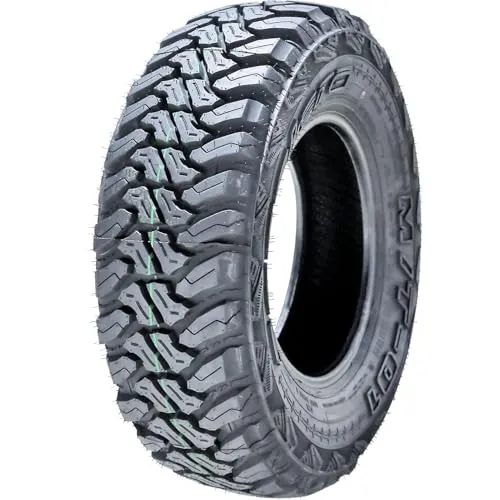
The cheapest way into a real mud terrain here, a load range C tire in a common 15 inch size, sold one at a time and offered across four sizes.
What we like
- The lowest price of the five by a wide margin, which is what makes four matching tires affordable on an older rig
- Listed in four sizes, LT165/80R13, LT235/75R15, LT235/85R16 and LT265/65R17, so a match is more likely than with the other picks
- Load range C at 6 ply rated is a softer casing than the load range E picks, which rides better on a light vehicle
- Load index 104/101 supports up to 1,984 pounds per tire with a Q speed rating certified to 99 mph
What we don't
- The listing states treadlife as N/A, so there is no treadwear warranty and no mileage figure to hold anyone to
- Load range C is not enough casing if you tow or carry weight, and an under-rated tire runs hot when loaded
- No sidewall ply description at all, which is the specification that matters most on a tire meant for rocks
| Tire type | Mud terrain (M/T) tire for light trucks |
|---|---|
| Listed size | LT235/75R15 104/101Q |
| Listing covers | This size only. The same model is also listed in LT165/80R13, LT235/85R16 and LT265/65R17. |
| Load range | C, 6 ply rated |
| Load index | 104/101 |
| Price bracket | $$ |
Check the size first, as always. This listing is one Accelera M/T-01 in LT235/75R15, 104/101Q, load range C, 6 ply rated. The same model appears in LT165/80R13, LT235/85R16 and LT265/65R17, and the two larger ones are listed as load range E in sets of four. Read your own sidewall and buy the number that matches it.
The case for this tire is money, and money is a real argument. Four mud tires from a well known brand can cost more than an older truck is worth. Mixing tread patterns across an axle is a bad idea, because the two tires grip and brake differently and the vehicle behaves oddly under hard stops. Four cheap matching tires is a better outcome than two good ones and two worn ones, every single time.
Load range C is the right pick for the vehicle this size fits. A 235/75R15 goes on older light trucks, small SUVs and trailers. A 6 ply casing supports up to 1,984 pounds per tire, which is plenty for a light vehicle, and it rides noticeably softer than a 10 ply E casing. Put weight on it though and the argument reverses. Under-rated tires build heat, and heat is what causes blowouts.
The honest weakness is how little the listing tells you. Accelera states the performance category as mud terrain and the season as all season, and then lists treadlife as N/A. There is no tread pattern description, no sidewall ply count and no mileage warranty. On a mud tire, the sidewall build is the specification you most want to know, because that is what rocks attack.
Buy this one knowing what it is. It is an inexpensive, honest-looking mud terrain with a thin spec sheet, and it will wear faster than anything with a published warranty.
Research-based pick: this recommendation is based on product data, owner feedback and comparison with products we have tested, not on direct hands-on testing.
Buy it if: An owner of an older, lighter truck or a small SUV who needs four matching mud tires now and cannot justify spending several hundred dollars more.
Skip it if: You tow, haul or run heavy, where the load range C casing is not enough and the Finalist Terreno M/T or the Kanati Mud Hog M/T are the safer buys.
How we chose#
This is a research-based guide, not a hands-on off-road test. We started from mud terrain tires actually in stock on Amazon in the United States, then read each listing for the things that separate one mud tire from another: the tire type, the exact listed size, the load range and load index, what the listing says about sidewall construction, whether it claims any snow certification, and whether the tire is sold singly or as a set of four.
We then picked for spread. That gave us a load range E tire with a stated three-ply sidewall and a written warranty, the most openly mud-focused tread in the pool, a low profile 20 inch fitment for newer trucks, a 35 inch tire for lifted rigs, and a genuinely cheap tire that makes four matching mud terrains possible on an older vehicle.
One gap is worth naming. The candidate pool held no rugged terrain hybrid, the in-between category that sits between an all-terrain and a mud terrain, so we did not pretend one was there. Every tire in this guide is a full M/T. If you want the middle ground, read our all-terrain tire guide instead, because that is where the compromise tires live.
We also did not match tires to vehicles. Every listing here is a single size, and we name that size in every review and in the comparison table so you can check it against your own sidewall.
What to consider before buying#
Be honest about the ground you drive on. Most people who buy mud terrains do not need them. If your off-road driving is a gravel road, a boat ramp and a fire trail in summer, an all-terrain will get you there just as well and will be quieter, safer in the rain and much longer lived. Plenty of buyers want the look, and there is nothing wrong with admitting that, but you should know what the look costs.
Check the load range against your door placard, not against your instincts. Load range C is a 6 ply rated casing and rides softly, which suits a light older truck like the one the Accelera M/T-01 fits. Load range E is 10 ply rated and built for weight, which is what the Finalist Terreno M/T, the Kanati Mud Hog M/T and the Zeetex MT1000 give you. Going above what you need means a hard ride and more weight for nothing. Going below what you need makes the tire run hot when loaded, and heat is what kills tires.
Think about wheel diameter as well as tire size. A tall sidewall on a 15, 16 or 17 inch wheel protects the rim, flexes over rocks and airs down properly. A short sidewall on a 20 inch wheel steers more sharply on the road and does much less off it. That is the whole difference between the Aplus Shredder M/T fitment and the Kanati fitment.
Budget for four tires plus mounting and balancing, and check what the price covers. Two of these listings are single tires and two are sets of four, so the sticker price is not comparable until you do the multiplication.
Void ratio, and why a mud tire clears instead of packs#
Grip in mud does not come from rubber touching dirt. There is no solid ground to touch. It comes from the tread digging into soft material, throwing it backwards and clearing itself so the next block arrives clean.
Void ratio is the number that describes this. It is the share of the tread face made up of grooves rather than rubber. A highway tire sits somewhere around 15 to 20 percent void. A mud terrain runs far higher, with big blocks separated by channels wide enough to let a fistful of clay pass through. The Aplus Shredder M/T states high void ratios directly, along with massive open tread blocks.
Block shape matters as much as spacing. Angled, stepped blocks scoop material toward the shoulder, and the rotation of the wheel flings it out. Small features called stone ejectors sit in the bottom of the grooves, and their job is to stop gravel wedging itself in place. A stone stuck in a groove does two bad things. It blocks the groove from clearing, and over thousands of miles it works its way down toward the steel belts.
The failure mode to understand is packing. When a tread fills with mud and the mud stays put, the tire becomes a smooth cylinder with a coating of the exact material you are trying to drive through. That is the moment traction vanishes completely. A closed all-terrain tread packs almost immediately in deep mud. An open M/T tread keeps clearing, which is the entire reason the category exists.
Three ply sidewalls, and what actually ends an off-road day#
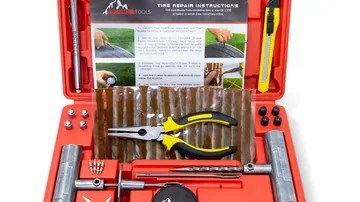
Most people worry about the tread and get punished by the sidewall. A nail through the tread is a twenty minute job with a tire plug kit. A slice through the sidewall cannot be repaired at all. The cords are the structure of the tire, and once they are cut the tire is scrap.
Sidewalls get cut because of where they sit. They hang out past the tread, so they are the part that rubs a rock ledge, catches a sharp shale edge or drags across a stump. The problem gets worse when you air down, which is the right thing to do in sand and on rock, because a lower pressure lets the sidewall bulge outward and expose more of itself.
That is why a stated ply count on the sidewall is worth paying for. The Finalist Terreno M/T claims reinforced three-ply sidewall construction, and that is the single specification that separates it from the others here. The Aplus Shredder M/T states a tough polyester casing without giving a ply count. The Kanati, Zeetex and Accelera listings say nothing about the sidewall at all beyond the overall ply rating, which describes casing strength rather than sidewall layers.
Carry the recovery gear anyway. A torn sidewall means the spare goes on, and if the tire failed because you were stuck in the first place, a winch is what gets you out. No tire is a substitute for a way to pull yourself backwards.
The real costs on pavement#
Noise comes from air being squeezed and released between tread blocks and the road. Wide voids mean more air, more slap and more hum, so an aggressive tread is always louder. It also gets worse with age, because blocks wear into a slight ramp shape and each one hits the road harder than it did when new.
Wet braking is the cost people underestimate. A mud terrain has less rubber on the road and almost no siping, which is what cuts through a thin film of water. Stopping distances in the rain are simply longer than on an all-terrain, and hydroplaning starts at a lower speed. That is a safety trade, not a comfort one, and it applies to every tire in this guide.
Fuel economy and tread life both drop as well. These tires are heavy, they roll harder, and soft open blocks wear faster on asphalt than closed tread does. Only the Finalist Terreno M/T publishes a warranty here, and the Accelera M/T-01 listing states treadlife as N/A. Rotating every 5,000 to 7,000 miles and keeping the alignment straight will slow the wear, but it will not change the category.
Snow deserves its own sentence, because the look is misleading. Deep unpacked snow behaves a bit like mud and a mud terrain does fine in it. Packed snow and ice are the opposite problem, needing dense siping and a compound that stays soft in the cold, and mud tires have neither. None of these five claims three-peak snowflake certification. If winter is your reason for buying, buy a winter tire or a certified all-terrain instead.
Final recommendation#
If you drive real trails and want the one specification that matters most, buy the Finalist Terreno M/T for its reinforced three-ply sidewall and its written warranty, provided the LT285/70R17 size matches your sidewall. When your ground is genuinely soft and you run 15 inch wheels, the Aplus Shredder M/T has the most open tread here, with stone ejectors and a studdable pattern, and it is the one that will keep clearing when the others pack. Owners of newer trucks stuck on factory 20 inch wheels should take the Kanati Mud Hog M/T, since it is the only 20 inch fitment in this guide, and accept that a short sidewall gives up rock protection. On a lifted rig that already has the clearance and the gearing, the Zeetex MT1000 gets you to a true 35 inch tire on a load range E casing without premium brand money. And if the real choice is four matching tires now or a mismatched set for another year, the Accelera M/T-01 is the cheapest honest way to get there. If reading all of this made you think your truck mostly lives on pavement, that is the right conclusion, and an all-terrain will serve you better.
Frequently asked questions
How do I know which mud tire size to buy?
Read the sidewall of the tires already on your truck. You will see something like LT285/70R17 121/118Q, usually with a load range letter. Buy that exact size unless a tire shop has told you to change it. Every listing in this guide is one size, so the Finalist Terreno M/T link is an LT285/70R17 and the Zeetex MT1000 link is a 35X12.50R17. If the numbers do not match, most of these models are sold in other sizes, so search the model name plus your size. Your door placard lists the factory size and the load index the vehicle needs.
Are mud tires worse than all-terrains in the rain?
Yes, and it is not close. A mud terrain has fewer, larger tread blocks and far less rubber touching wet asphalt, and it has very little siping, which is what cuts through a thin film of water. The result is longer wet braking distances and easier hydroplaning at highway speed. The Finalist Terreno M/T and the Kanati Mud Hog M/T both claim shoulder grooves that channel water, and that helps, but it does not close the gap. If most of your miles are wet pavement, an all-terrain is the safer tire.
Do mud tires work in snow?
Poorly, despite how capable they look. Deep, unpacked snow behaves a little like mud, so an M/T can do well there. Everything else about winter goes against it. Packed snow and ice need thousands of tiny siping edges and a compound that stays soft when it is cold, and mud tires have neither. None of the five picks here claims three-peak snowflake certification. The Aplus Shredder M/T is the only one with studdable tread, which is a genuine ice answer where studs are legal, but it is still not a winter tire.
What is void ratio and why does it matter?
Void ratio is the share of the tread face that is empty space rather than rubber. A highway tire might be around 15 to 20 percent void. A mud terrain is far higher. In soft ground, the empty space does the work. The blocks push mud sideways into the voids, and the spinning tire flings it out so a clean edge bites on the next rotation. The Aplus Shredder M/T is the most open tread here, with a stated high void ratio and stone ejectors. High void is also exactly why mud tires are loud and grip poorly on wet roads.
What does a three-ply sidewall actually do?
It adds layers of cord to the part of the tire that hangs over the rim, which is where off-road damage happens. Tread punctures can be plugged on the trail. A sliced or torn sidewall cannot be repaired, so it means a spare on the rim and a new tire later. Rocks, sharp shale and stumps cut sidewalls, especially when you air down and the sidewall bulges outward. The Finalist Terreno M/T is the only pick here that states reinforced three-ply sidewall construction, which is the main reason it leads this guide.
How long do mud tires last and how much fuel do they cost?
Less and more than you would like, and most listings avoid saying so. Big soft blocks wear faster on asphalt than a closed tread does, and uneven wear ruins them quickly. Of the five picks here, only the Finalist Terreno M/T publishes any warranty at all, a 5 year warranty plus 3 years of road hazard cover, and the Accelera M/T-01 listing simply states treadlife as N/A. Heavy, aggressive tires also add rolling resistance and rotating weight, so expect a real drop in fuel economy. Rotate every 5,000 to 7,000 miles to slow the damage.
About the author

Dale Harper Lead Gear Editor
Dale is a longtime truck owner and former accessory-shop tech who builds these guides from manufacturer fit data, aggregated owner feedback and direct spec comparison. Research-based picks are always labelled as such.
Daily driver: 2022 Ford F-150 XLT SuperCrew
- Tonneau covers and bed accessories
- Seat covers and interior protection
- Lift kits and suspension