The Best Diesel Fuel Additives: 5 Picks Compared for Winter and Year Round Use
Five real diesel fuel additives compared, from a year round cetane booster to a cheap anti-gel jug, with honest notes on what a bottle can and cannot fix.

A bottle of diesel additive is cheap insurance, and it only helps if you pour it in before the weather turns. That is the main thing to take from this guide. Once the wax in your fuel has plugged the filter, nothing on the shelf will unplug it, and you are calling for a tow instead. We compared five diesel additives actually sold on Amazon: the year round Hot Shot's Secret Everyday Diesel Treatment, the cold weather Hot Shot's Secret EDT+ Winter Defense, the heavily specified Archoil AR6300, the cheap and large Lucas Oil 10866 anti-gel jug, and the Stanadyne Performance Formula four pack from a fuel injection manufacturer. We looked at what kind of additive each one is, bottle size, how much fuel it treats, whether it carries a real anti-gel package, the cetane boost it claims, and what it says about lubricity. This guide is diesel only. Gasoline treatments are different chemistry.
Table of contents
- Quick picks
- Bottle size compared
- Comparison table
- Best Overall: Hot Shot's Secret Everyday Diesel Treatment EDT, 16 oz
- Best for Cold Weather: Hot Shot's Secret EDT+ Winter Defense Fuel Additive, 32 oz
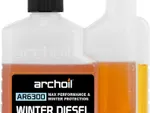
- Upgrade Pick: Archoil AR6300 Winter Diesel Treatment 41 oz
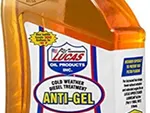
- Best Value: Lucas Oil 10866 Anti-Gel Cold Weather Diesel Additive, 64 oz
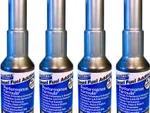
- Best for Emissions Equipped Trucks: Stanadyne 38564 Performance Formula Diesel Fuel Additive, 4 x 8 oz
- How we chose
- What to consider before buying
- Gelling and the cloud point, what happens to diesel at 15F
- Cetane is not octane
- Ultra low sulphur diesel and the lubricity gap
- Treat ratio, and why half a dose is the same as none
- Final recommendation
- FAQ
Quick picks
Every pick wins a specific use case. Jump to the full review before you buy.
-
Best Overall
Hot Shot's Secret Everyday Diesel Treatment EDT, 16 oz
A year round diesel treatment that raises cetane, cleans injectors and adds lubricity back to ultra low sulphur fuel, sized for a single truck.
-
Best for Cold Weather
Hot Shot's Secret EDT+ Winter Defense Fuel Additive, 32 oz
The winter version of the everyday treatment, adding an anti-gel package that keeps fuel flowing well below the point where wax normally plugs a filter.
-
Upgrade Pick
Archoil AR6300 Winter Diesel Treatment 41 oz
The most heavily specified bottle here, with a tested lubricity number, the biggest cetane claim and deposit control aimed at the DPF and the turbo.
-
Best Value
Lucas Oil 10866 Anti-Gel Cold Weather Diesel Additive, 64 oz
A large, cheap anti-gel jug that focuses on two winter problems, wax and water, and skips the cetane and detergent extras the pricier bottles add.
-
Best for Emissions Equipped Trucks
Stanadyne 38564 Performance Formula Diesel Fuel Additive, 4 x 8 oz
A four bottle pack from a company that builds diesel fuel injection equipment, stated to be safe on exhaust aftertreatment and compatible with ULSD and B20 blends.
Compare every pick
| Product | Award | Additive type | Container size | Lubricity improver | Best for | Where to buy |
|---|---|---|---|---|---|---|
| Hot Shot's Secret Everyday Diesel Treatment EDT, 16 oz | Best Overall | All season everyday treatment | 16 fl oz squeeze bottle | Yes, raises fuel lubricity to protect the pump and injectors | Someone with one diesel pickup who wants a single bottle to use at every fill up for most of the year. | Check price for Hot Shot's Secret Everyday Diesel Treatment EDT, 16 oz at Amazon (affiliate link) |
| Hot Shot's Secret EDT+ Winter Defense Fuel Additive, 32 oz | Best for Cold Weather | Winter anti-gel with cetane and lubricity boost | 32 fl oz squeeze bottle | Yes, up to 32 percent better lubricity | Anyone parking a diesel outside in a place where overnight lows sit near or below freezing for months at a time. | Check price for Hot Shot's Secret EDT+ Winter Defense Fuel Additive, 32 oz at Amazon (affiliate link) |
| Archoil AR6300 Winter Diesel Treatment 41 oz | Upgrade Pick | Winter treatment with DPF and turbo deposit control | 41 fl oz bottle with a measuring chamber | Yes, 43 percent improvement tested to ASTM D6079 | Owners of modern high pressure common rail trucks with a CP4 pump and a DPF who would rather overspend on fuel than on fuel system parts. | Check price for Archoil AR6300 Winter Diesel Treatment 41 oz at Amazon (affiliate link) |
| Lucas Oil 10866 Anti-Gel Cold Weather Diesel Additive, 64 oz | Best Value | Cold weather anti-gel and water dispersant | 64 fl oz jug | Not claimed on the listing | A budget minded owner who only wants gelling and water protection through winter and does not care about cetane or cleaning. | Check price for Lucas Oil 10866 Anti-Gel Cold Weather Diesel Additive, 64 oz at Amazon (affiliate link) |
| Stanadyne 38564 Performance Formula Diesel Fuel Additive, 4 x 8 oz | Best for Emissions Equipped Trucks | All season performance formula sold as a four bottle pack | 32 fl oz total across four 8 oz bottles | Yes, listed as lubricates, cleans and protects | An owner of a modern emissions equipped diesel who wants an additive from a fuel system manufacturer and runs biodiesel blends. | Check price for Stanadyne 38564 Performance Formula Diesel Fuel Additive, 4 x 8 oz at Amazon (affiliate link) |
Swipe sideways to compare every column.
Best Overall
Hot Shot's Secret Everyday Diesel Treatment EDT, 16 oz
by Hot Shot's Secret
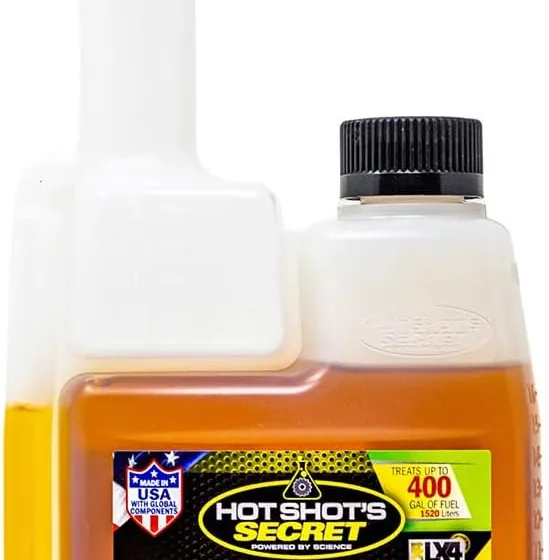
A year round diesel treatment that raises cetane, cleans injectors and adds lubricity back to ultra low sulphur fuel, sized for a single truck.
What we like
- One of the strongest sellers in the whole category, sitting at a sales rank of 92 on Amazon
- Raises cetane by up to 7 points, which is the headline number most owners buy this for
- Cleans deposits on both the inside and the outside of the injector, not just the tip
- A 16 oz bottle covers about 400 gallons of fuel at the 1 oz per 25 gallon dose, so one bottle lasts a daily driver months
What we don't
- It is not an anti-gel, so it will not stop your fuel waxing up in a hard freeze
- The squeeze bottle has no dose chamber, so you are eyeballing ounces at the pump
- Doubling the dose for more cetane and lubricity halves how far the bottle goes
| Additive type | All season everyday treatment |
|---|---|
| Container size | 16 fl oz squeeze bottle |
| Treats up to gallons | 400 gallons at the 1 oz per 25 gallon dose |
| Cetane boost | Up to 7 points |
| Lubricity improver | Yes, raises fuel lubricity to protect the pump and injectors |
| Price bracket | $ |
Everyday Diesel Treatment is the plain version of what Hot Shot’s Secret sells. No anti-gel package, no winter branding, just the four things a diesel additive is supposed to do all year. It raises cetane by up to 7 points, cleans injector deposits, puts lubricity back into ultra low sulphur fuel, and pulls moisture out so it does not sit in the tank and rust things.
It takes Best Overall for a simple reason. Its Amazon sales rank sits at 92, which is very low for a category this crowded, and that means a lot of people are buying it over and over. Repeat sales are the closest thing to a real world verdict that public data gives you.
The dose is where it gets flexible. One ounce per 25 gallons is the standard rate, and two ounces per 25 gallons is what Hot Shot’s suggests when you want more cetane and more lubricity. A 16 ounce bottle covers roughly 400 gallons at the light dose and half that at the heavy one. For a truck that burns 40 gallons a week, one bottle is most of a season.
The limit is right there in the name. Everyday is not winter. This formula makes no gelling claim, and Hot Shot’s sells a separate Winter Defense product because the anti-gel chemistry is a different job. If you buy this in October and expect it to save you in January, it will not.
Buy this if you want one bottle that quietly improves the fuel you already put in, and swap to an anti-gel product when the forecast starts showing hard freezes.
Research-based pick: this recommendation is based on product data, owner feedback and comparison with products we have tested, not on direct hands-on testing.
Buy it if: Someone with one diesel pickup who wants a single bottle to use at every fill up for most of the year.
Skip it if: You live somewhere that drops below freezing for weeks, where the EDT+ Winter Defense version is the bottle you actually need.
Best for Cold Weather
Hot Shot's Secret EDT+ Winter Defense Fuel Additive, 32 oz
by Hot Shot's Secret
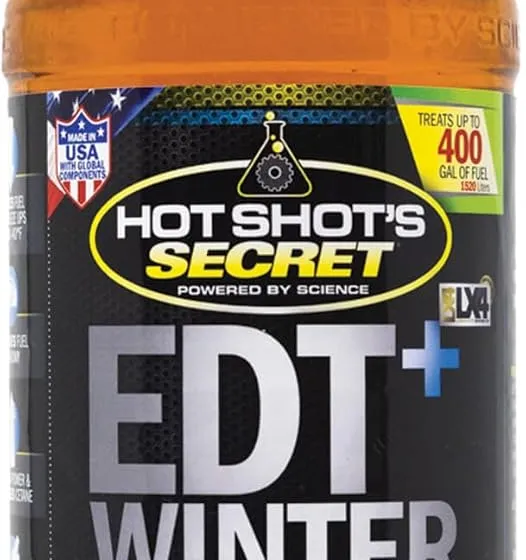
The winter version of the everyday treatment, adding an anti-gel package that keeps fuel flowing well below the point where wax normally plugs a filter.
What we like
- Shrinks the wax crystals in cold diesel so fuel still passes the filter 20F below the cloud point
- Keeps the cetane boost and injector cleaning of the regular EDT, so it is not a single purpose bottle
- Improves lubricity by up to 32 percent, which matters most on cold starts
- Disperses water and is rated against fuel line freeze up down to -40F
What we don't
- The dose doubles below 0F, so a bottle empties fast in a real cold snap
- It has to be in the tank before the fuel gels, and it cannot rescue a truck that is already plugged
- Buying it means running two different bottles across the year if you also use the everyday formula
| Additive type | Winter anti-gel with cetane and lubricity boost |
|---|---|
| Container size | 32 fl oz squeeze bottle |
| Anti gel rated | Yes, keeps fuel moving through the filter 20F below the cloud point |
| Cetane boost | Up to 7 points |
| Lubricity improver | Yes, up to 32 percent better lubricity |
| Price bracket | $ |
EDT+ Winter Defense is the same everyday treatment with a cold weather package bolted on. Hot Shot’s calls it a 7 in 1, and the part that earns the name is what it does to wax. Diesel carries paraffin wax that stays dissolved until the fuel cools to its cloud point, then starts forming crystals. This additive does not stop the crystals forming. It keeps them small enough to slip through the filter media, which the maker rates at 20F below the cloud point.
The second half of the winter job is water. Cold plus water in a fuel line means ice, and ice plugs things just as well as wax does. This formula demulsifies moisture so it can be dropped out rather than carried through, and the listing claims protection against fuel line freeze up down to -40F.
We picked the 32 ounce bottle over the 16 ounce and the gallon on purpose. At the 2 ounce per 25 gallon dose it covers roughly 400 gallons, which is a full winter for one pickup. The gallon jug makes sense for a fleet or a farm, not for a driveway.
The trap is the dose. Below 0F the instruction is to double it, which means the same bottle covers half the fuel. People who keep pouring the mild weather dose during a cold snap are effectively running untreated fuel, and that is where most anti-gel disappointment comes from.
Buy it in autumn, keep it in the cab, and start using it while it is still only cool out. That is the whole strategy.
Research-based pick: this recommendation is based on product data, owner feedback and comparison with products we have tested, not on direct hands-on testing.
Buy it if: Anyone parking a diesel outside in a place where overnight lows sit near or below freezing for months at a time.
Skip it if: Your winters rarely get near freezing, in which case the plain everyday treatment does the useful parts for less money.
Upgrade Pick
Archoil AR6300 Winter Diesel Treatment 41 oz
by Archoil
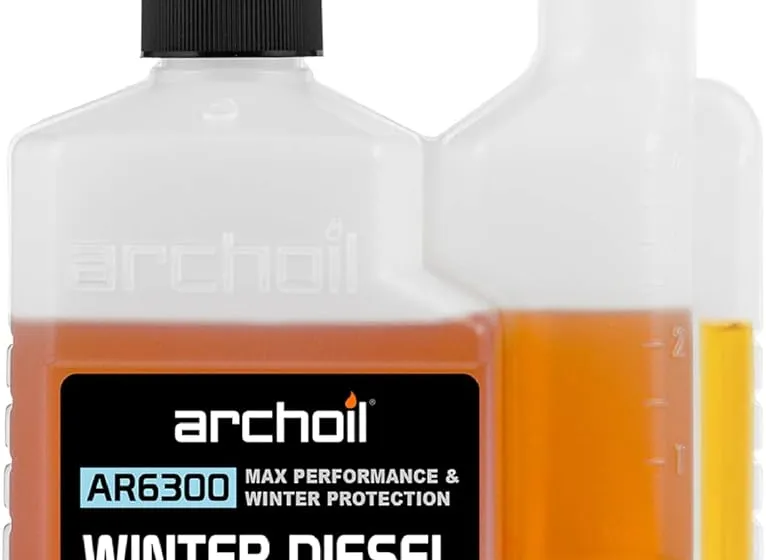
The most heavily specified bottle here, with a tested lubricity number, the biggest cetane claim and deposit control aimed at the DPF and the turbo.
What we like
- Lubricity improvement of 43 percent, tested to ASTM D6079, which is a published method rather than a vague claim
- Raises cetane by up to 8 points, the largest boost of the five picks
- Targets DPF and turbo deposits, so it is built around modern emissions hardware instead of ignoring it
- The long neck and built in measuring chamber mean you dose it correctly without a separate cup
What we don't
- Roughly double the price of the cheaper anti-gels, and you feel that on a big tank
- It is the winter formula, so Archoil expects you to switch to AR6500 for the rest of the year
- Stock was showing as low at the time we checked, so it is not always a grab it today purchase
| Additive type | Winter treatment with DPF and turbo deposit control |
|---|---|
| Container size | 41 fl oz bottle with a measuring chamber |
| Treats up to gallons | 275 gallons per bottle |
| Cetane boost | Up to 8 points |
| Lubricity improver | Yes, 43 percent improvement tested to ASTM D6079 |
| Price bracket | $$ |
AR6300 is the bottle for people who read spec sheets. Where most additives say they improve lubricity, Archoil names the test. ASTM D6079 is the high frequency reciprocating rig test that fuel labs use to measure how well diesel protects the metal sliding against metal inside a pump, and Archoil claims a 43 percent improvement on it. That is a checkable claim, and it is the single strongest reason to pay more for this one.
Cetane is the other number. Up to 8 points is the biggest boost in this guide. Archoil notes that pump diesel often lands between 40 and 45, while many engines are happiest nearer 48 to 50, which is a fair description of the gap the additive is trying to close.
The rest of the package leans modern. Detergents to clear injector deposits and restore spray pattern, deposit control aimed at keeping the DPF cleaner and cutting how often it needs to regenerate, and soot control for the turbo. If your truck has a CP4 pump and an emissions system you cannot afford to replace, this is the pick that speaks to that.
The bottle itself is smart. A long neck and a measuring chamber mean you pour a known amount instead of guessing, and 41 ounces covers about 275 gallons of fuel.
Two honest limits. This is the winter formula and Archoil wants you on AR6500 the rest of the year, which is two products instead of one. And at nearly 45 dollars it is the expensive answer to a problem the Lucas Oil jug half solves for a third of the money.
Research-based pick: this recommendation is based on product data, owner feedback and comparison with products we have tested, not on direct hands-on testing.
Buy it if: Owners of modern high pressure common rail trucks with a CP4 pump and a DPF who would rather overspend on fuel than on fuel system parts.
Skip it if: You drive an older mechanical diesel with no particulate filter, where a cheaper anti-gel covers the same ground.
Best Value
Lucas Oil 10866 Anti-Gel Cold Weather Diesel Additive, 64 oz
by Lucas Oil
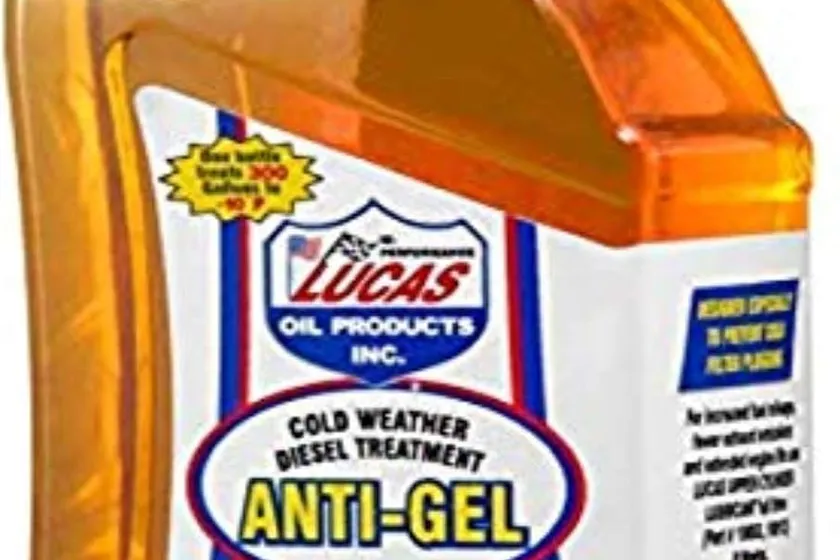
A large, cheap anti-gel jug that focuses on two winter problems, wax and water, and skips the cetane and detergent extras the pricier bottles add.
What we like
- The cheapest bottle in this guide and the second largest, so the cost per treated tank is very low
- Lowers the cold filter plugging point of both ultra low sulphur diesel and biofuel blends
- Contains water dispersants to pull moisture out of the whole fuel system, not just the tank
- Stated to have no harmful effect on diesel particulate filters, so it is safe on emissions equipped trucks
What we don't
- No cetane boost is claimed, so it does nothing for cold start roughness or power
- No injector detergent package, meaning it is a winter insurance policy and not a fuel system cleaner
- The listing does not publish a treat ratio or a gallons covered figure, so you must read the label before dosing
| Additive type | Cold weather anti-gel and water dispersant |
|---|---|
| Container size | 64 fl oz jug |
| Anti gel rated | Yes, lowers the cold filter plugging point of ULSD and biofuels |
| Cetane boost | Not claimed, this one is an anti-gel rather than a cetane booster |
| Lubricity improver | Not claimed on the listing |
| Price bracket | $ |
Lucas Oil 10866 is the narrow product here, and that is the point. It sets out to do two things well. It lowers the cold filter plugging point of ultra low sulphur diesel and biofuel blends, which is the temperature where wax stops fuel passing the filter, and it carries water dispersants that pull moisture out of the fuel system rather than letting it pool.
At around 16 dollars for 64 ounces it is the cheapest jug in this guide by a wide margin. Buying winter protection is a bit like buying a spare tyre. You hope you never find out whether it worked. A cheap bottle makes that easier to accept, and this is the one we would keep behind the seat all winter without thinking about it.
Lucas is also clear that the formula has no harmful effect on diesel particulate filters. That matters more than it used to. Plenty of older additive chemistry was fine on a mechanical engine and unwelcome on a truck with an emissions system behind it.
Here is what you give up. No cetane claim, so cold starts will still sound like cold starts. No detergent package, so injector deposits keep building at the same rate they were. And the Amazon listing does not publish a treat ratio, which means the label on the jug is the only dosing instruction you get.
Pick this if your only winter worry is gelling. Pick the Hot Shot’s EDT+ Winter Defense instead if you want the anti-gel plus the cleaning and cetane in one bottle.
Research-based pick: this recommendation is based on product data, owner feedback and comparison with products we have tested, not on direct hands-on testing.
Buy it if: A budget minded owner who only wants gelling and water protection through winter and does not care about cetane or cleaning.
Skip it if: You want one additive that does everything, since this one deliberately does not clean injectors or raise cetane.
Best for Emissions Equipped Trucks
Stanadyne 38564 Performance Formula Diesel Fuel Additive, 4 x 8 oz
by Stanadyne
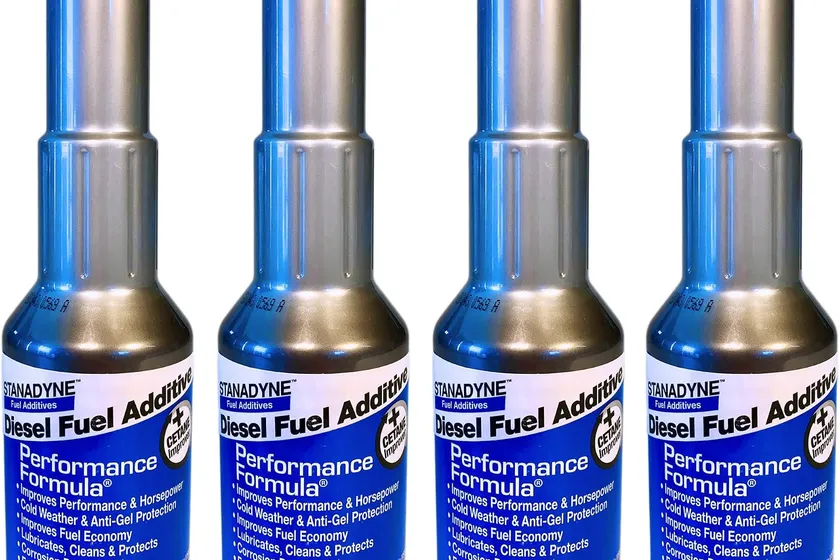
A four bottle pack from a company that builds diesel fuel injection equipment, stated to be safe on exhaust aftertreatment and compatible with ULSD and B20 blends.
What we like
- Comes from Stanadyne, a fuel injection equipment maker rather than an additive brand, which is unusual in this aisle
- Listed as exhaust aftertreatment safe, so it is aimed at trucks with a DPF and SCR system behind the engine
- Compatible with both ultra low sulphur diesel and B20 biodiesel blends
- Four separate 8 oz bottles are easier to carry in a cab and keep sealed than one big jug
What we don't
- No cetane number is published on the listing, so you cannot compare it against the Archoil or Hot Shot's claims
- The listing gives no treat ratio or gallons covered figure, which makes value hard to judge before you buy
- Works out more expensive per ounce than the Lucas Oil jug while claiming a similar cold weather job
| Additive type | All season performance formula sold as a four bottle pack |
|---|---|
| Container size | 32 fl oz total across four 8 oz bottles |
| Treats up to gallons | Not stated on the Amazon listing |
| Anti gel rated | Yes, listed for cold weather and anti-gel protection |
| Lubricity improver | Yes, listed as lubricates, cleans and protects |
| Price bracket | $ |
Stanadyne is not an additive company that also sells fuel treatment. It builds diesel fuel injection equipment, and the additive exists because the same firm has to live with what bad fuel does to its pumps. That background is the main reason this pack is here.
Performance Formula covers the standard list. Cold weather and anti-gel protection, lubrication and cleaning, corrosion prevention, and claimed gains in performance and fuel economy. Two lines on the listing stand out. It is described as exhaust aftertreatment safe, and it is stated to be compatible with ultra low sulphur diesel and B20 biodiesel blends. If you run a truck with a particulate filter and an SCR system, or you buy B20 at the pump, those two lines are worth more than a big cetane number.
The four bottle format suits real use. Eight ounces is easy to keep in a door pocket, an opened bottle does not sit half empty in a garage all season, and you can hand one to someone else without decanting.
What is missing is numbers. The listing does not publish a cetane boost, a lubricity percentage, or a treat ratio. Everything is stated as a benefit rather than a measurement. Next to the Archoil bottle, which names an ASTM test and a percentage, this feels thin on paper even if the chemistry is sound.
Buy it for the source and the aftertreatment compatibility. If you want claims you can compare side by side, the Archoil or the Hot Shot’s bottles publish more.
Research-based pick: this recommendation is based on product data, owner feedback and comparison with products we have tested, not on direct hands-on testing.
Buy it if: An owner of a modern emissions equipped diesel who wants an additive from a fuel system manufacturer and runs biodiesel blends.
Skip it if: You want published numbers for cetane and lubricity, because this listing does not give them.
How we chose#
This is a research-based guide, not a fuel lab. We started from the diesel additives that sell steadily on Amazon, then checked each one against its live listing on 2 September 2026: what kind of additive it is, bottle size, published treat ratio, whether it carries a genuine anti-gel package, the cetane boost claimed, and what the maker says about lubricity.
We spread the picks across jobs rather than ranking five near identical bottles. That gives one year round treatment, one winter anti-gel, one high specification bottle aimed at modern emissions hardware, one cheap large anti-gel jug, and one pack from a fuel injection equipment maker. Where a product publishes a number, we used it. Where it does not, we say so in the table instead of guessing, which is why two of the five have blanks against cetane and gallons treated.
One rule shaped everything below. An anti-gel has to be in the tank before the fuel gels. Nothing here is a rescue product.
What to consider before buying#
Start by deciding which problem you are buying for. Gelling is a winter problem and a scary one. Injector deposits and low cetane are a year round problem and a slow one. Very few bottles are equally good at both, and the ones that try, like the Hot Shot’s EDT+ Winter Defense, cost more per treated gallon than a single purpose product.
Then look at the treat ratio, not the bottle size. A 16 ounce bottle dosed at 1 ounce per 25 gallons treats 400 gallons of fuel. A 64 ounce jug dosed heavily might treat less. Price per bottle tells you almost nothing. Price per treated gallon tells you everything, and that is the number the chart above cannot show you on its own.
Check what your truck needs. A modern high pressure common rail engine with a CP4 pump and a particulate filter behind it cares about lubricity and deposit control. An older mechanical diesel does not have a DPF to protect, so the expensive package buys less.
Finally, buy before you need it. Additive sells out in cold snaps, and that is exactly the week it stops being useful anyway.
Gelling and the cloud point, what happens to diesel at 15F#
Diesel is not one liquid. It carries paraffin wax dissolved in it, and that wax stays invisible while the fuel is warm. As the fuel cools it reaches the cloud point, the temperature where wax starts crystallising and the fuel turns hazy. Cool it further and you hit the cold filter plugging point, where those crystals are big enough to blind the fuel filter. Your engine does not seize. It simply stops being fed and dies, usually at the worst moment.
Anti-gel additives do not remove wax. That is the part most people get wrong. They act on crystal growth so the wax stays as tiny particles that pass through filter media instead of matting together. Hot Shot’s states this as fuel still flowing 20F below the cloud point. Lucas Oil states it as lowering the cold filter plugging point. Same idea, different wording.
Which brings back the honest part. Because the additive works on crystals as they form, it must be mixed into liquid fuel first. Pouring it into a tank of already gelled diesel changes nothing, because the fuel it needs to mix with is not moving. When that happens you need heat, a fuel filter change and often a tow truck. A bottle bought that morning would have cost fifteen dollars. Fixing it costs a day.
Cetane is not octane#
These two numbers get swapped constantly, and they mean close to opposite things. Octane in gasoline measures resistance to ignition, because you want the fuel to wait for the spark plug. Cetane in diesel measures willingness to ignite, because there is no spark plug and the fuel has to light on compression alone.
Higher cetane means a shorter delay between injection and ignition. In practice that shows up as easier cold starting, quieter running, less of the clatter people associate with diesels, and slightly better combustion. Archoil puts real numbers on the gap. Pump diesel is often 40 to 45, while many engines run best nearer 48 to 50, and their AR6300 claims up to 8 points of boost. Hot Shot’s claims up to 7 for both EDT and EDT+ Winter Defense.
Do not expect a power transformation. A cetane boost is most noticeable on a cold morning at start up. That is also when your battery is working hardest, so if your truck cranks slowly in winter it may be a charging problem rather than a fuel one. Our guide to the best portable jump starters covers the other half of a cold start.
Ultra low sulphur diesel and the lubricity gap#
Diesel fuel does more than burn. It lubricates the injection pump and the injectors, because those parts have no oil supply of their own and rely on the fuel passing through them. Sulphur compounds used to provide much of that lubricity. When ULSD rules cut sulphur to 15 parts per million, that natural lubricity dropped with it, and refiners have to add it back.
Most of the time refinery additive is enough. The reason people top it up is that modern high pressure pumps have very little margin. A CP4 pump failure is a well known and expensive event, and it sends metal debris through the whole fuel system. That is why Archoil names a test method and a number, 43 percent improvement measured to ASTM D6079, rather than just saying it improves lubricity. Hot Shot’s EDT+ Winter Defense claims up to 32 percent.
If you drive an older mechanical diesel, this matters less. If you own a modern truck with a high pressure common rail system, a lubricity additive is the cheapest insurance in the whole aisle.
Treat ratio, and why half a dose is the same as none#
Dosing is where good products fail. Anti-gel chemistry is not proportional in the way people assume. Half the dose does not buy you half the protection, it buys you a fuel that still plugs at close to its untreated temperature. Underdosing an anti-gel is functionally the same as skipping it.
The Hot Shot’s EDT+ Winter Defense instructions make this concrete. Two ounces per 25 gallons is the normal winter rate, and below 0F you double it. Owners who keep pouring the mild weather dose through a hard cold snap are the ones who end up parked. Archoil solves the problem in hardware by building a measuring chamber into the bottle so you pour a known amount rather than eyeballing it at a dark pump.
Two practical habits fix most of this. Treat at fill up so the additive mixes as fuel goes in, and pick your dose from the forecast low rather than the temperature outside right now. Winter driving rewards planning generally, and the same logic applies to your winter tires.
Final recommendation#
Most diesel owners should start with Hot Shot’s Secret Everyday Diesel Treatment. It raises cetane, cleans injectors and adds lubricity for about twenty dollars a bottle, and its sales rank of 92 says a lot of people keep rebuying it. When the forecast starts showing hard freezes, switch to the Hot Shot’s Secret EDT+ Winter Defense, which keeps all of that and adds the anti-gel package. If your truck runs a CP4 pump and a particulate filter you would rather not replace, Archoil AR6300 publishes the strongest numbers here and is worth the extra money. If you only care about not getting stranded, the Lucas Oil 10866 jug does the anti-gel and water job for the least money and skips everything else. And if you run biodiesel blends or simply want your additive to come from the company that builds fuel injection equipment, the Stanadyne Performance Formula four pack is the one to keep in the door pocket.
Frequently asked questions
At what temperature does diesel actually gel?
There is no single number, because it depends on the fuel you bought. Diesel starts clouding as wax crystals form, often somewhere in the teens Fahrenheit for summer blend fuel, and plugs the filter a few degrees below that. Winter blend diesel sold in cold states is treated at the terminal and gels much lower. That is why the Hot Shot's EDT+ Winter Defense claim is written as 20F below the cloud point rather than as a fixed temperature. It shifts your fuel down, whatever your fuel started at.
My truck already gelled up. Will an anti-gel additive fix it?
No. This is the part people learn the expensive way. Anti-gel works by keeping wax crystals small while the fuel is still flowing, so it has to be mixed into liquid fuel before the temperature drops. Once the filter is packed with wax, pouring a bottle into the tank does nothing, because that fuel cannot reach the filter anyway. At that point you need a diesel fuel de-icer or emergency rescue product, a warm place to park, a new fuel filter, and usually a tow. Treat early instead.
Do diesel additives really improve fuel economy?
Sometimes a little, and almost never as much as the bottle implies. A cetane boost like the 7 points from Hot Shot's EDT or the 8 points from Archoil AR6300 makes fuel ignite sooner and burn more completely, which can help drivability and economy slightly. Cleaning fouled injectors so they spray properly can help more, but only if they were dirty to begin with. If your truck is healthy and you already buy decent fuel, expect small gains, not a percentage you can feel.
Can I use a gasoline fuel injector cleaner in my diesel?
No, and it is worth being firm about that. Gasoline injector cleaners are built around solvents like PEA for port and direct injection systems running at a fraction of diesel pressure. Diesel additives have to handle wax, water, lubricity for ULSD and pressures in the tens of thousands of PSI. The chemistries are not interchangeable. If you are shopping for a gas engine, our guide to the [best fuel injector cleaners](/maintenance/best-fuel-injector-cleaner/) covers those separately.
Do I still need an additive if I buy premium diesel at the pump?
Less often, but you cannot assume it. Premium diesel usually means the terminal has already added a detergent and cold flow package, and in northern states the winter blend is genuinely treated. The catch is that quality varies station to station and month to month, and nobody posts the cetane number on the pump. Running a modest dose of something like the Hot Shot's Everyday Diesel Treatment is a cheap way to stop caring where you filled up.
Are these additives safe with a DPF and an SCR system?
The four picks that address it say yes, and it is worth checking rather than assuming. Lucas Oil states its anti-gel has no harmful effect on diesel particulate filters. Stanadyne Performance Formula is listed as exhaust aftertreatment safe. Archoil AR6300 goes further and claims it targets DPF deposits to cut how often the filter regenerates. Older additive chemistry aimed at mechanical engines was not always friendly to emissions hardware, so on a modern truck read the label before pouring.
About the author

Dale Harper Lead Gear Editor
Dale is a longtime truck owner and former accessory-shop tech who builds these guides from manufacturer fit data, aggregated owner feedback and direct spec comparison. Research-based picks are always labelled as such.
Daily driver: 2022 Ford F-150 XLT SuperCrew
- Tonneau covers and bed accessories
- Seat covers and interior protection
- Lift kits and suspension