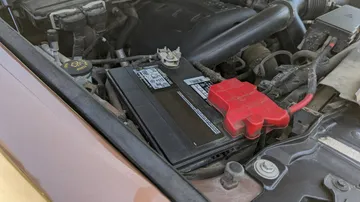
The Best Car Battery Chargers: 5 Picks Compared for Flat Batteries
Five car battery chargers compared on amps, charge time, engine start power and lithium support, from a 26 dollar value pick to a wheeled 250 A shop unit.


A car battery charger is the difference between a morning that starts with a dead click and one that starts normally. The number that decides everything is amps, because amps set how long you wait, and almost every listing shouts a big one at you without saying what it costs the battery. This guide compares five chargers sold on Amazon right now: the NOCO GENIUS10, a 10 amp smart charger that will wake a battery reading zero volts, the TowerTop TP108MB with 25 amps and a 100 amp engine start, the compact NOCO GENIUS5 for small batteries, a YDBAO 10 amp unit at around twenty six dollars, and the wheeled Schumacher SC1445 with a 250 amp engine start for a busy shop. We compared them on charge rate, voltage support, battery chemistry, engine start power, repair mode and how far down a battery can go before the charger refuses it.
Table of contents
- Quick picks
- Top charging current each unit can deliver
- Comparison table
- Best Overall: NOCO GENIUS10 10A 6/12V Smart Battery Charger
- Best for Fast Charging: TowerTop 2/10/25 Amp 12V Smart Battery Charger with Engine Start
- Best Compact Option: NOCO GENIUS5 5A 6/12V Smart Battery Charger
- Best Value: YDBAO 12V 10A Smart Car Battery Charger
- Best for Heavy Duty Use: Schumacher Electric SC1445 Wheeled Battery Charger and Engine Starter
- How we chose
- What to consider before buying
- Amps decide charge time, and bigger is usually worse
- What a smart charger does that a trickle charger does not
- Desulfation and repair mode, what it can and cannot do
- Charging AGM and lithium without wrecking the battery
- Final recommendation
- FAQ
Quick picks
Every pick wins a specific use case. Jump to the full review before you buy.
-
Best Overall
NOCO GENIUS10 10A 6/12V Smart Battery Charger
A 10 amp smart charger that refills a flat car battery overnight and will still wake up a battery that has fallen to zero volts.
-
Best for Fast Charging
TowerTop 2/10/25 Amp 12V Smart Battery Charger with Engine Start
A 25 amp charger with a 100 amp engine start mode, for the times you need the car moving today rather than tomorrow.
-
Best Compact Option
NOCO GENIUS5 5A 6/12V Smart Battery Charger
The same smart charging as the GENIUS10 at half the current, in a unit small enough to bolt to a garage wall or live in a saddlebag.
-
Best Value
YDBAO 12V 10A Smart Car Battery Charger
A 10 amp automatic charger with an LCD screen for around twenty six dollars, which is enough charger for most people who own one car.
-
Best for Heavy Duty Use
Schumacher Electric SC1445 Wheeled Battery Charger and Engine Starter
A wheeled shop charger with a 250 amp engine start and 50 amp boost, built for a garage that has to get several vehicles running.



Compare every pick
| Product | Award | Charging amps | Voltage support | Best for | Where to buy |
|---|---|---|---|---|---|
| NOCO GENIUS10 10A 6/12V Smart Battery Charger | Best Overall | 10 A | 6 V and 12 V | A driver with one or two vehicles who wants a single charger that refills a flat battery overnight and works on every battery in the garage. | Check price for NOCO GENIUS10 10A 6/12V Smart Battery Charger at Amazon (affiliate link) |
| TowerTop 2/10/25 Amp 12V Smart Battery Charger with Engine Start | Best for Fast Charging | 25 A maximum, selectable 2 A, 10 A, 25 A or Auto | 12 V only | Someone who works on trucks, RVs or boats with large batteries and wants the option to crank the engine straight off the charger. | Check price for TowerTop 2/10/25 Amp 12V Smart Battery Charger with Engine Start at Amazon (affiliate link) |
| NOCO GENIUS5 5A 6/12V Smart Battery Charger | Best Compact Option | 5 A | 6 V and 12 V | Anyone charging small batteries from motorcycles, mowers and powersports gear alongside the family car. | Check price for NOCO GENIUS5 5A 6/12V Smart Battery Charger at Amazon (affiliate link) |
| YDBAO 12V 10A Smart Car Battery Charger | Best Value | 10 A | 12 V only | A one-car household that needs a charger a few times a year and does not want to spend a hundred dollars for it. | Check price for YDBAO 12V 10A Smart Car Battery Charger at Amazon (affiliate link) |
| Schumacher Electric SC1445 Wheeled Battery Charger and Engine Starter | Best for Heavy Duty Use | 50 A boost, 25 A boost and 10 A standard charging | 6 V and 12 V | A busy home shop, a farm or a small fleet where more than one vehicle needs starting and charging in a day. | Check price for Schumacher Electric SC1445 Wheeled Battery Charger and Engine Starter at Amazon (affiliate link) |
Swipe sideways to compare every column.
Best Overall
NOCO GENIUS10 10A 6/12V Smart Battery Charger
by NOCO

A 10 amp smart charger that refills a flat car battery overnight and will still wake up a battery that has fallen to zero volts.
What we like
- 10 amps refills a normal car battery in a night instead of the two or three days a 1 amp unit needs
- Force Mode lets you start a charge on a battery that has dropped to zero volts, which most automatic chargers refuse to touch
- Handles 6 V and 12 V, and covers AGM, gel, flooded, deep-cycle and LiFePO4 lithium from the same box
- A thermal sensor trims the charge voltage in heat and raises it in cold, so a garage in January does not get a half charge
What we don't
- There is no engine start mode, so a dead battery still means waiting for the charge rather than driving away
- Force Mode bypasses the safety checks, and NOCO makes you hold the button because it can damage a battery that is genuinely failed
- The clamps are small, which is fine on a car post and awkward on big marine or truck terminals
| Charging amps | 10 A |
|---|---|
| Voltage support | 6 V and 12 V |
| Battery chemistries | Lead-acid (AGM, gel, SLA, VRLA, flooded, deep-cycle, marine) and LiFePO4 lithium |
| Engine start mode | None, this unit charges only |
| Dead battery recovery | Charges from as low as 1 volt, Force Mode charges down to zero volts |
| Price bracket | $$ |
The GENIUS10 is the pick because 10 amps is the right amount of current for a car battery. A typical group 35 battery holds somewhere around 50 to 60 amp hours. At 10 amps you are looking at a single night to go from flat to full. At 1 amp you are looking at most of a week. At 25 amps you save a few hours and put more heat into the plates. Ten sits in the useful middle.
It also handles the chemistry problem for you. The same unit charges 6 volt and 12 volt batteries, flooded and AGM and gel lead-acid, and LiFePO4 lithium. That matters because AGM and lithium want different voltage ceilings than an old flooded battery, and a dumb charger that ignores the difference will cook one of them. You pick the mode, the charger holds the right profile.
The recovery feature is the part people buy it for. A normal automatic charger looks at the battery, sees under a few volts, decides nothing is connected and does nothing. The GENIUS10 starts charging from as low as 1 volt on its own, and Force Mode makes it push current into a battery reading zero. That is how a battery left in a car all winter comes back.
What it does not do is start your engine. There is no boost or start mode here. If the battery is flat and you are late for work, this charger cannot help you in the next ten minutes. Keep a portable jump starter in the trunk for that and let the GENIUS10 do the slow, correct work afterward.
One more honest note. Force Mode exists because the charger cannot always tell a deeply discharged battery from a broken one, so it hands the decision to you. If the battery has a shorted cell, forcing current into it will not fix anything.
Research-based pick: this recommendation is based on product data, owner feedback and comparison with products we have tested, not on direct hands-on testing.
Buy it if: A driver with one or two vehicles who wants a single charger that refills a flat battery overnight and works on every battery in the garage.
Skip it if: You need to start the car in the next ten minutes, where the TowerTop or the Schumacher SC1445 have a proper engine start mode.
Best for Fast Charging
TowerTop 2/10/25 Amp 12V Smart Battery Charger with Engine Start
by TowerTop
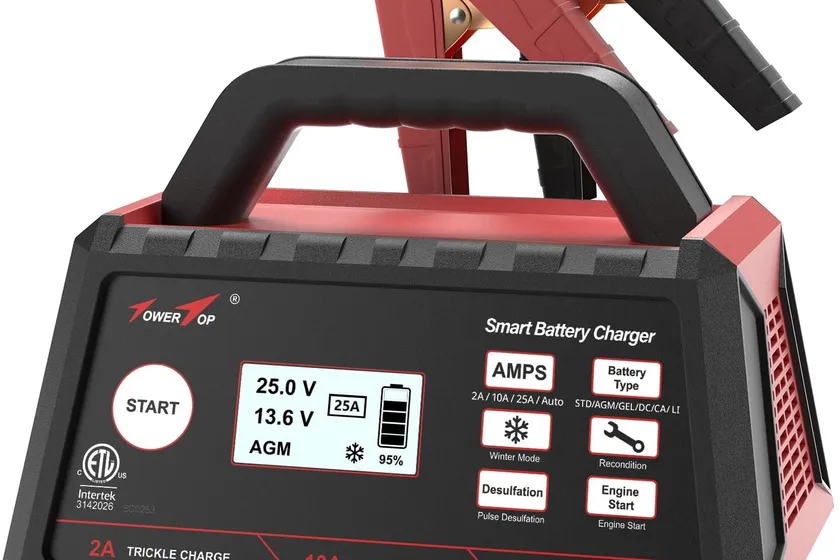
A 25 amp charger with a 100 amp engine start mode, for the times you need the car moving today rather than tomorrow.
What we like
- 25 amps is the fastest charge rate here short of a wheeled shop unit, and TowerTop rates a 100 Ah battery at under 3.5 hours
- Four current settings of 2 A, 10 A, 25 A and Auto let you slow it right down for a motorcycle battery
- Engine start pushes 100 amps for 100 seconds, so a flat battery can crank without a second vehicle
- The LCD shows the charging stage and live numbers instead of a single colored light you have to guess at
What we don't
- 12 volt only, so it is no use on a 6 volt classic car or tractor battery
- TowerTop states it cannot repair a completely drained battery, so the repair button is not a rescue for every dead cell
- Charging at 25 amps builds heat in the battery, and on an older battery you should drop to 10 amps instead
- No lithium support is listed, so LiFePO4 owners need the NOCO instead
| Charging amps | 25 A maximum, selectable 2 A, 10 A, 25 A or Auto |
|---|---|
| Voltage support | 12 V only |
| Engine start mode | Yes, 100 A engine start that runs for 100 seconds |
| Repair mode | Yes, separate desulfation and repair buttons you press yourself |
| Dead battery recovery | Repair mode can revive a weak battery, but the maker says it cannot repair a completely drained one |
| Price bracket | $$ |
Speed is the whole reason to buy this one. TowerTop rates the TP108MB at 25 amps and says it will bring a 100 amp hour battery to full in under three and a half hours. That is a genuinely different experience from an overnight charger when you have a boat battery or an RV house battery that has sat all season.
The engine start mode is the second reason. It delivers 100 amps for 100 seconds, which is enough to spin a car or light truck starter once the battery has taken a short surface charge. It is not a replacement for jumper cables or a lithium jump pack, because you need a wall outlet within reach of the car. In a home garage that is usually true.
The four current settings do real work. Small batteries do not want 25 amps. A motorcycle or lawn mower battery is often 12 amp hours, and charging that at 25 amps heats it fast. The 2 amp setting exists for exactly that, and the Auto setting picks a rate based on what the charger sees.
The limits are worth reading twice. This is a 12 volt unit only. There is no 6 volt mode and no lithium profile listed, so a LiFePO4 pack should go on the NOCO GENIUS10 instead. And TowerTop is unusually clear in its own listing that the repair mode will not fix a battery that is completely drained. That honesty is welcome, and it is also a warning. If your battery reads under a few volts and will not take a charge at all, you probably need a new battery, not more time on this one.
Research-based pick: this recommendation is based on product data, owner feedback and comparison with products we have tested, not on direct hands-on testing.
Buy it if: Someone who works on trucks, RVs or boats with large batteries and wants the option to crank the engine straight off the charger.
Skip it if: You have a 6 volt battery or a lithium pack, or you only ever top up one car and would rather charge gently overnight.
Best Compact Option
NOCO GENIUS5 5A 6/12V Smart Battery Charger
by NOCO
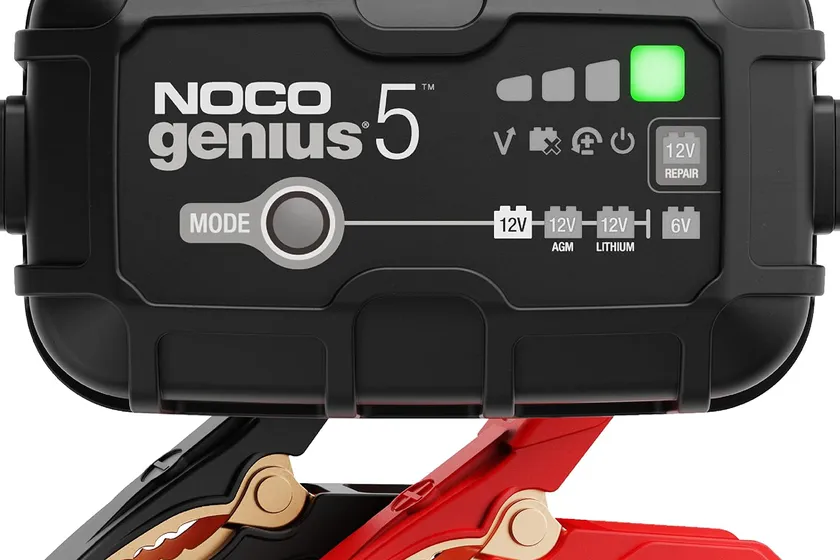
The same smart charging as the GENIUS10 at half the current, in a unit small enough to bolt to a garage wall or live in a saddlebag.
What we like
- 5 amps still refills a car battery overnight while staying gentle enough for motorcycle and lawn mower batteries
- Small enough to mount out of the way, and NOCO includes the bracket and screws in the box
- Covers 6 V and 12 V plus AGM, gel, flooded, deep-cycle and LiFePO4 lithium, same as the bigger GENIUS10
- Charges from 1 volt on its own and has the same Force Mode for batteries that read zero
What we don't
- 5 amps is slow on a big battery, so a discharged truck or RV battery can take a full day
- No engine start mode, and no boost setting to shorten the wait
- It costs most of what the 10 amp GENIUS10 costs, so the smaller size is the only reason to pick it
| Charging amps | 5 A |
|---|---|
| Voltage support | 6 V and 12 V |
| Battery chemistries | Lead-acid (AGM, gel, SLA, VRLA, flooded, deep-cycle, marine) and LiFePO4 lithium |
| Engine start mode | None, this unit charges only |
| Repair mode | Yes, precision pulse charging that reverses sulfation and acid stratification |
| Price bracket | $$ |
The GENIUS5 runs the same charging logic as our top pick and simply moves less current. That sounds like a downgrade and often is not. A motorcycle battery might be 12 amp hours. Pushing 10 amps into it is more than the battery wants. Five amps suits that battery and still fills a car battery while you sleep.
Size is the other argument. This is a small unit with a mounting bracket and screws included, so it can live screwed to a wall or a workbench leg instead of being dug out of a bin. NOCO says it is about a third smaller than the older G3500 it replaced. If your charger is easy to reach, you actually use it.
Everything smart about the GENIUS10 is here. Thermal compensation adjusts the charge for a cold garage or a hot one. It starts charging from as low as 1 volt, and Force Mode goes to zero volts for a battery that has been neglected. Pulse charging works on sulfation. The 3 year warranty is the same.
The trade-off is time on big batteries. A discharged 100 amp hour deep-cycle battery at 5 amps is a whole day, sometimes more. Pick this one because you want a compact charger for small batteries, not because you are trying to save money. The 10 amp model is not much more.
If your real need is keeping a stored car topped up for months rather than refilling a flat one, look at our guide to battery maintainers instead. This charger will hold a float charge, but a dedicated maintainer is the simpler tool for that job.
Research-based pick: this recommendation is based on product data, owner feedback and comparison with products we have tested, not on direct hands-on testing.
Buy it if: Anyone charging small batteries from motorcycles, mowers and powersports gear alongside the family car.
Skip it if: Your batteries are large truck, marine or RV batteries, where 5 amps turns an overnight job into a two-day one.
Best Value
YDBAO 12V 10A Smart Car Battery Charger
by YDBAO
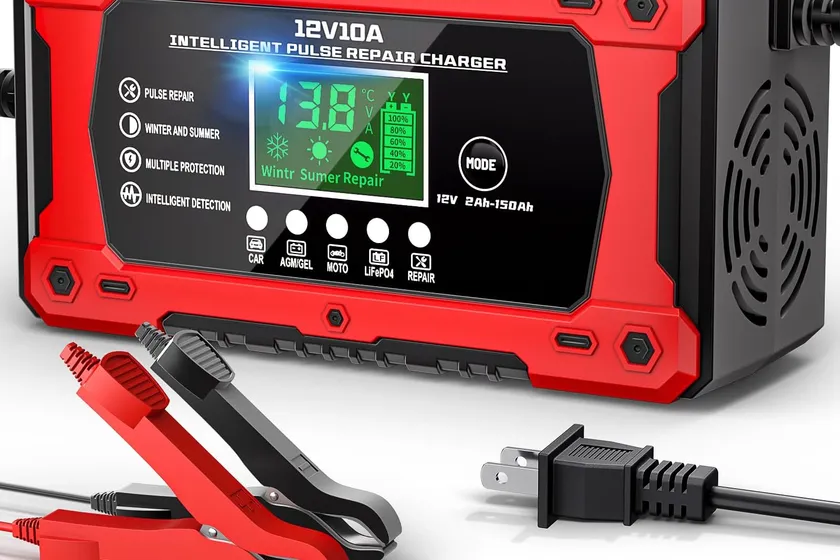
A 10 amp automatic charger with an LCD screen for around twenty six dollars, which is enough charger for most people who own one car.
What we like
- 10 amps at roughly a quarter of the price of the NOCO GENIUS10, and 10 amps is the rate most car batteries want
- Backlit LCD shows voltage, current, temperature and battery level, which cheap chargers usually leave out
- Five selectable modes cover CAR, AGM/gel/LiFePO4, WET, MOTO and pulse repair
- Summer and winter modes shift the charge voltage with ambient temperature, so a cold garage still gets a full charge
What we don't
- YDBAO tells you not to leave it running unattended for more than 12 hours, so it is not a set-and-forget storage charger
- 12 volt only, with no 6 volt mode for older vehicles
- No minimum starting voltage is published, so it may refuse a deeply discharged battery that the NOCO would take
- Short cords at about 102 cm on the AC side and 60 cm on the output side, so the outlet has to be close to the battery
| Charging amps | 10 A |
|---|---|
| Voltage support | 12 V only |
| Battery chemistries | 12 V lead-acid (AGM, gel, SLA, VRLA) and LiFePO4 lithium |
| Repair mode | Yes, a dedicated pulse repair mode for lead-acid batteries |
| Dead battery recovery | Pulse repair mode targets sulfation, no minimum starting voltage is published |
| Price bracket | $ |
Most people charge a car battery two or three times a year, usually after leaving a light on or after a car has sat for a month. For that job this YDBAO unit does everything the expensive chargers do. It puts 10 amps into a 12 volt battery, it stops on its own when the battery is full, and it shows you what is happening on a lit screen instead of a single blinking light.
The mode list is broader than the price suggests. There are five settings covering standard car batteries, AGM and gel and LiFePO4, wet batteries, motorcycle batteries and a pulse repair mode. There is also a temperature-driven summer and winter switch, which raises the charge voltage when it is cold so the battery actually reaches full instead of stopping short.
Two limits matter. YDBAO says in its own listing not to leave the charger running unattended for more than 12 hours. That is a meaningful restriction. It means this is a charger you plug in, watch and unplug, not one you connect in November and forget until March. If storage is your problem, buy a maintainer.
The second limit is the unknown. Unlike NOCO, YDBAO does not publish a minimum battery voltage the charger will accept. Automatic chargers usually need to see a few volts before they will start. If your battery is truly flat, this one may simply refuse to begin, and that is the situation where the GENIUS10 and its Force Mode earns its price. For a battery that is low rather than dead, the cheap charger is fine.
Research-based pick: this recommendation is based on product data, owner feedback and comparison with products we have tested, not on direct hands-on testing.
Buy it if: A one-car household that needs a charger a few times a year and does not want to spend a hundred dollars for it.
Skip it if: You want to leave a charger connected for weeks at a time, or you own a 6 volt battery.
Best for Heavy Duty Use
Schumacher Electric SC1445 Wheeled Battery Charger and Engine Starter
by Schumacher Electric
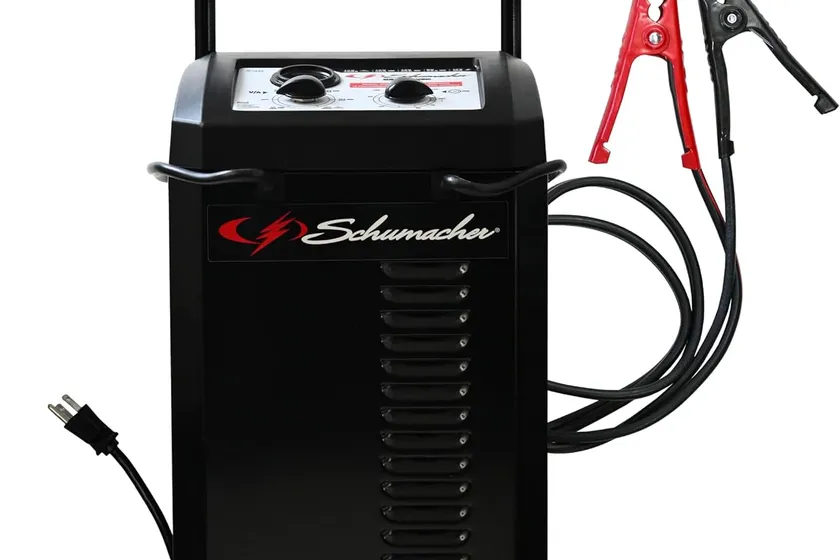
A wheeled shop charger with a 250 amp engine start and 50 amp boost, built for a garage that has to get several vehicles running.
What we like
- 250 amp engine start is the strongest here by a wide margin and will crank a truck or RV that a portable pack struggles with
- 50 amp and 25 amp boost charges pull a deeply discharged battery back up in a fraction of the time a 10 amp charger needs
- Wheels and a handle mean you push it to the vehicle instead of running extension cords across the shop
- Covers 6 V and 12 V plus standard, AGM, gel and deep-cycle batteries, so one unit serves cars, boats and power sports
What we don't
- Manual timer control, so it is on you to set the 135 minute timer and come back, not a set-and-forget smart charger
- It is the most expensive pick here by a long way, near 190 dollars against 26 for the YDBAO
- No lithium support is listed, so LiFePO4 batteries should go on the NOCO
- A wheeled unit takes up real floor space, which is a poor trade for someone with one car
| Charging amps | 50 A boost, 25 A boost and 10 A standard charging |
|---|---|
| Voltage support | 6 V and 12 V |
| Engine start mode | Yes, 250 A engine start |
| Dead battery recovery | 250 A engine start plus 25 A and 50 A boost charges for deeply discharged batteries |
| Repair mode | None listed by the maker |
| Price bracket | $$$ |
The SC1445 is a different class of tool from the rest of this list. It rolls on wheels, it plugs into a wall and it is built around getting a vehicle running now. The 250 amp engine start is the headline. That is enough current to spin a large truck or RV starter with a battery that has almost nothing left in it.
The boost charges are the other half. Where a 10 amp charger takes a night to bring a deeply discharged battery back, the 50 amp setting does the same work in a fraction of the time. Combined with the 25 amp setting and the standard 10 amp rate, you can match the current to how badly the battery is down and how much time you have.
The important difference from every other pick here is that this is a manual charger. It has a 135 minute timer you set yourself, not a microprocessor that decides when to stop. Schumacher frames that as control, and in a shop it is. It also means you cannot walk away and forget it. Leaving a high current charge running on a full battery is how you boil off electrolyte, so the timer is the safety net and you have to use it.
There is no repair or desulfation mode listed and no lithium profile. Those are not oversights so much as a different design goal. This is a starting and bulk charging machine.
Buy it if you keep several vehicles and hate waiting. If you own one car, this is far more machine than the job needs, and the GENIUS10 or even the YDBAO will serve you better for a fraction of the money. Anyone whose battery keeps needing this treatment should also read our guide to replacement car batteries, because a charger that gets used weekly is usually pointing at a battery that is finished.
Research-based pick: this recommendation is based on product data, owner feedback and comparison with products we have tested, not on direct hands-on testing.
Buy it if: A busy home shop, a farm or a small fleet where more than one vehicle needs starting and charging in a day.
Skip it if: You own one car, park in a driveway and just need a battery topped up now and then.
How we chose#
This is a research-based comparison, not a bench test. We started with the chargers that actually sell in the United States on Amazon, then read every claim against the maker’s own published data: charge current, voltage support, named battery chemistries, whether an engine start mode exists, and how low a battery can drop before the unit will still take it.
That last spec is the one buyers miss and then complain about. Most automatic chargers need to see a few volts before they will start. A battery left flat in a car for two months may read under one volt, and a charger that refuses to begin is useless to you. NOCO publishes a number for this and Force Mode goes to zero. Most brands publish nothing, so we said so rather than guessing.
We spread the list across the real jobs people buy a charger for: a do-everything 10 amp smart charger, a fast 25 amp unit with engine start, a compact 5 amp charger for small batteries, a cheap 10 amp charger, and a wheeled shop machine. Two of the five are NOCO because the GENIUS line covers two different needs.
What to consider before buying#
Start with amps, and start lower than you think. A 10 amp charger fills a normal car battery overnight, which is fast enough because the car is parked anyway. The reason to go higher is battery size, not impatience. A 100 amp hour RV or deep-cycle battery on a 10 amp charger is a ten hour job, and that is where the TowerTop’s 25 amp setting or the Schumacher’s 50 amp boost pays for itself.
Then check the voltage and the chemistry list. Most modern cars are 12 volt, so a 12 volt only charger like the YDBAO or the TowerTop is fine. If you have a classic car, an old tractor or some powersports gear, you need 6 volt too, which the NOCO units and the Schumacher SC1445 all cover. If you own anything with a LiFePO4 lithium battery, only buy a charger that names lithium in its modes.
Decide whether you need to start the engine. A charger with an engine start mode, like the TowerTop at 100 amps or the SC1445 at 250 amps, can crank the car after a short surface charge. A plain charger cannot help you for hours. If you want instant, keep a jump pack in the trunk instead.
Last, this guide is about refilling a flat or low battery. Holding a stored battery at full charge for six months is a different job that wants a smaller, simpler tool. If your car sits from November to April, read our guide to battery maintainers instead.
Amps decide charge time, and bigger is usually worse#
The math is simple. Take the battery’s amp hour rating, divide it by the charger’s amps, then add roughly 20 percent because the last stretch of a charge slows down on purpose. A 60 amp hour car battery on a 10 amp charger is about seven hours. On a 5 amp charger it is fourteen. On a 1 amp trickle charger it is nearly three days.
So why not always pick the biggest number? Because current makes heat, and heat is what kills lead-acid batteries. Pushing 25 or 50 amps into a battery raises its internal temperature, accelerates water loss in flooded batteries and warps plates over time. A rough rule that has held up for decades is to charge at no more than about a tenth of the battery’s amp hour rating for a healthy long charge. For a 60 amp hour car battery that is 6 amps. Ten is still gentle. Fifty is not.
High current has a proper use, and it is not daily. The 50 amp boost on the SC1445 exists so a shop can get a truck moving in twenty minutes. An occasional fast charge on a healthy battery is fine. A weekly one is a battery you are slowly destroying. Amps also do not fix a parasitic drain. If your battery goes flat every few days, something in the car is pulling current with the key out, and finding it is the only fix.
What a smart charger does that a trickle charger does not#
An old trickle charger is a transformer and a rectifier. It pushes a fixed current at the battery for as long as it is plugged in, and it has no idea whether the battery is empty, full or broken. Leave one connected for a week and it will keep pushing, boiling off water and cooking the plates.
A smart charger runs stages instead. It checks the voltage to decide whether a battery is even connected. It bulk charges at full current to roughly 80 percent. It switches to absorption, holding a steady voltage while the current tapers, which is the slow part that fills the last fifth. Then it stops and watches. That is why chargers advertise stage counts. TowerTop lists eight, including desulfurization, soft start, bulk, absorption, analysis, repair, float and pulse maintenance. NOCO does not publish a count but does the same work, plus a thermal sensor that raises the charge voltage in cold weather and lowers it in heat. A battery charged at summer voltage in a freezing garage never reaches full.
The Schumacher SC1445 is the deliberate exception here. It is a manual charger with a 135 minute timer, which is a shop tool, not a home appliance. It will happily overcharge a battery if you walk away and forget the timer.
Desulfation and repair mode, what it can and cannot do#
When a lead-acid battery sits discharged, lead sulfate forms on the plates. Fresh sulfate is soft and a charge dissolves it. Sulfate that has sat for months hardens into crystals that no longer take part in the reaction, and capacity drops. A desulfation or repair mode sends high frequency voltage pulses through the battery to break those crystals down.
It works within limits. A battery that sat flat over one winter has a fair chance of coming back partway. One that has been dead for two years usually does not. Here is the part almost no listing will tell you: a charger cannot save a battery with a shorted cell, and repair modes are oversold. Test the battery first.
Testing is quick. Charge it fully, let it rest a few hours, then measure the voltage. About 12.6 volts is full and 12.0 volts is half. A battery that will not go above roughly 10.5 volts after a full charge almost certainly has a dead cell, and a dead cell means a new battery. Better still, take it to a parts store for a free load test.
Claims about recovering 95 percent of dead batteries should be read as marketing. TowerTop deserves credit for stating plainly in its own listing that its repair mode cannot fix a completely drained battery.
Charging AGM and lithium without wrecking the battery#
Not all 12 volt batteries want the same charge. A flooded lead-acid battery is happy being charged to around 14.4 to 14.8 volts and tolerates a little gassing. An AGM battery is sealed, so it does not tolerate gassing, and charging it at flooded voltages dries it out permanently. Most AGM makers want a lower ceiling. That is why the NOCO, TowerTop and YDBAO units all give AGM its own setting, and why leaving an AGM battery on the default flooded setting quietly shortens its life.
Lithium is a bigger deal. A LiFePO4 battery has a different voltage curve and a management system inside it, so a lead-acid profile can push it outside the range that system expects. A desulfation pulse aimed at lead plates has no business going into a lithium pack either. The NOCO GENIUS10 and GENIUS5 both list LiFePO4 support, and the YDBAO has a combined AGM, gel and LiFePO4 mode. The TowerTop and the SC1445 do not list lithium at all.
Cold weather changes the rules again. Lead-acid batteries need slightly higher charge voltage when cold, which is what the NOCO thermal sensor and the winter modes on the TowerTop and YDBAO are doing. Lithium is the opposite. Most LiFePO4 packs must not be charged below freezing at all, and that protection sits in the battery, not the charger. If a lithium battery lives outdoors in winter, bring it inside before charging.
Final recommendation#
Most people should buy the NOCO GENIUS10. Ten amps is the right rate for a car battery, it covers 6 volt and 12 volt, it handles AGM and lithium, and Force Mode wakes a battery other chargers will not touch. If you need a charger a few times a year and your batteries are 12 volt, the YDBAO does the same core job for around a quarter of the price, as long as you respect its 12 hour unattended limit. Buy the TowerTop TP108MB for large batteries you want full in an afternoon, or if the 100 amp engine start would save you a tow. Buy the compact NOCO GENIUS5 if most of your charging is motorcycles, mowers and powersports batteries. The wheeled Schumacher SC1445 is for a shop or a farm, where a 250 amp engine start and a 50 amp boost earn their floor space. And if the battery keeps going flat, the charger is treating a symptom. Get it load tested, then read our guide to replacement car batteries.
Frequently asked questions
How long does it take to charge a car battery?
Divide the battery's amp hour rating by the charger's amps and add about 20 percent for the slow final stage. A typical car battery holds 50 to 60 amp hours. On the 10 amp NOCO GENIUS10 that is roughly six to eight hours from flat, so one night. On the 5 amp GENIUS5 it is most of a day. On the 25 amp setting of the TowerTop it is closer to three hours. A battery that is only half down takes half as long.
What amp charger do I need for a car battery?
Ten amps suits almost every car and light truck. It fills a flat battery overnight without putting much heat into the plates, which is why the GENIUS10 and the YDBAO both sit at that rate. Go to 25 amps like the TowerTop only if you charge big deep-cycle, RV or marine batteries and need the time back. Drop to 5 amps or 2 amps for motorcycle, mower and powersports batteries, because a small battery does not want a big current.
Can a battery charger fix a dead battery?
Sometimes, and less often than the listings suggest. A charger can recover a battery that is simply discharged, and a desulfation or pulse repair mode can break down soft sulfate crystals on a battery that sat flat for a few months. No charger can fix a shorted cell, a broken internal connection or plates that have shed their material. TowerTop says outright that its repair mode cannot fix a completely drained battery. Load test the battery before you spend a week on it.
Is it safe to leave a battery charger connected overnight?
It depends on the charger. Smart chargers like the NOCO GENIUS10 and GENIUS5 watch the battery and drop to a float charge when it is full, so they are designed to stay connected. The YDBAO listing tells you not to run it unattended for more than 12 hours, and the Schumacher SC1445 is a manual unit with a 135 minute timer you set yourself. Read which type you own before you plug it in and go to bed.
Do I need a special charger for an AGM or lithium battery?
Yes, or at least a charger with the right mode. AGM batteries want a slightly different voltage ceiling than an old flooded battery, and LiFePO4 lithium wants a different profile again. Charging lithium on a lead-acid setting, especially one with a desulfation pulse, can damage it. The NOCO GENIUS10 and GENIUS5 both carry an explicit lithium mode. The TowerTop and the Schumacher SC1445 do not list one, so keep lithium off them.
Should I disconnect the battery from the car before charging?
For a normal charge on a modern car you usually do not need to. Every pick here has reverse polarity protection and the smart chargers regulate their output. Disconnecting also wipes radio presets and stored settings on many vehicles. The exception is high current work. If you are using the 50 amp boost on the Schumacher SC1445 or its engine start, follow the manual, connect the negative clamp to a ground point away from the battery, and keep the area ventilated.
About the author

Dale Harper Lead Gear Editor
Dale is a longtime truck owner and former accessory-shop tech who builds these guides from manufacturer fit data, aggregated owner feedback and direct spec comparison. Research-based picks are always labelled as such.
Daily driver: 2022 Ford F-150 XLT SuperCrew
- Tonneau covers and bed accessories
- Seat covers and interior protection
- Lift kits and suspension