The Best Battery Maintainers: 5 Picks Compared for Stored Vehicles
Five real battery maintainers compared for cars, bikes and boats in storage, from a 20 dollar MOTOPOWER to a four-charger set, with honest float limits.


A battery maintainer has one job. It keeps a parked vehicle's battery topped up so that the car, bike or boat still starts after months of sitting. That is a different job from recharging a flat battery, and buying the wrong tool is the most common mistake here. This guide compares five maintainers you can actually buy on Amazon right now: the NOCO GENIUS1, which handles 6V, 12V and lithium; the Battery Tender Junior, the 750mA unit most motorcycle owners settle on; the MOTOPOWER MP00205A, a twenty dollar float charger that does the important part properly; the NOCO GENIUS2D, built to bolt onto a boat or RV and stay there; and a NEXPEAK four-pack for a garage with several batteries. We compare them on maintaining amps, voltage support, battery chemistry, connection type and warranty, and we are clear about what each one cannot do.
Table of contents
- Quick picks
- Maintaining current each unit delivers
- Comparison table
- Best Overall: NOCO GENIUS1 1A 6/12V Smart Battery Charger, Trickle Charger and Maintainer
- Best for Motorcycles and Powersports: Battery Tender Junior 12V 750mA Charger and Maintainer
- Best Value: MOTOPOWER MP00205A 12V 800mA Automatic Battery Charger, Maintainer and Desulfator
- Best Permanent Install: NOCO GENIUS2D 2A 12V Onboard Battery Charger, Trickle Charger and Maintainer
- Best for Multiple Vehicles: NEXPEAK 4-Pack 1.75A 6V and 12V Smart Battery Trickle Charger
- How we chose
- What to consider before buying
- Maintainer, charger and trickle charger are three different things
- Why a stored battery dies in about three months
- Float voltage, desulfation and the honest math on solar
- Final recommendation
- FAQ
Quick picks
Every pick wins a specific use case. Jump to the full review before you buy.
-
Best Overall
NOCO GENIUS1 1A 6/12V Smart Battery Charger, Trickle Charger and Maintainer
A small wall plug-in maintainer that handles 6V and 12V batteries plus lithium LiFePO4, so one unit can cover almost everything you park for the winter.
-
Best for Motorcycles and Powersports
Battery Tender Junior 12V 750mA Charger and Maintainer
The small 750mA maintainer that most motorcycle, ATV and mower owners end up buying, with a long cord and a five year warranty.
-
Best Value
MOTOPOWER MP00205A 12V 800mA Automatic Battery Charger, Maintainer and Desulfator
A twenty dollar 800mA maintainer that holds a stored 12V battery at 13.6 volts and does almost everything the expensive units do.
-
Best Permanent Install
NOCO GENIUS2D 2A 12V Onboard Battery Charger, Trickle Charger and Maintainer
A 2 amp maintainer designed to bolt near the battery and stay there, for a boat, RV or classic that gets plugged in rather than hooked up.
-
Best for Multiple Vehicles
NEXPEAK 4-Pack 1.75A 6V and 12V Smart Battery Trickle Charger
Four separate 1.75 amp smart chargers in one box, for a garage or barn where several batteries all need holding at once.



- NOCO GENIUS1 1A 6/12V Smart Battery Charger, Trickle Charger and Maintainer
- Battery Tender Junior 12V 750mA Charger and Maintainer
- MOTOPOWER MP00205A 12V 800mA Automatic Battery Charger, Maintainer and Desulfator
- NOCO GENIUS2D 2A 12V Onboard Battery Charger, Trickle Charger and Maintainer
- NEXPEAK 4-Pack 1.75A 6V and 12V Smart Battery Trickle Charger
Compare every pick
| Product | Award | Maintaining amps | Voltage support | Battery chemistries | Best for | Where to buy |
|---|---|---|---|---|---|---|
| NOCO GENIUS1 1A 6/12V Smart Battery Charger, Trickle Charger and Maintainer | Best Overall | 1 A | 6V and 12V | Lead-acid AGM, gel, SLA, VRLA, flooded, plus lithium LiFePO4 | Someone storing one vehicle over winter who wants a single unit that will still work if they switch to a lithium battery later. | Check price for NOCO GENIUS1 1A 6/12V Smart Battery Charger, Trickle Charger and Maintainer at Amazon (affiliate link) |
| Battery Tender Junior 12V 750mA Charger and Maintainer | Best for Motorcycles and Powersports | 0.75 A | 12V only | 12V lead-acid, flooded, AGM and gel cell | Motorcycle, ATV and lawn mower owners who park the machine for months and want a simple unit they can leave connected. | Check price for Battery Tender Junior 12V 750mA Charger and Maintainer at Amazon (affiliate link) |
| MOTOPOWER MP00205A 12V 800mA Automatic Battery Charger, Maintainer and Desulfator | Best Value | 0.8 A | 12V only | 12V lead-acid, flooded, sealed maintenance free, AGM and gel cell | Anyone who wants to stop a stored car, bike or mower battery from dying and does not want to spend much doing it. | Check price for MOTOPOWER MP00205A 12V 800mA Automatic Battery Charger, Maintainer and Desulfator at Amazon (affiliate link) |
| NOCO GENIUS2D 2A 12V Onboard Battery Charger, Trickle Charger and Maintainer | Best Permanent Install | 2 A | 12V only | 12V lead-acid AGM, gel, SLA, VRLA, flooded and deep-cycle | Boat, RV and classic car owners who want the charger wired in once and left on the vehicle for good. | Check price for NOCO GENIUS2D 2A 12V Onboard Battery Charger, Trickle Charger and Maintainer at Amazon (affiliate link) |
| NEXPEAK 4-Pack 1.75A 6V and 12V Smart Battery Trickle Charger | Best for Multiple Vehicles | 1.75 A per charger | 6V and 12V | Lead-acid flooded, gel, AGM, SLA and VRLA, no lithium | A garage, barn or storage unit with several stored vehicles, where one charger passed around is not enough. | Check price for NEXPEAK 4-Pack 1.75A 6V and 12V Smart Battery Trickle Charger at Amazon (affiliate link) |
Swipe sideways to compare every column.
Best Overall
NOCO GENIUS1 1A 6/12V Smart Battery Charger, Trickle Charger and Maintainer
by NOCO
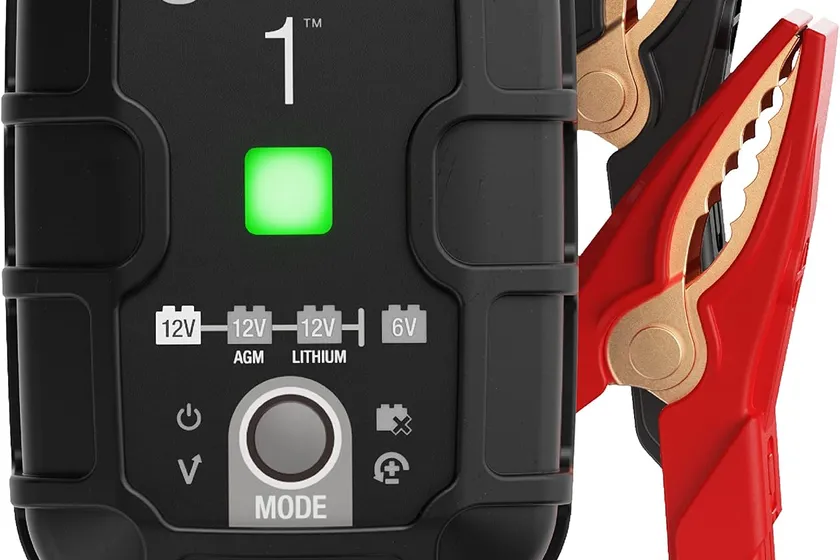
A small wall plug-in maintainer that handles 6V and 12V batteries plus lithium LiFePO4, so one unit can cover almost everything you park for the winter.
What we like
- Works on 6V and 12V, and on lithium LiFePO4 as well as every common lead-acid type, so it does not become useless when you change batteries
- A built-in thermal sensor adjusts the charge for ambient temperature, which matters in an unheated garage that swings from freezing to warm
- Ships with both clamps and eyelet terminals, so you can leave a permanent pigtail on the battery and plug in without opening the hood
- Very strong seller with a sales rank around 29 in its category, which means a long and public track record
What we don't
- At 1 A it is a maintainer first, so bringing a fully flat car battery back up takes many hours or a day
- Plugs straight into the wall with no AC cord, so the outlet has to be close to where the vehicle sits
- Only holds one battery, so a garage with a car, a bike and a mower needs three of them
| Maintaining amps | 1 A |
|---|---|
| Voltage support | 6V and 12V |
| Battery chemistries | Lead-acid AGM, gel, SLA, VRLA, flooded, plus lithium LiFePO4 |
| Connection type | Battery clamps and eyelet terminals on a 110-inch DC cable |
| Warranty | 3 years |
| Price bracket | $ |
The GENIUS1 takes Best Overall because it covers the widest range of batteries in the smallest package here. NOCO lists it for 6-volt and 12-volt lead-acid batteries in every common form, flooded, AGM, gel, SLA and VRLA, and also for lithium LiFePO4. That last part matters more each year, because motorcycle and powersport batteries are quietly switching to lithium, and a maintainer that only understands lead-acid will either refuse the job or do it badly.
Its rated output is 1 amp. That is the right size for holding a charge, not building one. NOCO says it can start charging batteries as low as 1 volt, and there is a Force Mode for packs that have fallen to zero, but at 1 amp you should expect a long wait. Think of it as a device you connect in November and unplug in March.
The temperature sensor is the quiet feature worth paying for. A charger that pushes the same voltage at 20 degrees and 90 degrees will either undercharge in the cold or cook the battery in the heat. This one adjusts as the garage temperature moves, which is exactly the condition a stored vehicle lives in.
The box includes clamps and eyelet terminals. Bolt the eyelets to the battery once, run the pigtail somewhere you can reach, and connecting for the season takes ten seconds. NOCO backs it for three years.
The honest limits are size and reach. One battery, one unit. And because the charger plugs directly into the wall with no AC extension cord, the outlet needs to be within reach of the 110-inch DC lead.
Research-based pick: this recommendation is based on product data, owner feedback and comparison with products we have tested, not on direct hands-on testing.
Buy it if: Someone storing one vehicle over winter who wants a single unit that will still work if they switch to a lithium battery later.
Skip it if: You need to revive a dead battery quickly rather than hold a healthy one at full charge.
Best for Motorcycles and Powersports
Battery Tender Junior 12V 750mA Charger and Maintainer
by Battery Tender
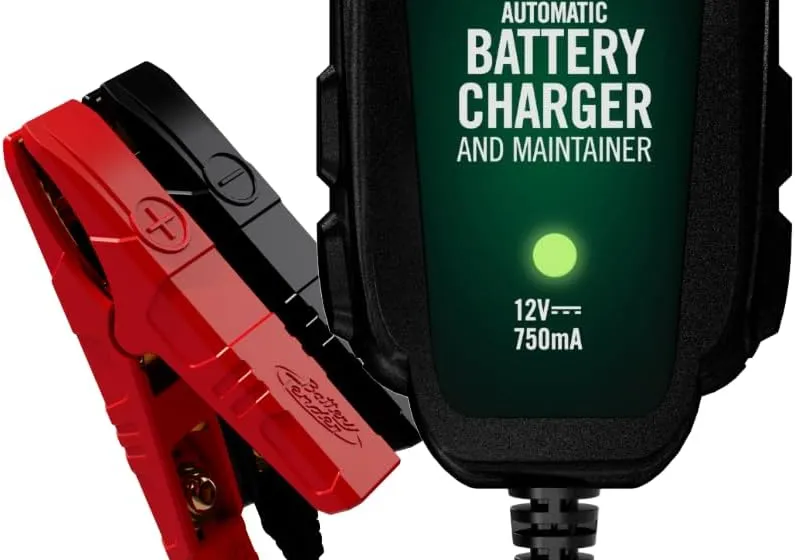
The small 750mA maintainer that most motorcycle, ATV and mower owners end up buying, with a long cord and a five year warranty.
What we like
- A 4-step program ends in true float mode, so it holds voltage rather than trickling current at a battery forever
- The 12-foot output cord reaches from a wall outlet to a bike parked across the garage without an extension lead
- Spark-proof circuitry and reverse hook-up detection make a wrong connection much less eventful
- Five year warranty on a charger that costs under forty dollars, plus a fused ring terminal harness in the box
What we don't
- 12V only, so it cannot help with a 6V classic tractor or garden tractor battery
- No lithium support, which rules out newer LiFePO4 powersport batteries
- At 750mA it is the slowest unit here, so it is a poor choice if you also want to recharge a drained battery
| Maintaining amps | 0.75 A |
|---|---|
| Voltage support | 12V only |
| Battery chemistries | 12V lead-acid, flooded, AGM and gel cell |
| Connection type | Alligator clips and fused ring terminals on a 12-foot cord |
| Warranty | 5 years |
| Price bracket | $ |
The Battery Tender Junior is the unit people picture when they say battery tender, and it earned that by doing one narrow job well for a long time. It puts out 750 milliamps at 12 volts, runs a four stage program of initialization, bulk charge, absorption and float, then sits in float and holds the battery there. That final stage is the whole point. A true float charger stops pushing current once the battery is full and only tops it up when voltage sags.
The physical details are better than the price suggests. The output cord is 12 feet, which is long enough to reach a bike parked at the back of a garage. It comes with both a fused ring terminal harness and alligator clips, so you can leave the harness bolted to the battery all season. The charger itself is about 3.3 by 1.3 by 2.4 inches and weighs a pound, so it hangs off a hook without a bracket.
Battery Tender covers it for five years, which is the longest coverage in this guide apart from the Plus model in the same family. That says something about expected failure rates on a device meant to run unattended for months.
Its limits are real. It is 12 volts only, so a 6-volt classic is out. It handles flooded, AGM and gel cell lead-acid, but not lithium, which is a growing problem as powersport batteries switch chemistry. And at 750 milliamps, waking up a properly flat battery takes a very long time. Buy it to hold a charge, not to rescue one.
Research-based pick: this recommendation is based on product data, owner feedback and comparison with products we have tested, not on direct hands-on testing.
Buy it if: Motorcycle, ATV and lawn mower owners who park the machine for months and want a simple unit they can leave connected.
Skip it if: Your bike or side by side runs a lithium LiFePO4 battery, or you also need a 6V option.
Best Value
MOTOPOWER MP00205A 12V 800mA Automatic Battery Charger, Maintainer and Desulfator
by MOTOPOWER
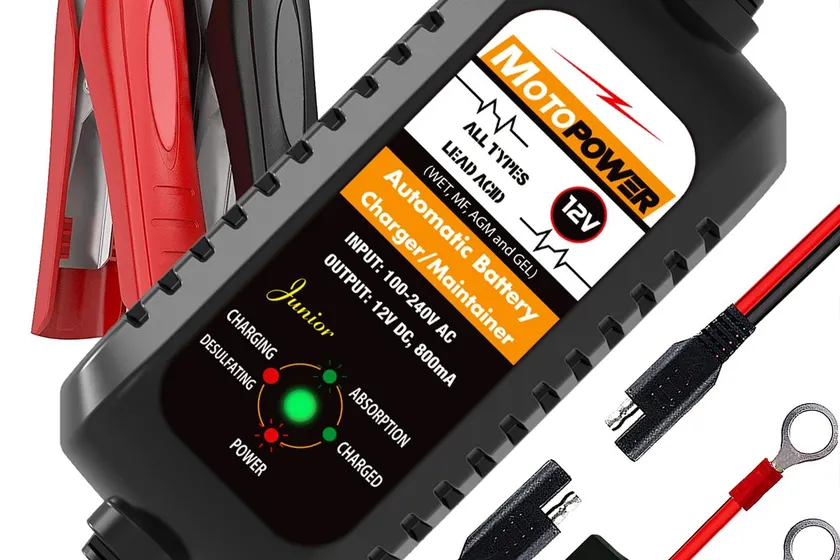
A twenty dollar 800mA maintainer that holds a stored 12V battery at 13.6 volts and does almost everything the expensive units do.
What we like
- Holds the battery at 13.6 volts once charged, which is a proper float voltage rather than an endless trickle
- Automatic pulse desulfation runs on its own with no button to press or mode to select
- Draws zero output in standby and does not drain the battery when it is connected but unpowered
- SAE quick release fitting means you can bolt a fused ring harness to the battery and clip in without tools
What we don't
- 12V only, and the maker states it cannot recover badly sulfated, leaking or cell-damaged batteries
- No warranty term is given in the listing, so the fallback if it dies is unclear
- The single LED tells you very little compared to the LCD screen on the NEXPEAK chargers
| Maintaining amps | 0.8 A |
|---|---|
| Voltage support | 12V only |
| Battery chemistries | 12V lead-acid, flooded, sealed maintenance free, AGM and gel cell |
| Desulfation mode | Yes, automatic pulse desulfation |
| Connection type | SAE quick release, ring terminals or alligator clips |
| Price bracket | $ |
Cheap chargers usually cut the part that matters. This one does not. The MP00205A charges a 12-volt battery up to 14.4 volts, then drops to a maintaining voltage of 13.6 volts and holds it there. That is float charging, done properly, and it is the single feature that separates a maintainer from a dumb trickle charger that will slowly boil a battery dry.
It also runs pulse desulfation automatically while it charges. Sulfation is what kills a battery that sat flat for a season, and the pulse stage is meant to break down the sulfate crystals before they harden. MOTOPOWER is honest about the limit here. The listing says outright that batteries with severe sulfation, water leakage or dead cells cannot be saved and should just be replaced. That is a more useful claim than a promise to revive anything.
Safety is covered. There is overcharge, short circuit and reverse polarity protection, plus spark-free connection and a 24 hour timer that forces the unit into maintaining mode once voltage climbs past 14 volts. Standby draw is zero, so leaving it clipped on unpowered does not pull the battery down.
What you give up is information and reassurance. There is one LED, so you get charging status and not much else. There is no warranty term in the listing. It is 12 volts only, with no 6-volt or lithium support. For a device you plug in once a season and forget, most people will accept all three. If you want a display and a stated warranty, spend more.
Research-based pick: this recommendation is based on product data, owner feedback and comparison with products we have tested, not on direct hands-on testing.
Buy it if: Anyone who wants to stop a stored car, bike or mower battery from dying and does not want to spend much doing it.
Skip it if: You want a stated warranty, a readable display, or support for 6V or lithium batteries.
Best Permanent Install
NOCO GENIUS2D 2A 12V Onboard Battery Charger, Trickle Charger and Maintainer
by NOCO
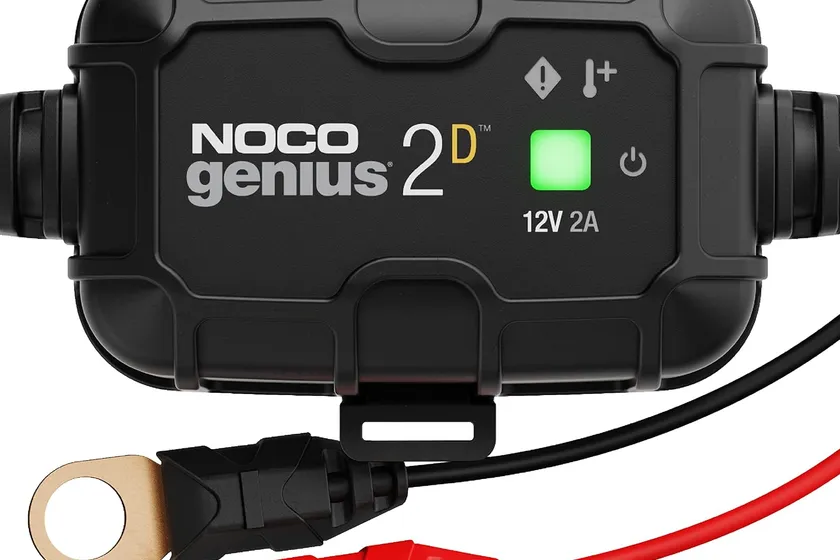
A 2 amp maintainer designed to bolt near the battery and stay there, for a boat, RV or classic that gets plugged in rather than hooked up.
What we like
- Snap-fit bracket and self-tapping screws let you mount it under the hood or in an engine bay so it never gets lost
- Eyelet terminals are wired on permanently, so seasonal maintenance means plugging in an extension cord and nothing else
- At 2 amps it is the strongest single-battery unit here, so it recovers a partly drained battery faster than the small trickle units
- Thermal sensor adjusts charging for ambient temperature, useful in a boat or RV that sits outside all winter
What we don't
- Cables are short, 24 inches of AC and 24 inches of DC, so it depends on you running an extension cord to it
- 12V lead-acid only, with no 6V mode and no lithium support
- Mounting it takes a drill and a decision about where it lives, so it is a worse fit for someone who wants to move one charger between vehicles
| Maintaining amps | 2 A |
|---|---|
| Voltage support | 12V only |
| Battery chemistries | 12V lead-acid AGM, gel, SLA, VRLA, flooded and deep-cycle |
| Connection type | Eyelet terminals on a 24-inch DC cable, bolted mounting bracket |
| Warranty | 3 years |
| Price bracket | $ |
The GENIUS2D solves a problem the portable units create. If a charger lives on a shelf, someone has to remember to fetch it, open the hood and clip it on. On a boat under a cover or an RV parked at the back of a lot, that is exactly the step that gets skipped. This one mounts to the vehicle with a snap-fit bracket and truss-head self-tapping screws, and its eyelet terminals stay bolted to the battery. Maintenance becomes plugging in an extension cord.
It puts out 2 amps, the highest single-battery figure in this guide. That gives it more headroom than the 750mA and 800mA units, so a battery that has drifted down over a few months comes back in hours rather than a day. NOCO rates it for 12-volt lead-acid batteries in AGM, gel, SLA, VRLA, flooded, maintenance free and deep-cycle form, and specifically mentions marine and RV batteries. It can begin charging from as low as 1 volt, with a Force Mode for batteries that read zero.
The thermal sensor does the same job it does in the GENIUS1, trimming the charge in heat and raising it in cold. On a vehicle stored outdoors through a real winter, that is worth more than it sounds.
Two things narrow its appeal. The cables are short at 24 inches each way, which is fine for a permanent install and awkward for anything else. And it drops the 6-volt and lithium support the GENIUS1 has, so it is strictly a 12-volt lead-acid tool. If you want one charger for several different vehicles, buy the GENIUS1 instead.
Research-based pick: this recommendation is based on product data, owner feedback and comparison with products we have tested, not on direct hands-on testing.
Buy it if: Boat, RV and classic car owners who want the charger wired in once and left on the vehicle for good.
Skip it if: You want one charger you can carry between a car, a bike and a mower.
Best for Multiple Vehicles
NEXPEAK 4-Pack 1.75A 6V and 12V Smart Battery Trickle Charger
by NEXPEAK
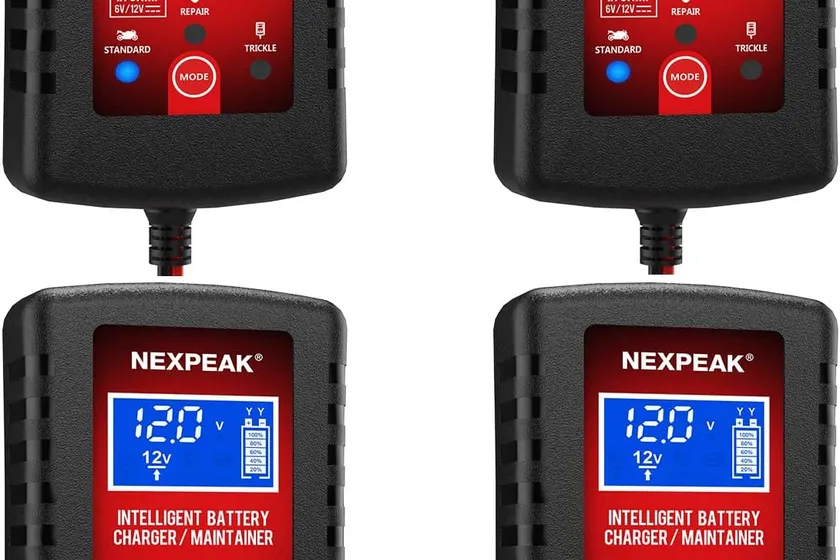
Four separate 1.75 amp smart chargers in one box, for a garage or barn where several batteries all need holding at once.
What we like
- Four independent chargers means four batteries stay maintained at the same time without swapping one unit around
- An LCD screen shows charge percentage, voltage and current, so you can see what is happening instead of reading one LED
- Handles both 6V and 12V, which covers older tractors and classics alongside modern vehicles
- Locks its mode through a power cut and restarts into the same mode, which matters for a shed that loses power in a storm
What we don't
- Explicitly not for lithium batteries, so a LiFePO4 powersport battery is out
- Cannot charge a battery that has fallen below 0.3 volts, so a deeply dead battery still needs a bigger charger
- Buying four at once costs more up front than a single maintainer, and there is no point unless you really have several batteries
- The 6V and 12V detection is automatic and can read a very low 12V battery as a 6V one, so it needs a manual mode override
| Maintaining amps | 1.75 A per charger |
|---|---|
| Voltage support | 6V and 12V |
| Number of banks | 4 batteries, one per charger |
| Battery chemistries | Lead-acid flooded, gel, AGM, SLA and VRLA, no lithium |
| Warranty | 2 years |
| Price bracket | $$ |
This is not a multi-bank charger in the marine sense. It is four separate 1.75 amp chargers sold together, and for most people that is better. Each one is independent, so a classic, a boat, a mower and a spare battery can all be on float at the same time without anyone rotating a single unit through the garage every few weeks.
Each charger runs a 7-stage program that includes desulfurization, trickle charging, constant current, constant voltage, current detection, compensation charging and float. In trickle mode it maintains the battery around 12.5 volts. There is an LCD screen that shows percentage, voltage and current, which is the most useful display in this guide. The single-LED units tell you the charger is doing something. This one tells you what.
Two practical touches matter for long storage. Standby protection is comprehensive, covering short circuit, overload, low and high voltage, overcharge, over-temperature, reverse connection and over-current. And after a power outage the charger restarts into the mode it was in, so a winter storm does not leave four batteries sitting idle until spring.
The exclusions are firm. NEXPEAK states this is not a lithium charger and not an e-bike or e-mobility charger. It also cannot detect or charge a battery below 0.3 volts, so a battery that has gone truly flat needs a recovery charger first. Automatic 6V and 12V detection can misread a very low 12-volt battery as a 6-volt one, which is why there is a manual override you hold for five seconds. Know that before you plug in.
Research-based pick: this recommendation is based on product data, owner feedback and comparison with products we have tested, not on direct hands-on testing.
Buy it if: A garage, barn or storage unit with several stored vehicles, where one charger passed around is not enough.
Skip it if: You only have one vehicle to maintain, or any of your batteries are lithium.
How we chose#
This is a research-based guide. We did not park five cars for a winter and come back in March. What we did do is pull the live Amazon listings for the maintainers that actually sell, then compare what each maker claims, spec by spec, and check those claims against what owners report over years of use.
We picked for spread rather than ranking five near-identical boxes. That means a small do-everything unit, the powersport standard, a budget float charger, a permanently mounted unit for boats and RVs, and a multi-charger set for a garage full of batteries. We ruled out anything with vague voltage claims, no float stage, or a listing that promised to revive any battery.
One thing we deliberately ignored is the word trickle in the product names. Nearly every unit here is marketed as a trickle charger and none of them behave like one. What we checked instead is whether the charger holds a real float voltage and stops pushing current when the battery is full. All five do.
What to consider before buying#
Start with the battery chemistry, because this is where people get stuck. Most vehicle batteries are lead-acid in some form, flooded, AGM, gel or SLA, and every pick here handles those. Lithium LiFePO4 is different, and only the NOCO GENIUS1 supports it. Check your battery before you buy, not after.
Next, decide whether you need 6 volts. Older tractors, garden equipment and some classics run 6-volt systems. The GENIUS1 and the NEXPEAK chargers cover both 6V and 12V. The Battery Tender Junior, the MOTOPOWER and the GENIUS2D are 12 volts only.
Then think about where the vehicle sits. A car in a garage next to an outlet can use anything. A boat under a cover at the back of a lot is better served by the GENIUS2D, which bolts to the vehicle so the connection is already made. The Battery Tender Junior takes the opposite approach with a 12-foot cord that reaches across a garage.
Last, count your batteries. One maintainer holds one battery. If you have a classic, a mower and a boat all sleeping through winter, you either buy three units or buy the NEXPEAK four-pack. If you also need to bring a flat battery back to life, that is a different tool, covered in our guide to car battery chargers.
Maintainer, charger and trickle charger are three different things#
These three words get printed on the same box, and they mean different jobs.
A battery charger is built to put energy back into a battery that has lost it. It works at higher amps, 4 to 10 or more, and it is meant to be connected, used, and disconnected. A trickle charger is the old design. It pushes a small fixed current for as long as it is plugged in and has no idea when to stop. Leave one on a full battery for a month and it will keep pushing, which raises voltage past the safe point and boils water out of the electrolyte.
A maintainer is the smart version. It charges to full, then drops to a low holding voltage and watches. When voltage sags, it adds a little. When it does not, it does nothing. That is why NOCO can say the GENIUS1 is safe to leave connected indefinitely, and why Battery Tender puts “smarter than a trickle charger” right in the product name.
The catch is that marketing has blurred all three words. Every product in this guide is sold with trickle charger in the title. What actually tells you the truth is the spec sheet. If the listing names a float or maintaining voltage, like the 13.6 volts on the MOTOPOWER, it is a real maintainer. If it just says small constant current, be careful.
Why a stored battery dies in about three months#
A lead-acid battery loses charge on its own, even disconnected. Self-discharge alone runs roughly 3 to 5 percent a month at room temperature, and faster when it is warm. That by itself would not kill a battery over one winter.
What kills it is parasitic draw. A modern vehicle never fully switches off. The alarm, the body control module, the keyless entry receiver, the telematics unit and the stereo memory all sip current with the key out. Add that to self-discharge and a car that would have held charge for a year in 1985 can be flat in eight to twelve weeks.
The damage is not just an empty battery. As a lead-acid battery sits at low charge, lead sulfate crystals form on the plates and start to harden. That is sulfation, and it permanently reduces how much charge the battery can hold. A battery left flat over one winter often comes back weaker forever, even after a full recharge.
That is the real argument for a maintainer. It is not about convenience in spring. It is about not turning a five year battery into a two year one. Several of these units also run a desulfation stage, which pulses current to break down soft crystals before they set. It helps early. It does not undo years of neglect.
Float voltage, desulfation and the honest math on solar#
Float voltage is the number that makes a maintainer safe. A 12-volt lead-acid battery is full at about 12.6 to 12.7 volts at rest. To hold it there without gassing, a charger settles at roughly 13.2 to 13.8 volts. The MOTOPOWER states 13.6 volts. NEXPEAK’s trickle mode holds around 12.5 volts. Both are in sane territory. Go much above 14 volts continuously and the battery starts venting hydrogen and losing water, which is exactly what a dumb trickle charger does over a long winter.
Temperature moves that target. A cold battery needs slightly higher voltage to reach full, a hot one needs less. That is what the thermal sensors in the NOCO GENIUS1 and GENIUS2D are for, and it matters more in an unheated garage than in a basement.
Solar maintainers come up constantly in this category, and they deserve a straight answer. A small solar panel on a dashboard is rated in full direct sun, at the right angle, with a clean surface. Behind windshield glass, in winter, at a northern latitude, in a garage or under a car cover, it produces a fraction of that rated output. A solar maintainer is a top-up, not a solution. If the vehicle has any parasitic draw at all, a panel behind glass in December will lose the race. Use solar when there is no outlet anywhere near the vehicle and you accept it may only slow the decline. If you can run an extension cord, run the extension cord. That is why every pick in this guide is an AC unit.
Final recommendation#
Most people should buy the NOCO GENIUS1. It handles 6V and 12V, it covers every common lead-acid type plus lithium LiFePO4, the thermal sensor deals with a garage that swings hot and cold, and it comes with both clamps and eyelets so you can wire it once and forget it. It also happens to be one of the strongest sellers in the whole category.
If the vehicle in question is a motorcycle, ATV or lawn mower with a standard lead-acid battery, the Battery Tender Junior is the safer buy. The 12-foot cord and the five year warranty are worth more in that setting than the GENIUS1’s extra chemistry support. If you just want the problem to go away for as little money as possible, the MOTOPOWER MP00205A holds 13.6 volts and desulfates automatically for around twenty dollars, and that is genuinely enough for a stored car.
Boat and RV owners should look at the NOCO GENIUS2D and mount it to the vehicle, because the maintainer that never has to be fetched is the one that actually gets used. And if your garage holds a classic, a mower, a boat and a spare battery, the NEXPEAK four-pack costs less than four separate units and keeps all of them on float at once. Whichever you pick, pair it with a battery in decent shape. If yours is already three or four years old and slow to crank, replace it first and read our guide to car batteries, then keep a jump starter in the vehicle for the day the maintainer was not plugged in.
Frequently asked questions
What is the difference between a battery maintainer and a trickle charger?
A trickle charger sends a small, constant current for as long as it is plugged in. It never stops, so left connected for months it will overcharge a battery and boil off electrolyte. A maintainer watches battery voltage and only tops it up when it drops. Every pick here does the second thing. The MOTOPOWER MP00205A holds 13.6 volts, the NEXPEAK holds around 12.5 volts in trickle mode, and the Battery Tender Junior ends its cycle in float. The word trickle still appears in the product names, which is confusing, but these are all smart units.
Can I leave a battery maintainer connected all winter?
Yes, that is what they are built for. NOCO says the GENIUS1 can stay connected indefinitely because it monitors the battery constantly instead of pushing current at it. The Battery Tender Junior switches to float after a full charge and stays there. The safe habit is still worth keeping: connect to a battery you know is in reasonable condition, use a grounded outlet, and check on the vehicle once a month. If the charger runs hot to the touch or the battery smells sour, unplug it and check the battery.
How many amps do I need in a battery maintainer?
For pure maintaining, very few. The 750mA Battery Tender Junior and the 800mA MOTOPOWER hold a full-size car battery without trouble, because a healthy parked battery only loses a small amount each day. Amps matter when the battery is already low. The 2 amp NOCO GENIUS2D will bring a half-drained battery back in hours where the small units take most of a day. If you expect to start from flat rather than full, you want a proper charger instead.
Will a battery maintainer work on a lithium LiFePO4 battery?
Only if it says so. Lithium needs a different charge profile, and a lead-acid maintainer can either refuse the battery or damage it. Of the picks here, only the NOCO GENIUS1 lists lithium LiFePO4 support. The Battery Tender Junior, the MOTOPOWER MP00205A and the NOCO GENIUS2D are lead-acid only, and NEXPEAK states plainly that its four-pack is not a lithium charger. If your motorcycle or side by side has switched to lithium, the GENIUS1 is the only pick in this guide that fits.
Do I need a maintainer if I drive the car every couple of weeks?
Probably not, though it depends on the vehicle. A short drive every two weeks is usually enough to keep a healthy battery above trouble. The problem is modern parasitic draw. Alarms, telematics, keyless entry and infotainment memory all pull current with the key out, and a twenty minute drive may not replace what a fortnight of sitting used. If your car has struggled to start after a two week gap before, a maintainer is cheaper than a battery.
Can a maintainer fix a battery that is already dead?
Usually not. Several of these run a desulfation stage, which pulses current to break down sulfate crystals, and that can help a battery that got low recently. It cannot rebuild a battery with a shorted cell, a leaking case or years of hardened sulfation. MOTOPOWER says this outright in its own listing and tells you to replace the battery instead. NEXPEAK cannot even detect a battery under 0.3 volts. A maintainer is a way to avoid that situation, not a repair for it.
About the author

Dale Harper Lead Gear Editor
Dale is a longtime truck owner and former accessory-shop tech who builds these guides from manufacturer fit data, aggregated owner feedback and direct spec comparison. Research-based picks are always labelled as such.
Daily driver: 2022 Ford F-150 XLT SuperCrew
- Tonneau covers and bed accessories
- Seat covers and interior protection
- Lift kits and suspension