The Best Torque Wrenches: 5 Picks Compared for Wheels and Engine Work
Five torque wrenches compared on drive size, torque range and calibration paperwork, from a 1/2 inch click wrench for lug nuts to a digital combo kit.

A torque wrench is the tool that decides whether your wheels stay on and your head bolts stay sealed, so the specs on the box matter more than the price. The two things that decide whether a wrench is right for you are its drive size and its torque range, and most listings bury both under marketing copy. This guide compares five wrenches sold on Amazon right now: the LEXIVON LX-183 1/2 inch click wrench that covers lug nuts and suspension work, the LEXIVON LX-182 3/8 inch built for crowded engine bays, the ACDelco ARM601-34 digital combo kit that shows a live number on a screen, the Matework 8-piece set that spans 1/4, 3/8 and 1/2 inch drives in one box, and the small INGJER 1/4 inch wrench for fasteners measured in inch-pounds. We compared them on drive size, torque range, stated accuracy, calibration paperwork and how you read the result. By the end you will know which wrench matches the bolts you actually turn.
Table of contents
- Quick picks
- Comparison table
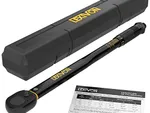
- Best Overall: LEXIVON LX-183 1/2-Inch Drive Click Torque Wrench
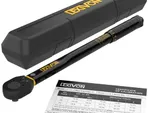
- Best for Engine Work: LEXIVON LX-182 3/8-Inch Drive Click Torque Wrench
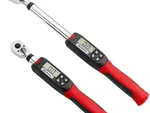
- Upgrade Pick: ACDelco ARM601-34 Digital Torque Wrench Combo Kit
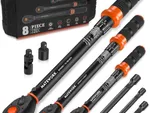
- Best Value Set: Matework 8-Piece Click Torque Wrench Set
- Best Compact Option: INGJER 1/4-Inch Drive Mini Torque Wrench
- How we chose
- What to consider before buying
- Torque range and why the bottom of the scale lies
- Click, digital and beam, what each gets right
- Storing a click wrench so it stays accurate
- Why an impact wrench and torque sticks are not the same thing
- Final recommendation
- FAQ
Quick picks
Every pick wins a specific use case. Jump to the full review before you buy.
-
Best Overall
LEXIVON LX-183 1/2-Inch Drive Click Torque Wrench
A 1/2 inch click wrench with a 10 to 150 ft-lb range and a real calibration certificate, which covers lug nuts, suspension bolts and axle work with one tool.
-
Best for Engine Work
LEXIVON LX-182 3/8-Inch Drive Click Torque Wrench
The same LEXIVON click mechanism in a 3/8 inch head with a 10 to 80 ft-lb range, sized for the bolts you reach around in an engine bay.
-
Upgrade Pick
ACDelco ARM601-34 Digital Torque Wrench Combo Kit
Two digital wrenches, 3/8 inch and 1/2 inch, that read live torque on an LCD and beep at the target, built to ISO 6789 with a calibration certificate.
-
Best Value Set
Matework 8-Piece Click Torque Wrench Set
Three click wrenches in 1/4, 3/8 and 1/2 inch drives plus extensions and adapters, which covers a wide torque band for the price of one mid-range wrench.
-
Best Compact Option
INGJER 1/4-Inch Drive Mini Torque Wrench
A small 1/4 inch click wrench reading 20 to 240 in-lb, for the low torque fasteners that a car-sized wrench cannot measure at all.
Compare every pick
| Product | Award | Drive size | Torque range | Accuracy claim | Best for | Where to buy |
|---|---|---|---|---|---|---|
| LEXIVON LX-183 1/2-Inch Drive Click Torque Wrench | Best Overall | 1/2 inch | 10 to 150 ft-lb (13.6 to 203.5 Nm) | Plus or minus 4 percent | A home mechanic who rotates their own tires and does brake and suspension work on a car, SUV or half-ton truck. | Check price for LEXIVON LX-183 1/2-Inch Drive Click Torque Wrench at Amazon (affiliate link) |
| LEXIVON LX-182 3/8-Inch Drive Click Torque Wrench | Best for Engine Work | 3/8 inch | 10 to 80 ft-lb (13.6 to 108.5 Nm) | Plus or minus 4 percent | Someone doing their own spark plugs, water pump, thermostat, pulley and manifold work who needs a wrench that fits into a crowded engine bay. | Check price for LEXIVON LX-182 3/8-Inch Drive Click Torque Wrench at Amazon (affiliate link) |
| ACDelco ARM601-34 Digital Torque Wrench Combo Kit | Upgrade Pick | 3/8 inch and 1/2 inch, two wrenches | 3.7 to 37 ft-lb (3/8 in) and 14.8 to 147.5 ft-lb (1/2 in) | Built to ISO 6789 standards | Someone who torques fasteners often, works to written specs, and wants to see the actual number rather than trust a click. | Check price for ACDelco ARM601-34 Digital Torque Wrench Combo Kit at Amazon (affiliate link) |
| Matework 8-Piece Click Torque Wrench Set | Best Value Set | 1/4 inch, 3/8 inch and 1/2 inch | 10 to 230 in-lb, 5 to 50 ft-lb and 10 to 180 ft-lb | Plus or minus 3 percent | A new home mechanic who wants coverage from small interior fasteners up to lug nuts without buying wrenches one at a time. | Check price for Matework 8-Piece Click Torque Wrench Set at Amazon (affiliate link) |
| INGJER 1/4-Inch Drive Mini Torque Wrench | Best Compact Option | 1/4 inch | 20 to 240 in-lb | Plus or minus 3 percent clockwise | Anyone tightening small fasteners specified in inch-pounds, such as sensors, covers, interior brackets and bicycle hardware. | Check price for INGJER 1/4-Inch Drive Mini Torque Wrench at Amazon (affiliate link) |
Swipe sideways to compare every column.
Best Overall
LEXIVON LX-183 1/2-Inch Drive Click Torque Wrench
by LEXIVON
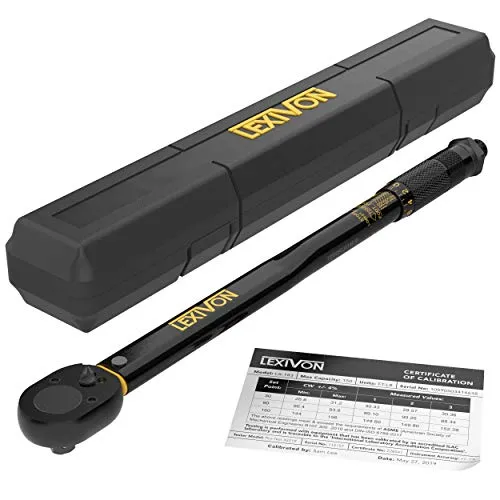
A 1/2 inch click wrench with a 10 to 150 ft-lb range and a real calibration certificate, which covers lug nuts, suspension bolts and axle work with one tool.
What we like
- Range of 10 to 150 ft-lb covers almost every lug nut spec on a car or light truck
- Ships pre-calibrated to plus or minus 4 percent with a certificate and a traceable serial number
- Dual range scale is printed yellow on black, which stays readable on a dark driveway
- Reversible ratchet head means you can loosen fasteners without swapping to another ratchet
What we don't
- Readings below about 30 ft-lb sit in the bottom fifth of the scale, where any click wrench is least trustworthy
- It only measures torque in the clockwise direction, so it is no help on left hand thread work
- A 1/2 inch head is too bulky for spark plugs and valve cover bolts in a tight engine bay
| Drive size | 1/2 inch |
|---|---|
| Torque range | 10 to 150 ft-lb (13.6 to 203.5 Nm) |
| Accuracy claim | Plus or minus 4 percent |
| Calibration certificate | Included, with a traceable serial number |
| Readout type | Dual scale ft-lb and Nm, yellow on black markings |
| Price bracket | $$ |
Lug nuts are the reason most people buy a torque wrench, and lug nut specs on cars and light trucks usually land between 80 and 140 ft-lb. The LX-183 sits right in the middle of that window. Its 10 to 150 ft-lb range means a 100 ft-lb wheel spec falls near the sweet spot of the scale, which is where a click wrench does its best work.
The part that matters more than the range is the paperwork. LEXIVON ships this wrench pre-calibrated to plus or minus 4 percent and includes a certificate with a serial number you can trace back to the tool. Plenty of cheap wrenches print an accuracy number on the box and stop there. A certificate is not proof the wrench is still accurate in three years, but it is proof somebody checked this one before it shipped.
Build quality follows the pattern of the better Taiwan-made wrenches. The ratchet head is hardened chrome vanadium steel, the handle is knurled so it does not slip with oily gloves, and the black finish resists rust in a damp garage. The scale is the practical win. Yellow on black is easy to set under a work light, and setting the wrong number is a more common mistake than people admit.
Two honest limits. First, this wrench measures torque only when you turn clockwise, which is normal for the type but worth knowing. Second, the bottom of the scale is soft. If you need 15 or 20 ft-lb on a small bolt, use a smaller wrench instead of trusting the low end of this one.
For one wrench that handles wheels, brakes, suspension and axle nuts, this is the pick. Add a 3/8 inch wrench later for engine work rather than trying to make this one do everything.
Research-based pick: this recommendation is based on product data, owner feedback and comparison with products we have tested, not on direct hands-on testing.
Buy it if: A home mechanic who rotates their own tires and does brake and suspension work on a car, SUV or half-ton truck.
Skip it if: Most of your fasteners are small engine bay bolts under 30 ft-lb, where the 3/8 inch LX-182 reads far more accurately.
Best for Engine Work
LEXIVON LX-182 3/8-Inch Drive Click Torque Wrench
by LEXIVON
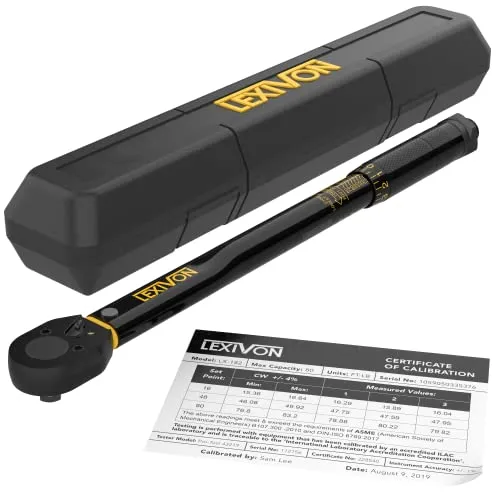
The same LEXIVON click mechanism in a 3/8 inch head with a 10 to 80 ft-lb range, sized for the bolts you reach around in an engine bay.
What we like
- A 3/8 inch head and slimmer body fit between hoses and brackets where a 1/2 inch wrench will not go
- The 10 to 80 ft-lb range puts common engine bolt specs in the middle of the scale, not the edge
- Comes pre-calibrated to plus or minus 4 percent with a certificate and traceable serial number
- Reversible ratchet head and a knurled non-slip handle, same as the larger LX-183
What we don't
- It tops out at 80 ft-lb, so it cannot be used on most lug nuts
- The scale starts at 10 ft-lb, which is still too high for many valve cover and plastic trim fasteners
- Torque is only measured clockwise, so it will not verify anything you are loosening
| Drive size | 3/8 inch |
|---|---|
| Torque range | 10 to 80 ft-lb (13.6 to 108.5 Nm) |
| Accuracy claim | Plus or minus 4 percent |
| Calibration certificate | Included, with a traceable serial number |
| Head material | Hardened chrome vanadium alloy steel |
| Price bracket | $ |
Engine bolts and wheel nuts live in different worlds. Wheel nuts want 80 to 140 ft-lb. Most bolts under the hood want 15 to 60 ft-lb, and a lot of them are behind a hose or a bracket. The LX-182 is built for the second job.
The head is 3/8 inch, so it takes the socket sizes you already own for engine work and slips into gaps a 1/2 inch head cannot reach. The 10 to 80 ft-lb range is the real reason to own it. A 40 ft-lb spec sits in the middle of this wrench’s scale, where a click mechanism is at its most repeatable. That same 40 ft-lb reading on a big 1/2 inch wrench sits near the bottom, where it is least repeatable.
Everything else matches its bigger brother. Chrome vanadium head, dual range scale in ft-lb and Nm, black rust-resistant finish, and a calibration certificate with a serial number. LEXIVON quotes plus or minus 4 percent out of the box, which is honest for the price. It is not a lab tool and it does not claim to be.
The limits are simple to state. It stops at 80 ft-lb, so wheels are out. It starts at 10 ft-lb, so the small stuff, like valve cover bolts often specified in inch-pounds, is also out. That is a narrow band, but it is the band where most engine work happens.
If you are building a two wrench setup, this is half of it. Pair it with the 1/2 inch LX-183 and you have covered nearly every fastener on a normal car without ever working at the ragged end of a scale.
Research-based pick: this recommendation is based on product data, owner feedback and comparison with products we have tested, not on direct hands-on testing.
Buy it if: Someone doing their own spark plugs, water pump, thermostat, pulley and manifold work who needs a wrench that fits into a crowded engine bay.
Skip it if: You want one wrench for wheels, because 80 ft-lb is under most lug nut specs and this one will never reach them.
Upgrade Pick
ACDelco ARM601-34 Digital Torque Wrench Combo Kit
by ACDelco
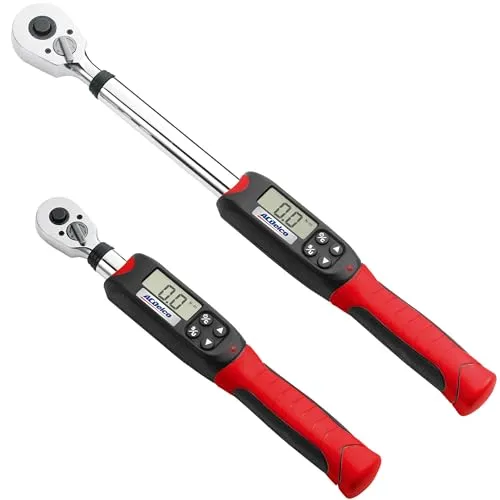
Two digital wrenches, 3/8 inch and 1/2 inch, that read live torque on an LCD and beep at the target, built to ISO 6789 with a calibration certificate.
What we like
- Live torque readout means you see the number climb instead of waiting for a click you might miss
- Two wrenches cover 3.7 to 37 ft-lb and 14.8 to 147.5 ft-lb, so engine work and wheels are both handled
- Buzzer plus LED flash gives you a signal you can catch under a noisy lift or with ear protection on
- Built to ISO 6789 standards and supplied with a certificate of calibration
What we don't
- It runs on 4 AAA batteries that are not included, and a dead battery means no reading at all
- It costs several times what a good click wrench costs, which is hard to justify for a few jobs a year
- Electronics and a soft grip housing are more fragile than a solid steel click wrench in a rolling toolbox
| Drive size | 3/8 inch and 1/2 inch, two wrenches |
|---|---|
| Torque range | 3.7 to 37 ft-lb (3/8 in) and 14.8 to 147.5 ft-lb (1/2 in) |
| Wrench type | Digital, powered by 4 AAA batteries |
| Accuracy claim | Built to ISO 6789 standards |
| Readout type | LCD in ft-lb and Nm, with buzzer and LED flash |
| Price bracket | $$$ |
A click wrench tells you one thing, at one moment: you hit the number. A digital wrench tells you the whole story. The ACDelco ARM601-34 shows torque on an LCD as you pull, so you can see it rise, slow down as you approach the target, and stop cleanly. For anyone who has ever pulled through a click by accident, that is the difference worth paying for.
The kit is two tools, not one. The ARM601-3 is a 3/8 inch wrench covering 3.7 to 37 ft-lb, which reaches lower than any click wrench in this guide. The ARM601-4 is a 1/2 inch covering 14.8 to 147.5 ft-lb, which covers wheels. Between them you get a much wider usable band than a single wrench can offer, and each one comes in its own hard case.
ACDelco states the wrenches are built to ISO 6789 and supplies a certificate of calibration. That is the standard written for hand torque tools, and naming it is more meaningful than a bare percentage on a box. Both read in ft-lb and Nm, and both signal the target with a buzzer and a flashing LED, which is useful when the shop is loud.
The trade-offs are real. It needs 4 AAA batteries, and they are not in the box. Electronics do not like being dropped on concrete, and a digital wrench needs periodic recalibration exactly like a mechanical one does. None of that makes it a bad tool, it just makes it a tool for someone who uses it often.
Buy this if torque specs are part of your regular routine. If you touch a torque wrench twice a year, the money is better spent on the LEXIVON pair.
Research-based pick: this recommendation is based on product data, owner feedback and comparison with products we have tested, not on direct hands-on testing.
Buy it if: Someone who torques fasteners often, works to written specs, and wants to see the actual number rather than trust a click.
Skip it if: You use a torque wrench a few times a year, since a certified click wrench does the same job for a fraction of the money.
Best Value Set
Matework 8-Piece Click Torque Wrench Set
by Matework
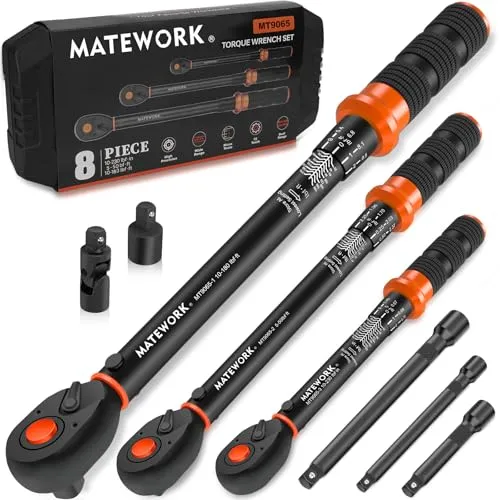
Three click wrenches in 1/4, 3/8 and 1/2 inch drives plus extensions and adapters, which covers a wide torque band for the price of one mid-range wrench.
What we like
- Three drive sizes cover 10 to 230 in-lb, 5 to 50 ft-lb and 10 to 180 ft-lb in one purchase
- Includes three extension bars, a universal joint and a 1/2 to 3/8 adapter, so you can reach recessed bolts
- Supplied with a calibration certificate and stated to ASME B107.300-2010 and ISO 6789-2017
- The locking ring now stays put in the unlocked position, which makes setting torque a one-handed job
What we don't
- Three wrenches means three tools to recalibrate over time, and that cost adds up
- The 1/2 inch wrench stops at 180 ft-lb, so heavy truck axle and hub specs are out of reach
- Owners of similar sets report the click is faint below about 5 Nm, which is inside the 1/4 inch wrench range
| Drive size | 1/4 inch, 3/8 inch and 1/2 inch |
|---|---|
| Torque range | 10 to 230 in-lb, 5 to 50 ft-lb and 10 to 180 ft-lb |
| Accuracy claim | Plus or minus 3 percent |
| Calibration certificate | Included, stated to ASME B107.300-2010 and ISO 6789-2017 |
| Head material | Cr-Mo steel head with aluminum handle |
| Price bracket | $$ |
Buying three torque wrenches at once sounds like overkill until you look at how torque specs are spread out. A wheel nut is 100 ft-lb. A caliper bracket bolt is 30 ft-lb. A sensor or an interior bracket is 80 in-lb. No single wrench reads all three well, and this set is an honest answer to that.
The three drives break down cleanly. The 1/4 inch handles 10 to 230 in-lb for small fasteners. The 3/8 inch covers 5 to 50 ft-lb for engine bay work. The 1/2 inch runs 10 to 180 ft-lb for wheels and suspension. The five adapters matter more than they look. A universal joint and three extension bars are what let you reach a bolt behind a subframe without giving up on the torque spec.
Matework quotes plus or minus 3 percent and includes a calibration certificate, and it names ASME B107.300-2010 and ISO 6789-2017 as the standards. Those are the right standards to reference for hand torque tools. Naming a standard does not guarantee compliance, but it is more than most budget sets in this price range put in writing.
There is a real cost buried here. Three wrenches means three tools that drift out of calibration, and getting three checked is not cheap. If you use them lightly and store them dialed back to the lowest setting, they will hold their accuracy longer, but this set does not remove the maintenance question. It multiplies it.
Take this set if you are starting from nothing and want broad coverage today. Take a single certified wrench instead if you already know the only fasteners you will ever torque are your wheels.
Research-based pick: this recommendation is based on product data, owner feedback and comparison with products we have tested, not on direct hands-on testing.
Buy it if: A new home mechanic who wants coverage from small interior fasteners up to lug nuts without buying wrenches one at a time.
Skip it if: You only ever torque wheels, in which case a single 1/2 inch wrench costs less and is one less thing to maintain.
Best Compact Option
INGJER 1/4-Inch Drive Mini Torque Wrench
by INGJER
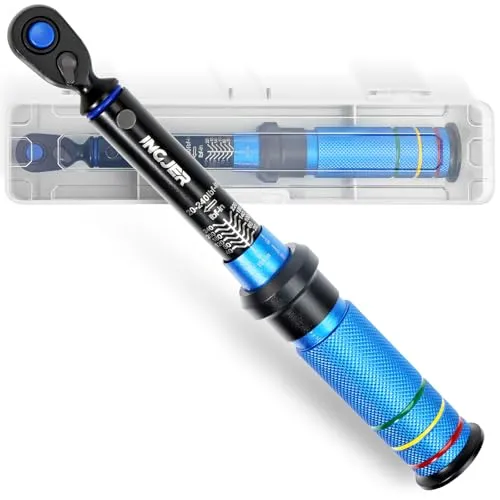
A small 1/4 inch click wrench reading 20 to 240 in-lb, for the low torque fasteners that a car-sized wrench cannot measure at all.
What we like
- Reads 20 to 240 in-lb, a band where a 1/2 inch wrench gives you no useful reading
- The 72 tooth reversible head has a slim profile that works inside trim, brackets and bike parts
- Gives both a click and a handle vibration, so you can feel the target through gloves
- Comes with a protective case, which is how a small wrench survives a drawer
What we don't
- No calibration certificate is offered, so the plus or minus 3 percent figure is a claim and nothing more
- The 3 percent figure is quoted for clockwise use only, so counterclockwise readings are unverified
- Its top end of 240 in-lb is only 20 ft-lb, which means it cannot help with brakes, suspension or wheels
| Drive size | 1/4 inch |
|---|---|
| Torque range | 20 to 240 in-lb |
| Wrench type | Click, 72 tooth reversible ratchet |
| Accuracy claim | Plus or minus 3 percent clockwise |
| Calibration certificate | Not offered in the listing |
| Price bracket | $ |
Some fasteners are specified in inch-pounds, and a big wrench simply cannot read them. Twelve foot-pounds on a 150 ft-lb wrench is 8 percent of full scale, which is guessing with extra steps. This INGJER wrench works in the range where those specs actually live, from 20 to 240 in-lb.
That covers a lot of ordinary jobs. Coolant sensors, plastic covers, interior brackets, small pulleys, valve covers on some engines and most bicycle hardware all sit in this band. Over-tighten any of them and you strip threads or crack plastic, and that is the failure mode this tool exists to prevent.
The build is standard for the type. Chrome vanadium steel with a polished chrome finish, a 72 tooth reversible ratchet with a slim head for tight spaces, dual scales, and a knurled handle that stays put with oily hands. It clicks and it vibrates at the setting, which is easier to notice on a small wrench where the click itself is quiet. The listing also tells you to wind the scale back to the lowest setting for storage, which is the right instruction and worth following.
Here is the honest catch. INGJER claims plus or minus 3 percent clockwise, but no calibration certificate comes with it. An accuracy number without documentation is a marketing claim. At this price that is a reasonable trade for low torque work where a mistake costs you a stripped bolt, not a wheel. It is not a reasonable trade on anything safety critical.
Get it as a second or third wrench for the small end of the scale. Do not make it your only torque wrench.
Research-based pick: this recommendation is based on product data, owner feedback and comparison with products we have tested, not on direct hands-on testing.
Buy it if: Anyone tightening small fasteners specified in inch-pounds, such as sensors, covers, interior brackets and bicycle hardware.
Skip it if: You need documented accuracy for safety critical work, where a wrench that ships with a certificate is the safer buy.
How we chose#
This is a research-based comparison, not a calibration bench test. We started with torque wrenches that actually sell in the United States on Amazon, then pulled the numbers that decide whether a wrench works for a given job: drive size, torque range, stated accuracy, whether a calibration certificate ships with the tool, and how you read the result. Where a listing made a vague claim, we used only what the maker put in writing.
We paid particular attention to calibration paperwork, because it is the one thing that separates a real accuracy figure from a printed one. Both LEXIVON wrenches include a certificate with a traceable serial number. The Matework set includes one and names the standards it was checked against. The ACDelco kit ships with a certificate of calibration and cites ISO 6789. The INGJER mini wrench does not, and we say so in its review rather than quietly leaving it out.
We also spread the list on purpose instead of ranking five near-identical 1/2 inch wrenches. You get a big click wrench for wheels, a smaller click wrench for engine work, a digital kit, a three-drive set, and a mini wrench for inch-pound fasteners. Those are five different jobs, not five versions of one.
What to consider before buying#
Start with the fasteners you actually turn. Write down two or three torque specs from your owner’s manual. If they are all around 100 ft-lb, you need one 1/2 inch wrench and nothing else. If they range from 15 ft-lb to 120 ft-lb, you need two wrenches or a set.
Next, look at drive size as a fit question, not a strength question. A 1/2 inch head is chunky. In a modern engine bay, that difference decides whether you can reach a bolt at all. A 3/8 inch wrench like the LX-182 gets into places the LX-183 physically cannot.
Then check the range against the middle of the scale rather than the ends. A wrench is at its best in the middle. If your most common spec lands near the bottom mark, buy a smaller wrench instead of accepting a bad reading.
Last, plan for calibration. Every torque wrench drifts. Sending one out for a check costs money, which is worth knowing before you buy three at once.
Torque range and why the bottom of the scale lies#
Accuracy on a torque wrench is stated as a percentage of the reading, and most makers only promise it across the upper part of the scale, commonly the top 80 percent. Below that, the numbers get soft. Internal friction and mechanical play stay roughly the same no matter what you set, so they matter far more when the reading is small.
Here is what that means in practice. A wrench that runs 10 to 150 ft-lb is trustworthy from about 38 ft-lb up. Set it to 15 ft-lb and you are outside the range anyone promised anything for. The bolt might end up at 13 ft-lb or 18 ft-lb, and you will never know which.
This is the whole reason to own more than one wrench. The LEXIVON LX-182 puts a 40 ft-lb spec in the middle of a 10 to 80 ft-lb scale. The INGJER mini puts a 100 in-lb spec in the middle of a 20 to 240 in-lb scale. The Matework set does the same thing across three drives. Buying by range, not by brand, is what makes the readings mean something.
Now the uncomfortable part. A cheap wrench that reads 15 percent off is worse than no wrench at all on a wheel or a head bolt, because it gives you confidence you have not earned. A person torquing by feel knows they are guessing. A person reading a wrong number does not. Accuracy claims without a calibration certificate are just claims, and every wrench in this guide states a percentage. Only some of them back it with paperwork.
Click, digital and beam, what each gets right#
A click wrench uses a spring loaded mechanism that releases with a sharp click and a small kick when you reach the setting. It is the most common type, it needs no power, and it is what four of our five picks are. Its weakness is that it signals once. Pull past the click and you keep adding torque with nothing telling you to stop.
A digital wrench, like the ACDelco ARM601-34, uses a strain gauge and shows the live number on a screen. You watch the value rise and ease off as it gets close, and the buzzer and LED flash confirm the target. It costs more, needs batteries, and does not enjoy being dropped. What it buys you is information, which matters when a fastener has a narrow window.
A beam wrench is the third type and the simplest. A pointer moves along a printed scale as the bar flexes, so there is nothing to wear out or set. Beam wrenches hold their accuracy for decades, but you have to see the scale while pulling, which is hard in a wheel well. None of our picks are beam wrenches, and if you like the idea, buy one from a maker who publishes a real accuracy spec.
Storing a click wrench so it stays accurate#
Wind the setting back to the lowest mark on the scale before you put a click wrench away. That is not a superstition. The mechanism holds a compressed spring, and leaving it compressed at a high setting for months lets the spring take a set, which shifts every reading afterward. Do not wind it below the bottom mark either. That can unload the mechanism and cause its own problems.
The rest is common sense that people still skip. Keep it in the case that came with it, since a wrench rattling loose in a drawer takes knocks it was never designed for. Never use it as a breaker bar to loosen a stuck nut, because you can overload it in one pull. If you drop it on concrete, treat the calibration as suspect until it is checked.
Plan on recalibration roughly once a year with regular use, or after a few thousand cycles. Most owners never do it, which is worth being honest about. If you will not recalibrate, at least buy a wrench that was certified when it shipped and treat it gently.
Why an impact wrench and torque sticks are not the same thing#
Torque sticks are popular for a reason. They are flexible extensions sized to twist and limit how much torque an impact gun passes through, and they let a tire shop run wheels on in seconds. The problem is that the result depends on your gun’s power, your air pressure or battery charge, and how long you hold the trigger. Change any of those and the number changes.
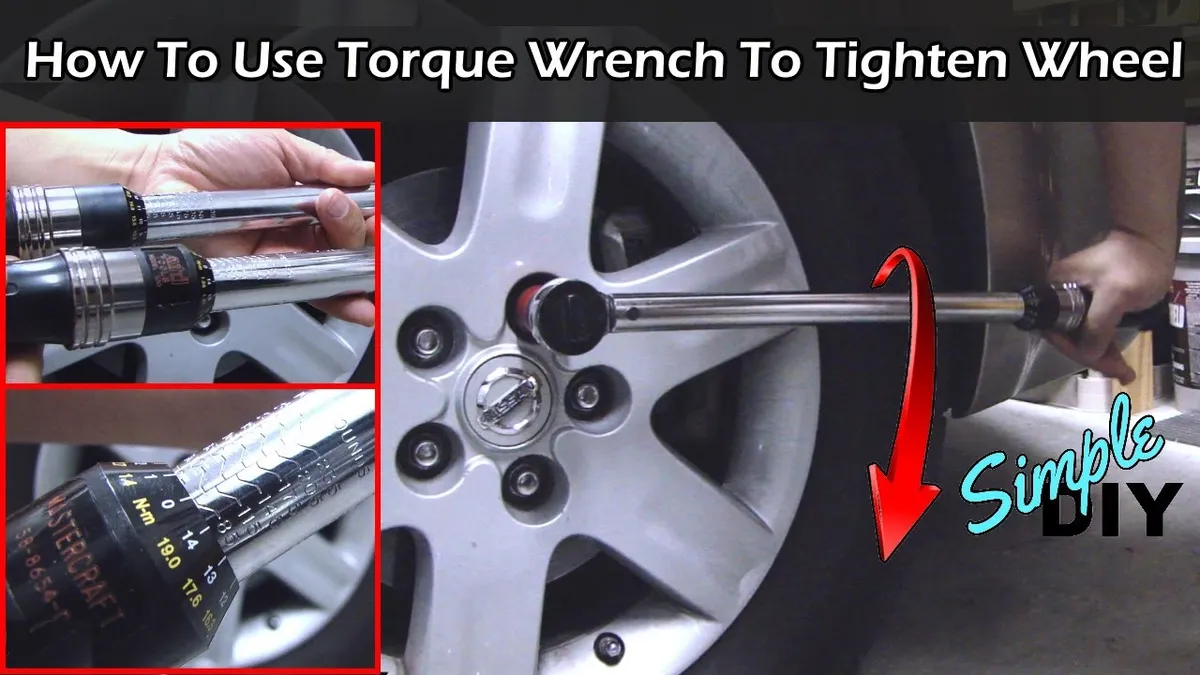
For a home garage the honest method is a two step one. Run the nuts down with the impact until they are snug, then set the final value by hand with a torque wrench in a star pattern. It takes an extra minute per wheel. It also removes the guesswork on the one fastener where guesswork is a very bad idea.
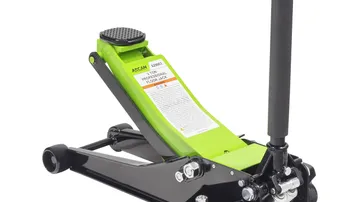
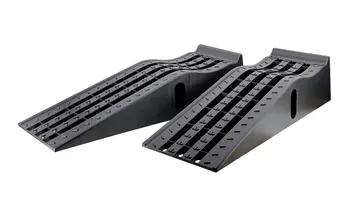
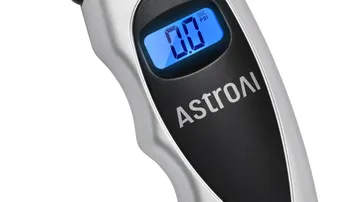
The same logic applies to anything with a gasket or an aluminum thread. Impact guns are for speed. Torque wrenches are for the last quarter turn. If you are doing wheel work at home, you also want a stable lift, and our guides to the best car jacks and the best car ramps cover that half of the job. Check your pressures with a proper tire pressure gauge once the wheels are back on.
Final recommendation#
Buy the LEXIVON LX-183 if you want one wrench and your main job is wheels, brakes and suspension. It covers 10 to 150 ft-lb, it ships with a certificate and a traceable serial number, and it sells well for a reason. Add the LEXIVON LX-182 when you start doing engine work, because a 3/8 inch head fits where the bigger wrench cannot and it reads 40 ft-lb far more honestly.
Get the Matework 8-piece set if you are starting from nothing and want 1/4, 3/8 and 1/2 inch coverage plus adapters in one purchase, and accept that three wrenches means three tools to look after. Step up to the ACDelco ARM601-34 digital kit only if you torque fasteners often enough that watching a live number is worth the money and the batteries. And add the INGJER 1/4 inch mini wrench as a second or third tool for anything specified in inch-pounds, where a big wrench simply cannot read low enough to help you.
Frequently asked questions
What size torque wrench do I need for lug nuts?
A 1/2 inch drive wrench that reaches at least 150 ft-lb. Most cars and light trucks call for 80 to 140 ft-lb at the wheel, and you want that number sitting in the middle of the wrench's range rather than at the very top. The LEXIVON LX-183 covers 10 to 150 ft-lb, which suits nearly every passenger vehicle. A 3/8 inch wrench like the LX-182 stops at 80 ft-lb, so it cannot do wheels at all. Check your owner's manual for the exact figure before you set anything.
Are cheap torque wrenches accurate?
Some are, and you have no way to tell which. Every wrench in this guide claims 3 or 4 percent accuracy, but a claim printed on a listing is not a measurement. The wrenches worth trusting ship with a calibration certificate, ideally with a serial number that ties the paperwork to the tool in your hand. Both LEXIVON wrenches do. The Matework set does and names ASME and ISO standards. The INGJER mini wrench does not, which is fine for small bolts and not fine for wheels.
Why is a torque wrench inaccurate at the bottom of its range?
Because the error is a percentage of the reading, and the mechanism itself has a fixed amount of friction and play that does not shrink as the setting goes down. Most makers only state accuracy across roughly the top 80 percent of the scale. Set a 10 to 150 ft-lb wrench to 15 ft-lb and you are working where nobody promised anything. That is why owning a 3/8 or 1/4 inch wrench matters. It puts small numbers back in the middle of a scale.
Is a digital torque wrench better than a click wrench?
It is better at telling you what is happening. A click wrench signals once, at the target, and if you keep pulling you can blow straight through it. The ACDelco ARM601-34 shows the number climbing on an LCD and adds a buzzer and an LED flash, so you can slow down as you get close. The trade is money, batteries and fragility. For a few jobs a year a certified click wrench does the same job for much less.
How do I store a click torque wrench?
Wind the setting back to the lowest number on the scale before you put it away, then keep it in its case. A click wrench works by loading an internal spring, and leaving it set at 120 ft-lb for months lets that spring take a set and drift out of calibration. Do not wind it below the lowest mark either, since that can unload the mechanism entirely. Store it dry, do not use it as a breaker bar, and do not drop it.
Can I use an impact wrench with torque sticks instead?
For speed, yes. For accuracy, no. A torque stick is a flexible extension that twists and limits how much torque passes through, but the result depends on your impact gun's power, air pressure, battery charge and how long you hold the trigger. Real world results scatter widely. The sensible method is running nuts down with the impact and then setting the final value by hand with a wrench like the LEXIVON LX-183.
About the author

Dale Harper Lead Gear Editor
Dale is a longtime truck owner and former accessory-shop tech who builds these guides from manufacturer fit data, aggregated owner feedback and direct spec comparison. Research-based picks are always labelled as such.
Daily driver: 2022 Ford F-150 XLT SuperCrew
- Tonneau covers and bed accessories
- Seat covers and interior protection
- Lift kits and suspension