Best GPS Tracker for a Car: 5 Picks Compared for 2026
We compared five car GPS trackers on subscription cost, battery life, update speed and mounting, from a $15 magnetic puck to a no monthly fee pick.


A car GPS tracker is a cheap thing with an expensive tail. The hardware often costs less than a set of wiper blades, and then the monthly plan quietly adds up to several hundred dollars over the life of the car. So the real question is not which tracker is best, it is which kind of tracker fits what you are actually trying to do. For this guide we compared the vehicle trackers Americans buy most on Amazon, looking at update speed, battery life, network type, mounting method and the total cost over three years rather than the sticker price. The five picks below each solve a different problem. The LandAirSea 54 is the best all round choice, the Bouncie plugs into the OBD2 port and reports driving behaviour, the Tracki Pro runs for months on one charge, the Moto Watchdog MW-800 gives live tracking with no monthly bill, and the zxhtqtx F08 is a cheap Bluetooth tag for finding your own parked car.
Table of contents
- Quick picks
- Comparison table
- Best Overall: LandAirSea 54 GPS Tracker
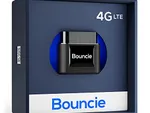
- Best for Family Driving Data: Bouncie GPS Tracker for Vehicles
- Best Battery Life: Tracki Pro 4G LTE GPS Tracker
- Upgrade Pick: Moto Watchdog MW-800 GPS Tracker
- Best Low-Cost Option: zxhtqtx F08 No Subscription Vehicle Tracker
- How we chose
- What to consider before buying
- The subscription is the real price
- Update speed, network type, and what real time means
- Magnetic, OBD port, or hardwired
- Final recommendation
- FAQ
Quick picks
Every pick wins a specific use case. Jump to the full review before you buy.
-
Best Overall
LandAirSea 54 GPS Tracker
A small magnetic tracker that updates as fast as every 3 seconds and costs less than most people spend on a tank of gas, as long as you accept the monthly plan.
-
Best for Family Driving Data
Bouncie GPS Tracker for Vehicles
An OBD2 port tracker that reports location plus how the car is being driven and how the engine is doing, aimed at parents and small fleet owners.
-
Best Battery Life
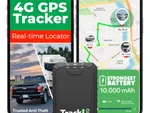
Tracki Pro 4G LTE GPS Tracker
A big 10,000mAh tracker built for trailers, boats and work equipment that can run for months between charges instead of days.
-
Upgrade Pick
Moto Watchdog MW-800 GPS Tracker
A live cellular tracker with real geofencing that charges nothing monthly, so you pay a high price once instead of a small price forever.
-
Best Low-Cost Option
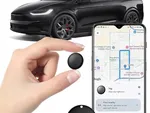
zxhtqtx F08 No Subscription Vehicle Tracker
A cheap Bluetooth tag that rides in your car and reports through Apple Find My or Google Find Hub, useful for finding a parked car and not much else.
Compare every pick
| Product | Award | Power source | Best for | Where to buy |
|---|---|---|---|---|
| LandAirSea 54 GPS Tracker | Best Overall | Internal battery with motion activated sleep | Someone who wants a hidden tracker on their own car or trailer and cares more about how quickly the map refreshes than about avoiding a monthly bill. | Check price for LandAirSea 54 GPS Tracker at Amazon (affiliate link) |
| Bouncie GPS Tracker for Vehicles | Best for Family Driving Data | The car itself, the unit plugs into the OBD2 port | A parent tracking a teen driver or an owner running a handful of work vehicles who wants driving behavior and engine health in the same app. | Check price for Bouncie GPS Tracker for Vehicles at Amazon (affiliate link) |
| Tracki Pro 4G LTE GPS Tracker | Best Battery Life | 10,000mAh rechargeable battery | Owners tracking a trailer, boat, RV or piece of equipment that sits parked for weeks and cannot be pulled inside for a charge. | Check price for Tracki Pro 4G LTE GPS Tracker at Amazon (affiliate link) |
| Moto Watchdog MW-800 GPS Tracker | Upgrade Pick | Internal rechargeable battery | A long term owner who wants live cellular tracking and geofence alerts without another line item on the card every month. | Check price for Moto Watchdog MW-800 GPS Tracker at Amazon (affiliate link) |
| zxhtqtx F08 No Subscription Vehicle Tracker | Best Low-Cost Option | Internal battery, no SIM card and no charging plan | A driver who keeps losing the car in airport lots and shopping centres and wants a cheap backup with nothing to pay each month. | Check price for zxhtqtx F08 No Subscription Vehicle Tracker at Amazon (affiliate link) |
Swipe sideways to compare every column.
Best Overall
LandAirSea 54 GPS Tracker
by LandAirSea
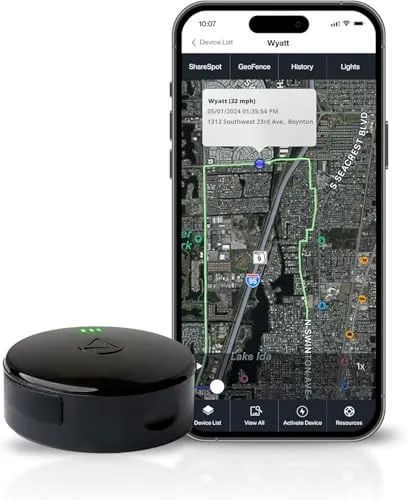
A small magnetic tracker that updates as fast as every 3 seconds and costs less than most people spend on a tank of gas, as long as you accept the monthly plan.
What we like
- Location updates as fast as every 3 seconds, the quickest refresh rate of anything in this guide
- Motion activated sleep means it stops reporting when the car sits still, so the battery is not wasted on a parked vehicle
- Internal magnet and a waterproof case let you place it in about a minute with no tools and no wiring
- LandAirSea backs it with an unconditional lifetime warranty against manufacturing defects in normal use
What we don't
- It will not work at all without a paid plan, so the low hardware price is only the entry fee
- The maker does not publish a runtime figure, so how often you recharge depends entirely on how much the car moves
- Historical playback is capped at one year, which is short if you need long term records for a fleet
| Power source | Internal battery with motion activated sleep |
|---|---|
| Subscription required | Yes, plans start at $9.95 a month on annual billing or $19.95 monthly |
| Update interval | As fast as every 3 seconds |
| Network type | Cellular, global tracking through the SilverCloud app or web software |
| Mounting | Internal magnet, waterproof case, 2.25 x 2.25 x 0.8 inches |
| Price bracket | $ |
The LandAirSea 54 is the tracker most people should start with, and the reason is simple. It does the basic job well. You stick it under a bumper or inside a wheel well, open the SilverCloud app, and watch the car move on a Google Map. Updates can come as fast as every 3 seconds, which is quicker than anything else here, and quick enough that the dot on the screen matches where the car actually is rather than where it was a minute ago.
The case is 2.25 inches square and less than an inch thick, with the magnet built in and a waterproof shell around it. That matters more than it sounds. A tracker you have to hide is only useful if it is small enough to hide well, and this one fits in places a bigger unit will not. It is also a strong seller on Amazon, which is a decent signal that the hardware holds up in normal use, and LandAirSea covers manufacturing defects with a lifetime warranty.
Where it stings is the plan. Fees start at $9.95 a month on an annual plan and $19.95 if you pay month to month. Over three years that is well north of $350, which makes the hardware price close to irrelevant. If you only want to find a car once, you are buying the wrong kind of device. If you want a live map every day, this is the cheapest way in.
The other soft spot is battery. The unit sleeps when the vehicle is parked, which helps, but LandAirSea does not publish a runtime number, and a car that drives all day will drain it far faster than one that sits in a driveway. Plan on checking the charge regularly rather than trusting it to last.
Buy it if you want the fastest refresh rate for the least money up front. Look at the Tracki Pro instead if the recharging schedule is the part that would annoy you. This is a research-based assessment built from specs and listing data, not our own road testing.
Research-based pick: this recommendation is based on product data, owner feedback and comparison with products we have tested, not on direct hands-on testing.
Buy it if: Someone who wants a hidden tracker on their own car or trailer and cares more about how quickly the map refreshes than about avoiding a monthly bill.
Skip it if: You refuse to pay a subscription, because this device is useless the day the plan lapses.
Best for Family Driving Data
Bouncie GPS Tracker for Vehicles
by Bouncie
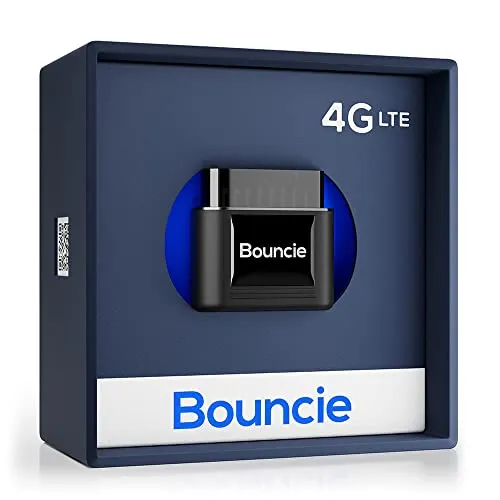
An OBD2 port tracker that reports location plus how the car is being driven and how the engine is doing, aimed at parents and small fleet owners.
What we like
- Plugs into the OBD2 port, so there is nothing to charge and nothing to remember
- Reports speed, hard braking, fast acceleration and idle time, not just a dot on a map
- Reads engine diagnostic data continuously and flags maintenance problems before they strand you
- Impact sensors trigger an SMS alert, and trip history is unlimited with full routes and addresses
What we don't
- It sits in the OBD2 port in plain sight, so anyone looking for it will find it in seconds
- Only works on vehicles from 1996 and newer, which rules out older project cars
- The hardware costs several times what a magnetic tracker does and still needs the $9.65 monthly plan
| Power source | The car itself, the unit plugs into the OBD2 port |
|---|---|
| Subscription required | Yes, $9.65 a month with no activation or return fees |
| Update interval | Up to the minute location updates |
| Geofencing | Yes, plus impact detection with SMS alerts |
| Mounting | Plugs into the OBD2 port, 1.87 x 1.75 x 1.0 inch |
| Price bracket | $$ |
Bouncie takes a different route from the magnetic pucks in this guide. It plugs into the OBD2 diagnostic port under the dash, the same port a shop uses to pull fault codes. That connection gives it two things a battery tracker cannot have. It never needs charging, and it can read what the engine is doing.
That second part is the real reason to buy it. Alongside up to the minute location, Bouncie logs speed, hard braking, quick acceleration and idle time, and colour codes the speed bands so a trip is easy to read at a glance. Parents use this to see how a new driver actually behaves on the road. Small fleet owners use it to spot the van that idles for two hours a day. It also watches engine diagnostic data and warns you about problems building up, which overlaps with what a plug-in OBD2 scanner tells you, except it does it every day without you asking.
The trade-off is that it is not hidden. The OBD2 port sits under the dash within easy reach, and a device plugged into it is obvious. Anyone who does not want to be tracked can unplug it in five seconds. Bouncie is a monitoring tool for vehicles you control, not a theft recovery device.
Cost is the other consideration. The hardware runs well above the magnetic options here, and the plan is $9.65 a month on top, though Bouncie does not charge activation or return fees and you can cancel anytime. Vehicles built before 1996 have no compatible port, so check the car first.
Choose Bouncie when the driving data matters as much as the location. Choose the LandAirSea 54 or the Tracki Pro when the tracker needs to stay out of sight. This is a research-based assessment built from manufacturer data and listing specs, not hands-on testing.
Research-based pick: this recommendation is based on product data, owner feedback and comparison with products we have tested, not on direct hands-on testing.
Buy it if: A parent tracking a teen driver or an owner running a handful of work vehicles who wants driving behavior and engine health in the same app.
Skip it if: You need the tracker hidden, since the OBD2 port is the first place anyone checks.
Best Battery Life
Tracki Pro 4G LTE GPS Tracker
by Tracki
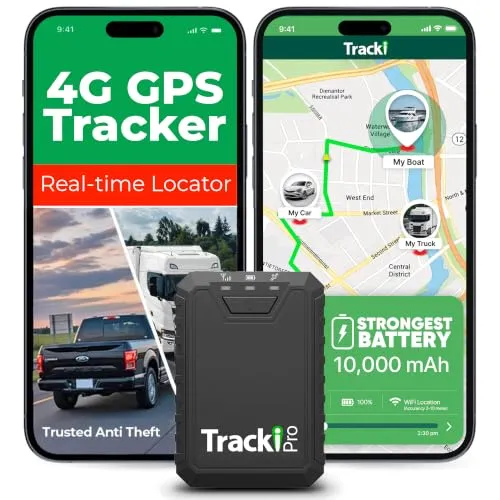
A big 10,000mAh tracker built for trailers, boats and work equipment that can run for months between charges instead of days.
What we like
- A 10,000mAh battery gives 2 to 7 months of active tracking and up to 12 months in sleep mode
- 4G LTE Cat1 with a built in global SIM covers 185 or more countries with no carrier setup
- Wi-Fi fallback keeps reporting a rough position indoors, where a GPS only tracker goes blind
- Alerts cover speed, geofence crossings, movement, idle time, impact and low battery
What we don't
- At 3.54 x 2.48 x 1.46 inches and 18 oz it is far too bulky to hide in a car cabin
- The long battery figures assume 1 to 5 minute updates, so running it at 15 second refresh drains it far faster
- Service only starts after activation, so the plan cost applies here like it does with the other cellular picks
| Power source | 10,000mAh rechargeable battery |
|---|---|
| Battery life | 2 to 7 months in active use, up to 12 months in sleep mode |
| Update interval | 15 seconds to 1 minute on plan, or 1 to 5 minutes to stretch the battery |
| Network type | 4G LTE Cat1 with a built in global SIM, Wi-Fi fallback indoors, 185+ countries |
| Mounting | Built in magnet or the included screw mount, 3.54 x 2.48 x 1.46 inches |
| Price bracket | $ |
Battery life is the thing that kills most vehicle trackers. You fit one, forget it, and three weeks later it is dead and the car is gone. The Tracki Pro answers that by being large. A 10,000mAh cell gives 2 to 7 months of active tracking at 1 to 5 minute updates, and up to 12 months if you leave it in sleep mode. Those numbers are in a different class from anything else here.
The radio side is current too. It runs on 4G LTE Cat1 with a global SIM already inside, so there is no carrier to sign up with, and Tracki lists coverage in more than 185 countries with outdoor accuracy of 5 to 10 meters. When the unit loses sky view, inside a container or a parking structure, Wi-Fi fallback gives you a rough position instead of nothing at all. On plan it can push updates as fast as every 15 seconds, with alerts for speed, geofences, movement, idle time and impact.
Size is what you pay for all of that. It measures 3.54 x 2.48 x 1.46 inches and weighs 18 oz, which is roughly the bulk of a pack of cards and the weight of a full can of soda. There is a strong magnet and a screw mount included, and the case is weatherproof, so bolting it to a trailer frame or sticking it inside a boat hull is easy. Hiding it in a sedan is not.
Read the runtime claims with the update interval in mind. Months of life comes from 1 to 5 minute reporting. Set it to 15 seconds for live theft tracking and you are back to weeks. That is a fair trade, not a flaw, but it is worth knowing before you set the refresh rate on day one.
Get it for assets that sit still for long stretches and are a pain to reach. Get the LandAirSea 54 instead if the tracker has to disappear inside a car.
Research-based pick: this recommendation is based on product data, owner feedback and comparison with products we have tested, not on direct hands-on testing.
Buy it if: Owners tracking a trailer, boat, RV or piece of equipment that sits parked for weeks and cannot be pulled inside for a charge.
Skip it if: You want something small enough to tuck under a car seat or inside a bumper.
Upgrade Pick
Moto Watchdog MW-800 GPS Tracker
by Moto Watchdog
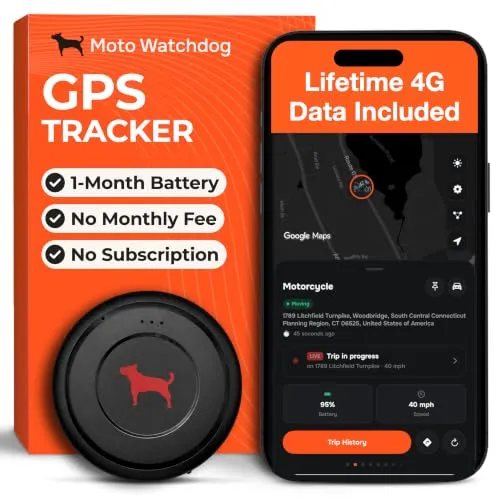
A live cellular tracker with real geofencing that charges nothing monthly, so you pay a high price once instead of a small price forever.
What we like
- No subscription, no activation charge and no hidden fees, which is rare for a tracker with its own cellular link
- Customizable geofencing with instant alerts, the feature most no-fee tags cannot offer at all
- About a month of battery per charge, so it is not a device you are topping up every week
- Coverage in more than 170 countries, including the US, Canada and Mexico
What we don't
- The purchase price is the highest in this guide by a wide margin, so it only pays back after roughly a year of ownership
- The maker does not publish an update interval, so you cannot compare its refresh rate against the LandAirSea 54 on paper
- One company controlling both the hardware and the free data means the service depends on that company staying in business
| Power source | Internal rechargeable battery |
|---|---|
| Battery life | About one month per charge |
| Subscription required | No, the maker charges no subscription, activation or hidden fees |
| Geofencing | Yes, customizable geofences with instant alerts |
| Network type | Cellular, works in 170+ countries including the US, Canada and Mexico |
| Price bracket | $$ |
Most cellular trackers sell cheap hardware and make their money on the plan. Moto Watchdog flips that. The MW-800 costs several times what the LandAirSea 54 does, and then it costs nothing. No subscription, no activation charge, no fees the company describes as hidden. The data cost is baked into what you pay on day one.
Run the math and it lands well. A tracker at $9.95 a month passes the MW-800 purchase price in about twelve months, and after that it keeps taking money every month for as long as you own the car. If you plan to keep the vehicle for three or four years, the no-fee model is straightforwardly cheaper. If you are tracking a car you plan to sell in the spring, it is not.
Feature-wise it does what the paid trackers do. Real time location, instant alerts, customizable geofencing so you get a message when the car leaves a defined area, and coverage in over 170 countries including the US, Canada and Mexico. Battery runs about a month per charge, which is the middle of this group, longer than a small magnetic puck being pushed hard and far shorter than the Tracki Pro.
Two things to weigh. Moto Watchdog does not publish an update interval, so you cannot line its refresh rate up against the 3 second figure LandAirSea quotes. And because there is no monthly payment funding the network side, the service leans entirely on the company continuing to operate. That is the quiet risk in every no-fee cellular tracker, and it is worth naming.
Buy the MW-800 if you want live tracking on a car you will keep for years and you are tired of subscriptions. Buy the LandAirSea 54 if you would rather spend less now and can live with the bill.
Research-based pick: this recommendation is based on product data, owner feedback and comparison with products we have tested, not on direct hands-on testing.
Buy it if: A long term owner who wants live cellular tracking and geofence alerts without another line item on the card every month.
Skip it if: You only need a tracker for a few months, because the up front cost never gets a chance to pay for itself.
Best Low-Cost Option
zxhtqtx F08 No Subscription Vehicle Tracker
by zxhtqtx
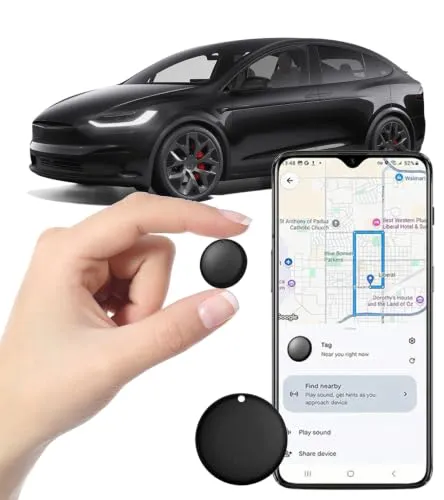
A cheap Bluetooth tag that rides in your car and reports through Apple Find My or Google Find Hub, useful for finding a parked car and not much else.
What we like
- No subscription, no SIM card and no data plan of any kind to sign up for
- Works with both Apple Find My and Google Find Hub, so it is not locked to one phone platform
- Up to 2 years of battery per the maker, far longer than any cellular tracker here
- A built in speaker rated up to 100dB helps you pin down the car in a big parking garage
What we don't
- It has no cellular radio, so it only reports a position when someone else's phone walks or drives past it
- No true geofencing, which means no alert the moment the car actually moves
- The listing contradicts itself on water resistance, claiming IP68 in the title and IP65 in the feature list
| Power source | Internal battery, no SIM card and no charging plan |
|---|---|
| Battery life | Up to 2 years per the maker on both iOS and Android |
| Subscription required | No, there is no monthly fee and no SIM |
| Update interval | Only when another phone in the network passes close enough to report it |
| Network type | Bluetooth through Apple Find My and Google Find Hub, no cellular link of its own |
| Price bracket | $ |
Understand what this is before you buy it. The zxhtqtx F08 is not a GPS tracker in the way the other four picks are. It has no cellular radio and no SIM. It is a Bluetooth tag that talks to Apple Find My and Google Find Hub, and its position on the map is really the position of the last stranger’s phone that came close enough to hear it. In a busy city that is often enough. On a rural road at 3am it reports nothing.
For what it costs, that is a fair deal. There is no plan, no activation, and the maker quotes up to 2 years of battery on both iOS and Android, so you drop it in the door pocket and forget about it. Supporting both Find My and Find Hub is genuinely useful, since most cheap tags of this type only work with iPhones. A speaker rated up to 100dB lets you make it beep once you are close, which is the feature that actually finds a car in a five level garage.
The limits are the ones you would expect from Bluetooth. There is no geofencing, so nothing pings your phone the instant the car pulls out of the driveway. Updates are not on a schedule, they happen when they happen. And if a thief parks the car somewhere with no foot traffic, the trail simply stops.
One more thing worth flagging. The listing claims IP68 waterproofing in the product title and IP65 in the feature bullets, and those are not the same rating. Treat it as splash resistant, keep it inside the cabin, and do not stick it in a wheel well.
Get it as a cheap way to find your own parked car. Get the LandAirSea 54 or the Moto Watchdog MW-800 if the point is knowing where a vehicle goes.
Research-based pick: this recommendation is based on product data, owner feedback and comparison with products we have tested, not on direct hands-on testing.
Buy it if: A driver who keeps losing the car in airport lots and shopping centres and wants a cheap backup with nothing to pay each month.
Skip it if: You are buying a tracker for theft recovery, because a stolen car parked in a quiet garage may never get reported.
How we chose#
We started with the vehicle trackers that actually sell on Amazon in the US, then compared them on the specs that decide whether a tracker is useful: how it gets power, how long it runs, whether it needs a plan and what that plan costs, how fast it refreshes, what network it uses, and how you mount it. We deliberately kept one device from each category rather than ranking five near-identical magnetic pucks, because the categories behave very differently in real use. The LandAirSea 54 was the strongest all round performer and is a high volume seller, which is a useful signal about hardware reliability. We did not fit these trackers to a car and drive them. These are research-based picks built from manufacturer data, listing specifications and aggregated owner feedback, and we say so in every review.
What to consider before buying#
Start with the legal part, because it is short and it matters. Tracking a vehicle you do not own, or tracking a person without their consent, is illegal in most states. On your own car, your own trailer or a company vehicle whose drivers know about it, you are fine.
Next, work out what you want the tracker to do. There are really three jobs. Finding a car you parked and misplaced needs almost nothing, a cheap Bluetooth tag will do. Watching how a car is driven, by a teenager or an employee, needs an OBD2 device that reads the engine. Recovering a stolen vehicle needs a hidden cellular tracker with its own battery, because the first thing a thief does is unplug anything visible.
Then think about power. A tracker plugged into the OBD2 port never needs charging but is trivially easy to find and remove. A battery tracker can hide anywhere, but a dead battery is a dead tracker, and that is how most of them fail. Size follows from this. Long battery life needs a big cell, and a big cell needs somewhere to live.
Last, budget for three years, not for today. Hardware here ranges from about $10 to $125, but a $10 a month plan adds $360 over three years. That single number reorders the whole list.
The subscription is the real price#
The tracker market is built on cheap hardware and recurring fees, the same way printers are built on cheap bodies and expensive ink. A LandAirSea 54 costs less than a case of oil, then asks $9.95 a month on an annual plan or $19.95 month to month. Bouncie asks $9.65 a month. Tracki requires activation before service starts. None of these devices do anything at all without an active plan.
Over one year that is roughly $115 to $155 in fees. Over three years it is $350 to $470. The hardware price, the number people compare when they shop, is a rounding error against that.
This is exactly why the Moto Watchdog MW-800 is worth a look even though it costs the most up front. There is no subscription, no activation charge and no fee schedule waiting for you later. Break-even against a $9.95 monthly plan arrives at around a year. Past that it is pure savings.
The catch is that a no-fee cellular device still costs its maker money in data every month, so the arrangement depends on that company staying in business. That is a real risk, not a theoretical one, and it is the honest counterweight to the cost saving.
Update speed, network type, and what real time means#
Every tracker on the market says real time. What that means in practice is the update interval, the gap between one position report and the next. The LandAirSea 54 quotes as fast as every 3 seconds. Bouncie gives up to the minute reporting. Tracki Pro runs 15 seconds to 1 minute on plan, or 1 to 5 minutes if you want months of battery.
Faster is not automatically better. A tracker reporting every 3 seconds is burning battery every 3 seconds, so a unit that would last two months at one minute intervals might last two weeks. Fast refresh earns its keep in one situation, following a stolen vehicle as it moves. For everything else, 30 to 60 seconds tells you what you need and leaves the battery alone.
Network type is the spec buyers skip and later regret. US carriers shut down their 3G networks years ago, so any old tracker built for 3G is a paperweight now. The Tracki Pro runs on 4G LTE Cat1 with a global SIM inside, which is the right answer for a device you want to keep for years. It also falls back to Wi-Fi positioning indoors, where a GPS signal cannot reach through a concrete deck.
The zxhtqtx F08 sits outside this whole discussion, because it has no cellular radio at all. It reports through Apple Find My and Google Find Hub, meaning its update interval is set by how many phones happen to walk past it. That is fine for a parking lot and useless on an empty highway.
Magnetic, OBD port, or hardwired#
Magnetic trackers stick to steel and hide anywhere you can reach. That is their whole appeal. The LandAirSea 54 is 2.25 inches square with the magnet and the waterproof case built in, and the Tracki Pro adds a screw mount alongside its magnet for assets that get bounced around. The cost is that you have to charge them, which means climbing under the car every few weeks or months depending on the settings.
OBD2 port trackers trade stealth for convenience. Bouncie plugs into the diagnostic port under the dash on any vehicle from 1996 onward, draws power from the car forever, and reads engine data no battery tracker can see. But the port is under the dash within arm’s reach, so anyone who does not want to be tracked will find it. Use an OBD2 device for monitoring, never for anti-theft. If you also want to read fault codes yourself, a dedicated OBD2 scanner does that job better.
Hardwired trackers are the third route. They splice into the vehicle’s power, so they never need charging and can be hidden deep behind trim. That is the setup most professional fleet installs use, often alongside a fleet dash cam. The downside is installation. You are running wires and either doing it yourself or paying a shop, and it is not the kind of thing you move between cars.
Pick by what you are protecting. Hidden and portable means magnetic. Data about the driver means OBD2. Permanent on a work truck means hardwired.
Final recommendation#
The LandAirSea 54 is the tracker to buy if you only read this far. It is small, it is quick, it hides well, and it costs very little up front, as long as you accept the monthly plan. Choose the Bouncie instead when you care about how the car is being driven rather than where it goes, which is most parents of new drivers and most owners of a few work vans. The Tracki Pro is for trailers, boats and equipment that sit parked for weeks, where a big battery beats a small case. The Moto Watchdog MW-800 makes sense on a car you plan to keep for years and want tracked with no monthly bill. And the zxhtqtx F08 is worth the small spend only if the goal is finding your own parked car, not recovering a stolen one. If you are already fitting electronics to the car, a dash cam covers the part a tracker cannot, which is what happened rather than where it happened.
Frequently asked questions
Is it legal to put a GPS tracker on a car?
On a vehicle you own outright, yes, in every state. The line you cannot cross is tracking a car titled to someone else or tracking a person without their consent, which is illegal in most states and can be both a crime and grounds for a civil suit. Company vehicles are usually fine if drivers are told, and a car you co-own with a spouse sits in murkier territory that varies by state. If you are unsure whether your situation qualifies, ask a lawyer before you fit the device, not after.
How much does a car GPS tracker really cost per year?
Add the plan to the hardware and the picture changes completely. The LandAirSea 54 is inexpensive to buy but its plans start at $9.95 a month on annual billing, which is close to $120 a year. Bouncie charges $9.65 a month on top of pricier hardware. Over three years either one lands in the several hundred dollar range. The Moto Watchdog MW-800 costs far more up front and charges nothing after that, so it usually wins past the first year of ownership.
Do I need a subscription for a GPS tracker?
You do for any tracker with its own cellular connection, because someone has to pay for the data it sends. That covers the LandAirSea 54, the Bouncie and the Tracki Pro. The two ways around it are a no-fee cellular device like the Moto Watchdog MW-800, where the data cost is built into the purchase price, or a Bluetooth tag like the zxhtqtx F08, which has no cellular link and piggybacks on nearby phones instead.
Will a Bluetooth tracker work for a stolen car?
Sometimes, and that is the problem. A tag like the zxhtqtx F08 reports a position only when a phone running Find My or Find Hub passes close enough to pick it up. In a dense city that can happen every few minutes. In a rural area, a closed garage or a shipping container, it may not happen at all. For theft recovery you want a cellular tracker that reports on its own schedule, such as the LandAirSea 54 or the Tracki Pro.
Where is the best place to hide a GPS tracker on a car?
Magnetic units like the LandAirSea 54 go on flat steel out of easy sight, commonly inside a rear bumper, above a wheel arch or on a frame rail. Avoid anything near the exhaust because of heat, and avoid spots buried under thick metal, which weakens the signal. Battery trackers also need to come out for charging, so pick a place you can reach. The Bouncie is the exception, since it lives in the OBD2 port and is not hidden at all.
How often does a GPS tracker update its location?
It depends on the device and the plan. The LandAirSea 54 can refresh as fast as every 3 seconds. The Tracki Pro runs 15 seconds to 1 minute on plan, or 1 to 5 minutes if you want the battery to last months. Bouncie gives up to the minute updates. Faster refresh means more accurate live chase data and a much shorter battery life, so most owners are better off at 30 to 60 seconds for daily use.
About the author

Dale Harper Lead Gear Editor
Dale is a longtime truck owner and former accessory-shop tech who builds these guides from manufacturer fit data, aggregated owner feedback and direct spec comparison. Research-based picks are always labelled as such.
Daily driver: 2022 Ford F-150 XLT SuperCrew
- Tonneau covers and bed accessories
- Seat covers and interior protection
- Lift kits and suspension