The Best Car Amplifiers: 5 Picks Compared for 2026
Five real car amplifiers compared, from a small four channel to a 3000 watt monoblock, with honest notes on RMS power, impedance and wiring.

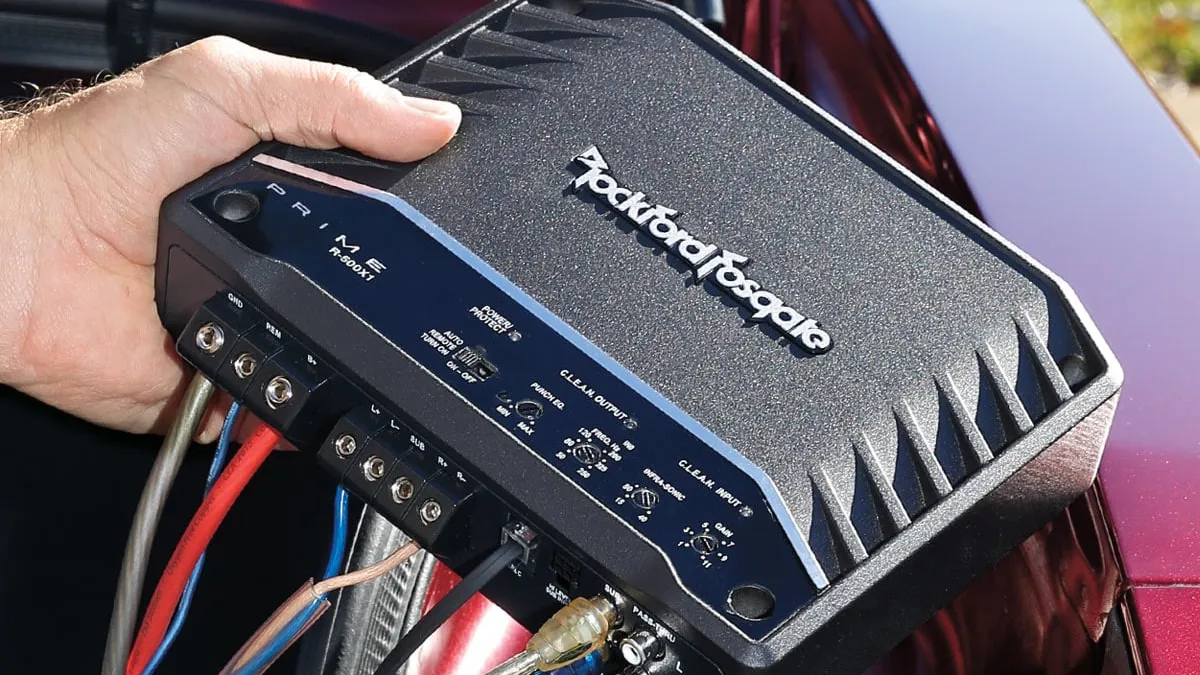
An amplifier is the part of a car audio system that decides how loud everything else gets, and it is also the part where the numbers on the box lie the most. We compared five amplifiers sold on Amazon right now and spread them across the jobs people actually buy an amp for. The Recoil RED1800.5 is a five channel amp that runs four speakers and a subwoofer from one chassis. The Pioneer GM-A6704 is a four channel Class A/B amp that states its power at a named impedance. The CT Sounds CT-1000.1D is a small monoblock for a single subwoofer. The Taramp's TS 400x4 is the cheap four channel pick. The Taramp's HD 3000 is the high power option for a build that is already rewiring the car. We compared them on channel count, published RMS power, stable impedance, class, crossovers and remote control.
Table of contents
- Quick picks
- How many channels each amplifier has
- Comparison table
- Best Overall: Recoil RED1800.5 Class-D 5-Channel Car Amplifier
- Best for Factory Speaker Upgrades: Pioneer GM-A6704 4-Channel Bridgeable Car Amplifier
- Best for a Subwoofer: CT Sounds CT-1000.1D Compact Class D Monoblock Car Amplifier
- Best Value: Taramp's TS 400x4 4-Channel Full Range Car Amplifier
- Best for High-Power Builds: Taramp's HD 3000 1 Ohm Monoblock Car Amplifier
- How we chose
- What to consider before buying
- RMS at a stated impedance is the only number worth comparing
- Class D efficiency, and why amplifiers got small
- Matching amp power to speakers, and why clipping kills more speakers than watts
- Wiring, fusing and the big three
- Final recommendation
- FAQ
Quick picks
Every pick wins a specific use case. Jump to the full review before you buy.
-
Best Overall
Recoil RED1800.5 Class-D 5-Channel Car Amplifier
A five channel Class D amp that runs four door speakers and a subwoofer from one box, with RMS figures published at three different impedances.
-
Best for Factory Speaker Upgrades
Pioneer GM-A6704 4-Channel Bridgeable Car Amplifier
A four channel Class A/B amp from a brand that states its RMS power at a named impedance, which is what makes it easy to match to speakers.
-
Best for a Subwoofer
CT Sounds CT-1000.1D Compact Class D Monoblock Car Amplifier
A small monoblock that publishes its RMS power at three impedances and all at 14.4 volts, which is the honest way to quote a car amplifier.
-
Best Value
Taramp's TS 400x4 4-Channel Full Range Car Amplifier
A cheap, small four channel Class D amp that will wake up a factory system, sold with a power rating that leaves out the impedance.
-
Best for High-Power Builds
Taramp's HD 3000 1 Ohm Monoblock Car Amplifier
A 3000 watt RMS monoblock that runs full range at 1, 2 or 4 ohms, aimed at people who already know what a 150 amp fuse is for.


Compare every pick
| Product | Award | Channel count | Rms power as listed | Stable impedance | Class type | Best for | Where to buy |
|---|---|---|---|---|---|---|---|
| Recoil RED1800.5 Class-D 5-Channel Car Amplifier | Best Overall | 5 channels, four full range plus one subwoofer channel | 140 watts RMS x 4 plus 600 watts RMS x 1 at 4 ohms, 1800 watts max | Subwoofer channel stable to 1 ohm, rated at 1, 2 and 4 ohms | Class D | Someone building a complete system in one weekend who wants speakers and a subwoofer handled by a single amplifier. | Check price for Recoil RED1800.5 Class-D 5-Channel Car Amplifier at Amazon (affiliate link) |
| Pioneer GM-A6704 4-Channel Bridgeable Car Amplifier | Best for Factory Speaker Upgrades | 4 channels | 60 watts RMS x 4 at 4 ohms, 190 watts RMS x 2 bridged, 1000 watts max | 4 ohms, the listing does not rate it any lower | Class A/B | A driver replacing tired factory door speakers who wants a clean, honestly rated amp behind them. | Check price for Pioneer GM-A6704 4-Channel Bridgeable Car Amplifier at Amazon (affiliate link) |
| CT Sounds CT-1000.1D Compact Class D Monoblock Car Amplifier | Best for a Subwoofer | 1 channel, monoblock | 1000 watts RMS at 1 ohm, 650 at 2 ohms, 350 at 4 ohms, all at 14.4 volts | 1 ohm | Class D | Anyone adding a single subwoofer to an otherwise stock system and wanting the power figure to mean something. | Check price for CT Sounds CT-1000.1D Compact Class D Monoblock Car Amplifier at Amazon (affiliate link) |
| Taramp's TS 400x4 4-Channel Full Range Car Amplifier | Best Value | 4 channels | 400 watts RMS total, the listing does not state the impedance | Not published on the listing | Class D | A first system on a small budget, where the goal is louder and cleaner than the factory radio rather than competition sound. | Check price for Taramp's TS 400x4 4-Channel Full Range Car Amplifier at Amazon (affiliate link) |
| Taramp's HD 3000 1 Ohm Monoblock Car Amplifier | Best for High-Power Builds | 1 channel, monoblock full range | 3000 watts RMS at 1 ohm | 1, 2 or 4 ohms | Class D, digital | A loud build with multiple subwoofers where the electrical system is going to be upgraded anyway. | Check price for Taramp's HD 3000 1 Ohm Monoblock Car Amplifier at Amazon (affiliate link) |
Swipe sideways to compare every column.
Best Overall
Recoil RED1800.5 Class-D 5-Channel Car Amplifier
by Recoil
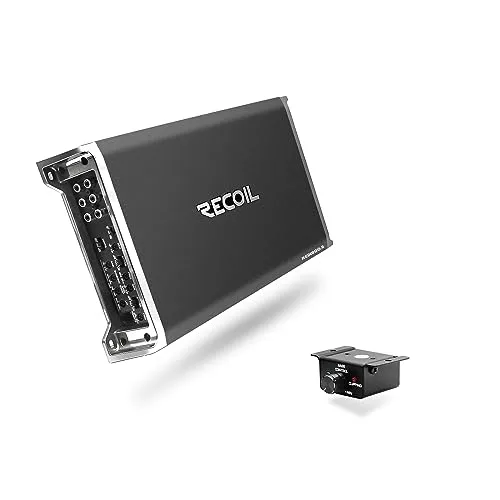
A five channel Class D amp that runs four door speakers and a subwoofer from one box, with RMS figures published at three different impedances.
What we like
- Publishes RMS power at 1, 2 and 4 ohms instead of leaning on the 1800 watt max number in the title
- Five channels means one power run, one ground and one fuse rather than two amplifiers fighting for space
- The mono channel is stable to 1 ohm, so it can drive a dual voice coil subwoofer wired down low
- Gain, low pass, subsonic filter and bass EQ are all on the amp, plus a bass remote knob in the box
What we don't
- At 14.6 inches long and 7.6 inches wide it is the biggest amp here, and a five channel chassis has to go somewhere
- It is the most expensive pick in this comparison
- 140 watts RMS per full range channel at 4 ohms is respectable but not huge, so it will not push aftermarket component speakers hard
| Channel count | 5 channels, four full range plus one subwoofer channel |
|---|---|
| Rms power as listed | 140 watts RMS x 4 plus 600 watts RMS x 1 at 4 ohms, 1800 watts max |
| Stable impedance | Subwoofer channel stable to 1 ohm, rated at 1, 2 and 4 ohms |
| Class type | Class D |
| Remote bass control | Yes, a bass remote knob is included |
| Install difficulty | Moderate |
| Price bracket | $$$ |
Five channel amps exist to solve a packaging problem. A car has four speakers and, if you want bass, a subwoofer. That is two amplifiers in most builds, which means two power cables to the battery, two grounds, two fuses and twice the hunting for somewhere flat to bolt things. The RED1800.5 folds all of that into one chassis.
The power ratings are the reason it leads this list. Recoil publishes 140 watts RMS on each of the four full range channels at 4 ohms plus 600 watts RMS on the sub channel, then repeats the whole set at 2 ohms and gives the mono channel a 1280 watt figure at 1 ohm. Three impedances, spelled out. Most listings in this category give you one number and leave you guessing.
The 1 ohm mono channel matters more than it sounds. Most aftermarket subwoofers are dual voice coil, and wiring the coils together often lands you at 1 ohm. An amp that is not built for that load runs hot and trips its protection circuit mid song. This one is rated for it.
Controls are complete. There is a gain, a low pass filter, a subsonic filter and a bass EQ on the panel, and a remote bass knob so you can pull the subwoofer back for a podcast without crawling under a seat.
The size is the trade. At 14.6 by 7.6 by 2.2 inches this is a real piece of hardware, and under a seat is probably out. Plan for a trunk wall or a false floor. And 140 watts a channel is enough to make factory speakers sound alive, but it will not wring the most out of a serious component set.
Research-based pick: this recommendation is based on product data, owner feedback and comparison with products we have tested, not on direct hands-on testing.
Buy it if: Someone building a complete system in one weekend who wants speakers and a subwoofer handled by a single amplifier.
Skip it if: You only need bass, in which case a monoblock costs less and takes up half the room.
Best for Factory Speaker Upgrades
Pioneer GM-A6704 4-Channel Bridgeable Car Amplifier
by Pioneer
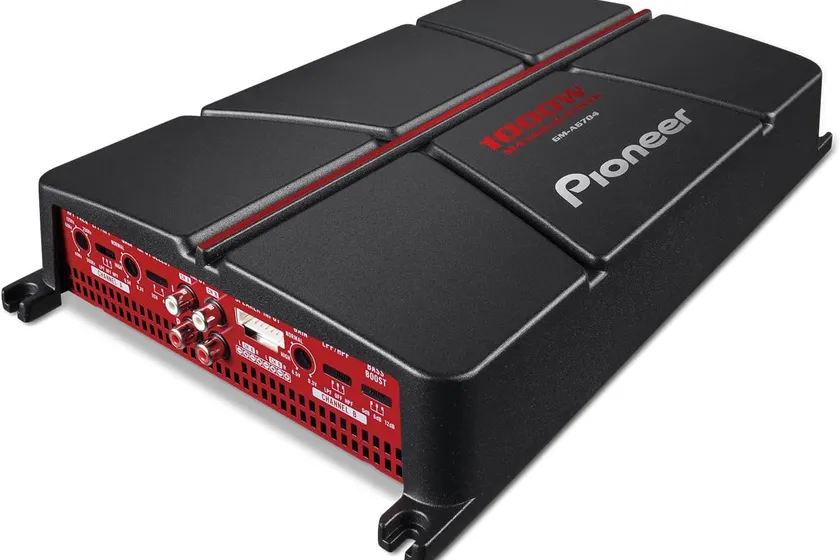
A four channel Class A/B amp from a brand that states its RMS power at a named impedance, which is what makes it easy to match to speakers.
What we like
- States 60 watts RMS x 4 at 4 ohms, so you can match it to a speaker's RMS rating without guessing
- Class A/B circuitry is the older, simpler design and it is still what many people prefer for door speakers and tweeters
- Bridges to 190 watts RMS x 2, so it can run a front pair plus a small subwoofer instead of four speakers
- Variable high pass and low pass filters let you keep bass out of small door speakers
What we don't
- Class A/B wastes more energy as heat than Class D, so this amp needs breathing room and will get warm
- 60 watts RMS a channel is a modest number for the price, and cheaper Class D amps claim more
- No bass remote is listed, so subwoofer level has to be set at the amp
- The listing does not rate it below 4 ohms, so a 2 ohm speaker load is not something the spec sheet supports
| Channel count | 4 channels |
|---|---|
| Rms power as listed | 60 watts RMS x 4 at 4 ohms, 190 watts RMS x 2 bridged, 1000 watts max |
| Stable impedance | 4 ohms, the listing does not rate it any lower |
| Class type | Class A/B |
| Built in crossover | Variable high pass and low pass filters |
| Install difficulty | Moderate |
| Price bracket | $$ |
The number in the title of this amp is 1000 watts max. Ignore it. The number that decides how it sounds is further down the listing: 60 watts RMS on each of four channels at 4 ohms. Pioneer states the impedance alongside the wattage, which is the whole point, and it is the reason this amp is easy to shop with.
Sixty watts a channel does not read as much. In practice it is roughly four to five times what a factory head unit sends to a door speaker, and factory speakers are usually rated somewhere between 40 and 60 watts RMS. That is a sensible match, not an underpowered one. If you are pairing this with a new set of car speakers, check their RMS rating first and buy speakers in that range.
Class A/B is the trade you are making here. It is the older topology, it runs the output transistors in a way that converts more of your battery’s energy into heat, and that is why this amp is bigger than a Class D amp of similar power. Pioneer calls out low crossover distortion as a benefit of the design. Whether you can hear the difference in a moving car is arguable. What is not arguable is that a hot amp needs airflow, so do not bury it under carpet.
Bridging is the flexible part. Two channels combine into one at 190 watts RMS, so you can run a front pair of speakers on two channels and put a small subwoofer on the bridged pair. That turns a four channel amp into a two speaker plus bass system without a second box.
The limits are real. There is no remote level knob, so subwoofer volume gets set once at the amp. And Pioneer does not rate this below 4 ohms, so it is not the amp for a low impedance experiment.
Research-based pick: this recommendation is based on product data, owner feedback and comparison with products we have tested, not on direct hands-on testing.
Buy it if: A driver replacing tired factory door speakers who wants a clean, honestly rated amp behind them.
Skip it if: You want the most watts per dollar, because Class D picks here publish much larger numbers for similar money.
Best for a Subwoofer
CT Sounds CT-1000.1D Compact Class D Monoblock Car Amplifier
by CT Sounds
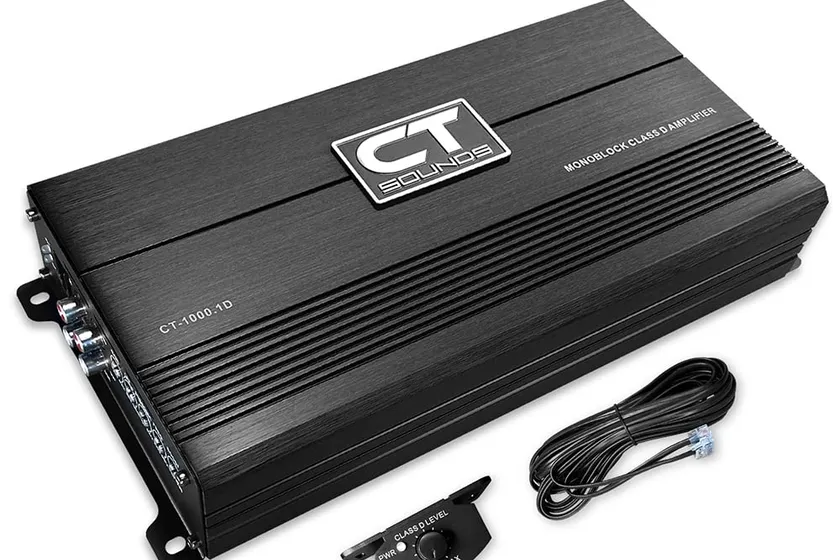
A small monoblock that publishes its RMS power at three impedances and all at 14.4 volts, which is the honest way to quote a car amplifier.
What we like
- Quotes 1000 watts RMS at 1 ohm, 650 at 2 ohms and 350 at 4 ohms, and names 14.4 volts as the test voltage
- Small chassis, so it fits behind a seat or on the back of a subwoofer box where a full size amp will not
- Four way protection covers high voltage, low voltage, over current and high temperature
- A bass knob is in the box, so subwoofer level is adjustable from the driver's seat
What we don't
- The 0 to 320 Hz frequency response means it is a subwoofer amp only and cannot run door speakers
- It costs more than amps here that claim two or three times the power on paper
- CT Sounds does not publish the chassis dimensions, so you cannot plan a tight mounting spot before it arrives
| Channel count | 1 channel, monoblock |
|---|---|
| Rms power as listed | 1000 watts RMS at 1 ohm, 650 at 2 ohms, 350 at 4 ohms, all at 14.4 volts |
| Stable impedance | 1 ohm |
| Class type | Class D |
| Remote bass control | Yes, a bass knob is included |
| Install difficulty | Moderate |
| Price bracket | $$$ |
Most car amplifier listings give you a wattage and hope you stop reading. CT Sounds gives you three of them, one for each common impedance, and then names the voltage the amp was measured at. That last detail is the tell of a spec sheet written by someone who cares. A car’s electrical system sits near 12.6 volts with the engine off and around 14.4 volts with it running, and an amplifier makes noticeably more power at the higher figure. Quoting 14.4 volts is standard practice among honest brands.
The numbers themselves are straightforward. At 4 ohms you get 350 watts RMS. Halve the impedance to 2 ohms and you get 650. Halve it again to 1 ohm and you get 1000. That is not quite doubling each time, which is exactly what you should expect from a real amplifier rather than a calculator.
The size is the second reason to buy it. CT Sounds calls the chassis compact and pitches it for tight installs, and a monoblock has fewer output stages to cool than a multichannel amp, so it can be genuinely small. Behind a rear seat or bolted to the back of a subwoofer enclosure both become options.
Understand what it will not do. The frequency response tops out at 320 Hz. That is a subwoofer amplifier and nothing else. Door speakers connected to it would sound like they were playing through a wall. If you want one amp for the whole system, look at a five channel instead.
The other honest note is price. There are amps in this guide printing bigger numbers for less money. You are paying for the power rating to be true across the whole range, which is a fair thing to pay for when you have already bought a car subwoofer you would rather not cook.
Research-based pick: this recommendation is based on product data, owner feedback and comparison with products we have tested, not on direct hands-on testing.
Buy it if: Anyone adding a single subwoofer to an otherwise stock system and wanting the power figure to mean something.
Skip it if: You need one amplifier to handle speakers as well, because this one only passes bass frequencies.
Best Value
Taramp's TS 400x4 4-Channel Full Range Car Amplifier
by Taramp's
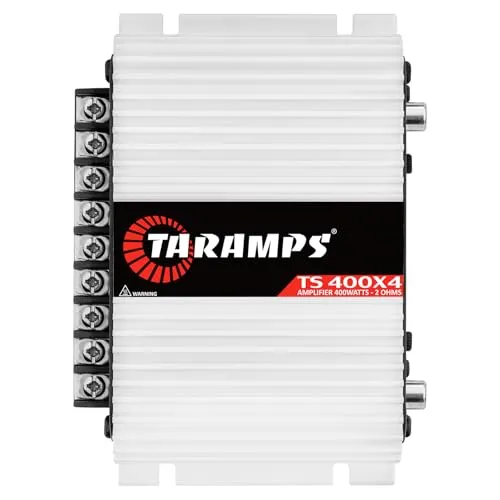
A cheap, small four channel Class D amp that will wake up a factory system, sold with a power rating that leaves out the impedance.
What we like
- The lowest price of the five picks by a wide margin, and the most popular of them on Amazon by sales rank
- Class D and physically small, so it hides behind a kick panel or under a seat where bigger amps will not go
- Two of the four channels bridge, so you can run a front pair plus one bridged output for bass
- Four channels at this price is unusual, since most budget amps at similar money are two channel
What we don't
- The listing states 400 watts RMS but never says at what impedance, so the figure cannot be compared to a rated speaker
- No stable impedance is published either, so wiring a low load is a guess rather than a decision
- The listing gives no crossover detail, meaning you may need to filter bass out of small door speakers at the head unit instead
- Taramp's states in the listing that professional installation is strongly recommended, which adds cost if you are not comfortable wiring it
| Channel count | 4 channels |
|---|---|
| Rms power as listed | 400 watts RMS total, the listing does not state the impedance |
| Stable impedance | Not published on the listing |
| Class type | Class D |
| Bridgeable | Yes, 2 bridged channels |
| Install difficulty | Moderate |
| Price bracket | $$ |
This is the cheap one, and cheap is a legitimate reason to buy an amplifier. A factory head unit sends something like 15 watts to each door speaker. Almost any outboard amp is a step up from that, and the TS 400x4 is a four channel Class D box that costs less than a set of decent speakers.
Now the uncomfortable part, and it is the whole reason this pick is not higher. The listing says 400 watts RMS across four channels. It does not say at what impedance. That single missing word turns a useful figure into a marketing one, because 100 watts a channel at 2 ohms and 100 watts a channel at 4 ohms are different products. Taramp’s also does not publish a stable impedance, so there is no spec sheet answer to whether you can safely wire a 2 ohm load.
We are naming that gap rather than filling it in. Assuming 100 watts RMS a channel at 4 ohms would be a guess, and a guess in a spec table is worse than a blank, because a reader will treat it as a fact and buy speakers around it.
What you can verify is the shape of the thing. It is Class D, which is why it is small and why it does not need a large heatsink. Two channels bridge, so a front pair of speakers plus one bridged channel for a small subwoofer is a workable layout. Taramp’s is a Brazilian brand with a long history in car audio and it sells a lot of these.
Treat it as a volume upgrade, not a precision instrument. Set the gain by ear at a level where nothing distorts, keep the head unit below its own clipping point, and it will do the job it was bought for.
Research-based pick: this recommendation is based on product data, owner feedback and comparison with products we have tested, not on direct hands-on testing.
Buy it if: A first system on a small budget, where the goal is louder and cleaner than the factory radio rather than competition sound.
Skip it if: You want to match power precisely to a speaker's RMS rating, because this listing does not give you the numbers to do it.
Best for High-Power Builds
Taramp's HD 3000 1 Ohm Monoblock Car Amplifier
by Taramp's
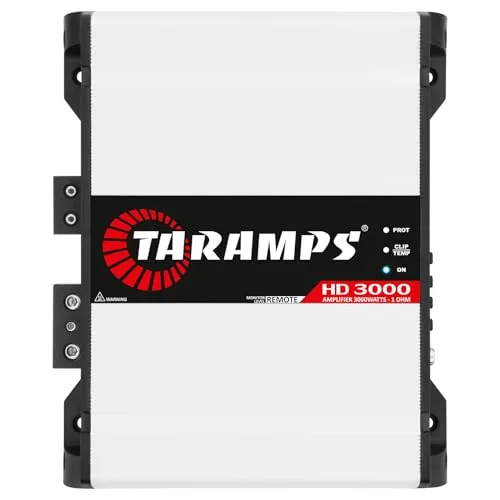
A 3000 watt RMS monoblock that runs full range at 1, 2 or 4 ohms, aimed at people who already know what a 150 amp fuse is for.
What we like
- Quotes 3000 watts RMS at 1 ohm, by far the largest continuous rating in this comparison
- Runs full range from 10 Hz to 20 kHz, so it can drive mid bass or midrange drivers as well as subwoofers
- Operates at 1, 2 or 4 ohms, which gives you room to change the subwoofer wiring later without changing the amp
- Taramp's publishes the wiring it expects, 4 AWG power and ground, 9 AWG output and a 150 amp fuse
What we don't
- A 150 amp fuse means the stock alternator, battery cable and ground strap all need looking at, and that is real extra cost
- Being mono, it can only be one thing in the system, so speakers still need their own amplifier
- The Monitor Level Remote is listed as compatible rather than included, so plan on sourcing it separately
- Taramp's publishes no chassis dimensions, so you cannot confirm it fits your chosen spot before ordering
| Channel count | 1 channel, monoblock full range |
|---|---|
| Rms power as listed | 3000 watts RMS at 1 ohm |
| Stable impedance | 1, 2 or 4 ohms |
| Class type | Class D, digital |
| Built in crossover | Low pass and high pass crossover, plus bass boost and gain |
| Install difficulty | Hard |
| Price bracket | $$$ |
Three thousand watts RMS is a serious claim, and Taramp’s at least attaches it to a named impedance. The HD 3000 is rated at 1 ohm, and the listing tells you what wiring that rating assumes: 4 AWG for power and ground, 9 AWG on the outputs, 18 AWG for the remote turn on lead, and a 150 amp circuit breaker or fuse.
Read that fuse figure again, because it is the honest cost of this amplifier. A 150 amp fuse is roughly a tenth of what a small car’s entire electrical system is built around. An amp drawing near that will dim headlights, load the alternator and expose every weak ground in the car. The usual fix is the big three upgrade, which means heavier cable from alternator to battery, battery to chassis and engine block to chassis. Budget for it before you budget for the amp.
The full range part is genuinely useful and often overlooked. Most monoblocks are low pass only and stop somewhere around 250 Hz. This one runs 10 Hz to 20 kHz, so it can be used on mid bass drivers or a pair of large midranges instead of a subwoofer. That is why competition builds use it in stacks, one amp per pair of drivers.
Being mono is still a limit. It does one job at a time. Door speakers need their own channels, so this is a second amplifier in most systems, not the only one.
Buy it if the plan is loud and the electrical work is already on the list. If the plan is a single sealed subwoofer in a daily driver, a 1000 watt monoblock costs less, fits easier and will not make you rewire the car.
Research-based pick: this recommendation is based on product data, owner feedback and comparison with products we have tested, not on direct hands-on testing.
Buy it if: A loud build with multiple subwoofers where the electrical system is going to be upgraded anyway.
Skip it if: This is your first amplifier, because the wiring and charging demands are a project on their own.
How we chose#
This is a research-based comparison, not a bench test. We pulled live Amazon listings, then judged each amplifier on what a spec sheet can prove: channel count, the RMS power the brand is willing to publish, the impedance that rating was measured at, the amplifier class, the crossovers on board, and whether a remote level control is in the box.
We spread the five picks across jobs rather than ranking five near-identical monoblocks: a five channel amp for a whole system, a four channel Class A/B amp for speakers, a compact monoblock for one subwoofer, a budget four channel amp, and a high power monoblock for a build with no limits.
Amazon returned no star ratings or review counts for these products, so nothing here rests on either. Where a listing leaves out the impedance or the stable load, we say so, because a wattage with no impedance attached is not a specification.
What to consider before buying#
Start with the job, not the wattage. If the goal is to make tired factory speakers sound alive, you want a four channel amp and modest, honest power. If the goal is bass, you want a monoblock. If it is both and you only want to run one power cable, you want five channels. Buying the wrong shape of amplifier is a more expensive mistake than buying one that is 200 watts short.
Then check what the amp will connect to. Some amps only take RCA inputs, which a factory radio usually does not have. High level or speaker level inputs let you tap the existing speaker wires instead. If your amp is RCA only and your radio has no preamp outputs, you need a line output converter, which is another part and another wiring step. Replacing the radio is the other route, and our guide to car stereos covers that side.
Add up the whole install before you commit. You also need power cable sized to the draw, a fuse near the battery, a ground point, a remote turn on wire and either RCA leads or a speaker level harness. On a big amp like the Taramp’s HD 3000, that wiring can cost as much as the amp. Space matters too. The Recoil RED1800.5 is 14.6 inches long, so plan on a trunk wall rather than an under seat spot.
RMS at a stated impedance is the only number worth comparing#
Every car amplifier listing carries at least two power figures, and only one means anything. Peak power, sometimes labelled max power, is the biggest number the brand can defend for a split second. RMS power is continuous, the amount the amp can deliver through a whole song without falling over.
The gap between them is large and deliberate. The Recoil is sold as an 1800 watt amp and its real rating is 140 watts RMS on each of four channels plus 600 watts RMS on the sub channel at 4 ohms. The Pioneer is sold as 1000 watts and delivers 60 watts RMS a channel. Neither brand is lying, exactly. They are just putting the useless number in the title.
RMS alone is still not enough, because power changes with impedance. The CT Sounds CT-1000.1D shows this: 350 watts RMS at 4 ohms, 650 at 2 ohms, 1000 at 1 ohm. Same amp, three answers.
This is where the Taramp’s TS 400x4 falls short. The listing says 400 watts RMS across four channels and never states the impedance. We could have written 100 watts RMS a channel at 4 ohms in the spec table and nobody would have noticed. We did not, because that would be an invented figure. The honest entry is that the impedance is not published.
The standard that fixes this is CEA-2006, now CTA-2006. It forces brands to measure at 14.4 volts into 4 ohms with distortion capped at one percent, so two compliant amps can be compared straight across. None of the five listings here claims compliance. When one does, that is worth more than any wattage on the box.
Class D efficiency, and why amplifiers got small#
Amplifier class describes how the output stage handles the signal, and it explains most of the size difference between the picks here. Class A/B, which the Pioneer GM-A6704 uses, keeps the output transistors partly switched on at all times. That is smooth through the middle of the waveform, and it also means a good share of your battery’s energy leaves as heat instead of sound.
Class D switches the output devices fully on or fully off, very fast, then filters the result back into an audio waveform. A transistor that is fully on or fully off wastes little energy, so efficiency is high. That is why the Recoil, the CT Sounds and both Taramp’s amps are Class D, and why a 1000 watt Class D monoblock can be smaller than a 240 watt Class A/B four channel. It also changes what your car has to supply, since an inefficient amp draws more current to make the same sound.
The old objection to Class D was sound quality on high frequencies. It was fair twenty years ago and it is much less relevant now, which is why nearly every subwoofer amp sold today is Class D. If you specifically want Class A/B for door speakers, the Pioneer is your pick here.
Matching amp power to speakers, and why clipping kills more speakers than watts#
The instinct is to buy an amplifier weaker than the speakers so nothing gets damaged. That instinct is backwards, and it is responsible for a lot of dead voice coils. An amplifier has a maximum clean output. Push it past that and the peaks of the waveform get flattened off, which is called clipping. A clipped signal is closer to a square wave than a sine wave, and it delivers far more average power into the voice coil as heat. The coil overheats, the glue softens, and the speaker fails.
The practical rule is to buy clean power slightly above the speaker’s RMS rating, then set the gain so it never clips. Gain is not a volume knob. It matches the amplifier’s input sensitivity to the output of your head unit. Set the head unit to about three quarters, raise the gain only until you hear distortion, then back off.
Impedance is the other half of the match. Lower impedance makes an amp work harder and produce more power, which sounds free and is not. Run a 2 ohm load into an amp rated only for 4 ohms and it runs hot, hits thermal protection and shuts down mid song. Do it repeatedly and the output stage fails. The Pioneer is rated at 4 ohms and the listing goes no lower, so wire it accordingly. If you are pairing an amp with a car subwoofer, work out the final coil wiring before you order either part.
Wiring, fusing and the big three#
An amplifier is a large electrical load bolted to a car that was not designed for it, and the wiring is where most first builds go wrong. Cable gauge follows current draw. A modest four channel amp is generally fine on 8 gauge. The Taramp’s HD 3000 asks for 4 AWG power and ground, 9 AWG on the outputs and a 150 amp fuse, and that fuse rating is the number to watch, because 150 amps is a serious load for a standard charging system.
The fuse goes within roughly 18 inches of the battery, and it protects the cable rather than the amplifier. If the power wire ever chafes through to the body, that fuse is the only thing standing between you and a fire under the carpet. Never fit one larger than the cable is rated for. Grounding is the other rushed step. Use bare chassis metal, sand off the paint, match the power cable gauge and keep the run short. A long or painted ground is the usual cause of alternator whine, the rising and falling noise that tracks engine speed.
The big three upgrade matters once you pass roughly 1000 watts RMS. It means replacing three factory cables with heavy gauge: alternator to battery, battery to chassis, and engine block to chassis. It does not add power. It stops the voltage sagging when the bass hits, which is what makes headlights dim.
Final recommendation#
Most people building a full system should buy the Recoil RED1800.5. Four speaker channels plus a 1 ohm stable subwoofer channel in one chassis means one power run and one fuse, and Recoil publishes RMS figures at three impedances instead of hiding behind the number in the title. If you only want your door speakers to come alive, the Pioneer GM-A6704 gives you Class A/B and a plainly stated 60 watts RMS a channel at 4 ohms. If bass is the whole point and space is tight, the CT Sounds CT-1000.1D is the most honestly specified amp here and it fits where the others will not. On a small budget, the Taramp’s TS 400x4 gets you four Class D channels for very little, as long as you accept that its power rating has no impedance attached. And if the build is meant to be loud and the wiring work is already on the list, the Taramp’s HD 3000 delivers 3000 watts RMS at 1 ohm and tells you upfront that it wants 4 AWG cable and a 150 amp fuse.
Frequently asked questions
How many watts do I actually need in a car amplifier?
Less than the marketing suggests. A factory head unit sends roughly 15 watts to each door speaker, so a four channel amp at 60 watts RMS a channel, like the Pioneer GM-A6704, is already a four times jump. Most factory and entry aftermarket speakers are rated between 40 and 60 watts RMS, and matching that range is the right target. Subwoofers are the exception, since they need real current to move a heavy cone. A single 10 or 12 inch sub is usually happy somewhere between 300 and 1000 watts RMS.
What does RMS power mean and why is peak power useless?
RMS is continuous power, the amount an amplifier can deliver all the way through a song. Peak, or max, is the largest figure the marketing team could justify over a fraction of a second. The Recoil is titled 1800 watts max but its real numbers are 140 watts RMS x 4 plus 600 watts RMS x 1 at 4 ohms. The Pioneer is titled 1000 watts max and delivers 60 watts RMS x 4. Always compare RMS to RMS, and always check the impedance the RMS figure was measured at.
What is CEA-2006 and should I look for it?
CEA-2006, now called CTA-2006, is a voluntary standard that makes brands measure power the same way, at 14.4 volts into 4 ohms with distortion held to one percent. An amp with a compliant rating can be compared directly to another one. None of the five listings here claims CEA-2006 compliance, which is normal for this price band. The next best thing is a brand that states RMS power, the impedance and the test voltage. CT Sounds does all three on the CT-1000.1D.
Can I run door speakers and a subwoofer from one amplifier?
Yes, and there are two ways. A five channel amp like the Recoil RED1800.5 gives you four full range channels and a dedicated subwoofer channel in one box, which means one power cable and one fuse. The other way is bridging. The Pioneer GM-A6704 and the Taramp's TS 400x4 both bridge two channels into one, so you can run a front pair of speakers and put a small subwoofer on the bridged output. Bridging works, but it halves your speaker count.
What size power wire and fuse does a car amplifier need?
It depends on current draw, and current draw follows power. A modest four channel amp is usually fine on 8 gauge cable with a 40 to 60 amp fuse. The Taramp's HD 3000 is at the other end of the scale and the listing calls for 4 AWG power and ground with a 150 amp fuse. The fuse always goes within about 18 inches of the battery, because its job is to protect the cable, not the amplifier. Ground the amp to bare chassis metal with a short run of the same gauge.
Will underpowering a speaker damage it?
It can, and it happens more often than blowing a speaker with too much power. A small amplifier pushed past its limit clips, meaning the top of the waveform gets flattened into something closer to a square wave. That clipped signal dumps far more heat into the voice coil than clean power does, and the coil cooks. This is why a 60 watt amp run at full tilt kills speakers that a 100 watt amp run gently never would. Buy a bit more clean power than you think you need, then set the gain properly.
About the author

Dale Harper Lead Gear Editor
Dale is a longtime truck owner and former accessory-shop tech who builds these guides from manufacturer fit data, aggregated owner feedback and direct spec comparison. Research-based picks are always labelled as such.
Daily driver: 2022 Ford F-150 XLT SuperCrew
- Tonneau covers and bed accessories
- Seat covers and interior protection
- Lift kits and suspension