The Best Trailer Brake Controllers: 5 Picks Compared for 2026
Five trailer brake controllers compared on proportional versus time delay braking, axle support, wiring and mounting, plus what a cheap unit costs you.

If your trailer has electric brakes, the controller in the cab is what decides whether stopping feels normal or feels like being shoved. It is a small box, it is not expensive, and most people buy the wrong type. This guide compares five real controllers sold on Amazon in the United States, picked to cover five different jobs rather than five versions of the same thing. The REDARC Tow-Pro Liberty hides behind the dash and leaves only a small dial in sight. The Lrichy 8508211 is proportional braking for under fifty dollars and handles up to four axles. The HRepair 90160 adds boost settings for heavy loads and drops into trucks already wired for a Tekonsha Primus IQ. The CURT 51181 Echo plugs into the 7-way socket and runs from your phone, so it moves between trucks. The CURT 51116 Venturer Next is the time delay option, and this guide is honest about why that matters.
Table of contents
- Quick picks
- How many trailer axles each controller can run
- Comparison table
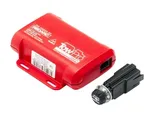
- Best Overall: REDARC Tow-Pro Liberty Electric Trailer Brake Controller
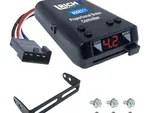
- Best Value: Lrichy 8508211 Proportional Trailer Brake Controller
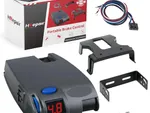
- Best for Heavy Loads: HRepair Universal Proportional Trailer Brake Controller 90160
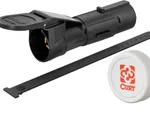
- Best Wireless Option: CURT 51181 Echo Mobile Bluetooth Trailer Brake Controller Kit
- Best Time Delay Pick: CURT 51116 Venturer Next Electric Trailer Brake Controller
- How we chose
- What to consider before buying
- Proportional and time delay, the difference you feel at every stop
- Why a vehicle specific harness turns this into a plug-in job
- Mounting angle, leveling and what modern sensors handle
- Setting gain properly on a loaded trailer
- Final recommendation
- FAQ
Quick picks
Every pick wins a specific use case. Jump to the full review before you buy.
-
Best Overall
REDARC Tow-Pro Liberty Electric Trailer Brake Controller
A proportional controller that hides behind the dash and leaves only a small dial in view, which suits anyone who tows often and hates a box hanging under the steering column.
-
Best Value
Lrichy 8508211 Proportional Trailer Brake Controller
A proportional controller with a digital display and a manual lever at a price where most rivals are still selling you a time delay unit.
-
Best for Heavy Loads
HRepair Universal Proportional Trailer Brake Controller 90160
A proportional dash controller with three boost levels, made as a drop-in replacement for the Tekonsha 90160 Primus IQ that many trucks already have.
-
Best Wireless Option
CURT 51181 Echo Mobile Bluetooth Trailer Brake Controller Kit
A proportional brake controller that plugs into the 7-way socket and is run from your phone, for people who tow with a borrowed or rented truck.
-
Best Time Delay Pick
CURT 51116 Venturer Next Electric Trailer Brake Controller
A slim time delay controller from an established towing brand, worth buying only if your budget or your dash space rules out a proportional unit.
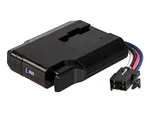
Compare every pick
| Product | Award | Controller type | Axles supported | Display type | Best for | Where to buy |
|---|---|---|---|---|---|---|
| REDARC Tow-Pro Liberty Electric Trailer Brake Controller | Best Overall | Proportional, with active calibration and sway control | 2 axles maximum (1 to 2 axle trailers) | Illuminated remote dial, no digital screen | Someone who tows a single or double axle camper or boat regularly and wants a clean factory look in the cab. | Check price for REDARC Tow-Pro Liberty Electric Trailer Brake Controller at Amazon (affiliate link) |
| Lrichy 8508211 Proportional Trailer Brake Controller | Best Value | Proportional, internal sensors read the tow vehicle's braking | 4 axles maximum (2, 4, 6 or 8 brakes) | LED digital display showing settings, diagnostics and alarms | A first time tower who wants proper proportional braking without spending more than the trailer is worth. | Check price for Lrichy 8508211 Proportional Trailer Brake Controller at Amazon (affiliate link) |
| HRepair Universal Proportional Trailer Brake Controller 90160 | Best for Heavy Loads | Proportional, with three boost settings for heavier loads | 3 axles maximum (1 to 3 axle trailers) | Digital screen showing brake settings, connection status and continuous diagnostics | Someone towing near the top of their truck's rating who wants extra bite at the start of every stop. | Check price for HRepair Universal Proportional Trailer Brake Controller 90160 at Amazon (affiliate link) |
| CURT 51181 Echo Mobile Bluetooth Trailer Brake Controller Kit | Best Wireless Option | Proportional, using a triple-axis accelerometer | 2 axles maximum (2 to 4 electric brakes) | Smartphone app on Apple or Android, no fixed screen in the truck | Anyone who tows with more than one vehicle, or who cannot cut into a leased or rented truck's wiring. | Check price for CURT 51181 Echo Mobile Bluetooth Trailer Brake Controller Kit at Amazon (affiliate link) |
| CURT 51116 Venturer Next Electric Trailer Brake Controller | Best Time Delay Pick | Time delay, with adjustable power and ramp time | 3 axles maximum (2 to 6 trailer brakes) | Simple indicator, no app and no diagnostics screen | A driver who needs a compact controller from a known brand and tows a light trailer on quiet roads. | Check price for CURT 51116 Venturer Next Electric Trailer Brake Controller at Amazon (affiliate link) |
Swipe sideways to compare every column.
Best Overall
REDARC Tow-Pro Liberty Electric Trailer Brake Controller
by REDARC
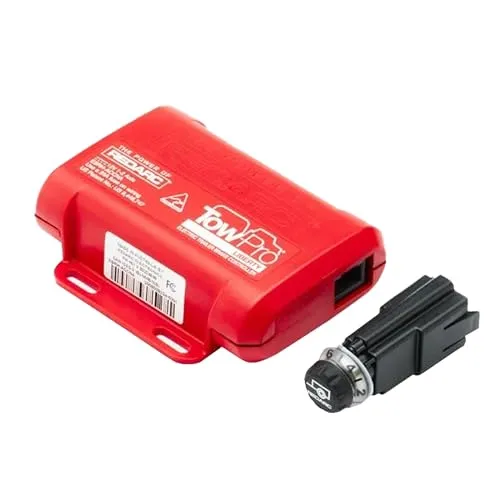
A proportional controller that hides behind the dash and leaves only a small dial in view, which suits anyone who tows often and hates a box hanging under the steering column.
What we like
- Proportional braking with active calibration, so trailer braking matches how hard you press the pedal
- The main module mounts out of sight and only a small round dial sits on the dash, so nothing hits your knee
- REDARC lists sway control as part of the system, which helps on open highway with a light trailer behind you
- Backed by a 2 year limited warranty from a towing brand that has been around for more than 45 years
What we don't
- No wiring harness in the box, so budget for the universal TPH-025 pigtail or a vehicle specific harness on top of the price
- Rated for 1 to 2 axle trailers only, so a triple axle car hauler or a big fifth wheel is out
- No digital display, so you read brake output by feel and dial position instead of a number on a screen
- The hidden module and switch panel install takes longer than clipping a box to the dash
| Controller type | Proportional, with active calibration and sway control |
|---|---|
| Axles supported | 2 axles maximum (1 to 2 axle trailers) |
| Display type | Illuminated remote dial, no digital screen |
| Mounting style | Main unit hidden behind the dash, small dial mounted in a blank switch slot |
| Wiring harness included | No, universal pigtail TPH-025 or a vehicle specific harness is sold separately |
| Install difficulty | Moderate |
| Price bracket | $$$ |
The Tow-Pro Liberty splits the job into two parts. The controller itself is a sealed module that you tuck behind the dash, and the only thing you see is a small dial that fits into a spare switch blank. That layout solves the oldest complaint about brake controllers, which is a plastic box bolted under the column right where your right knee lands every time you climb out.
It brakes proportionally. Internal sensors read what your truck is doing and send the trailer the same amount of braking, so a gentle roll up to a red light stays gentle. REDARC calls its setup routine active calibration, and the listing also credits the system with sway control that works with or without a trailer attached.
The catch is the shopping list. The universal version does not include the wiring harness. You either add the TPH-025 pigtail and wire it yourself, or you buy the vehicle specific harness and switch insert for your truck. That is real money and real time on top of a controller that already costs more than most.
The other limit is capacity. REDARC supports 1 to 2 axles here, which covers most travel trailers, boats and single axle utility trailers, but not the three and four axle rigs the cheaper dash units handle.
Choose it if you tow the same trailer often and want the cab to look like the truck came that way. If you want a screen and a lever, the Lrichy 8508211 gives you both for far less money.
Research-based pick: this recommendation is based on product data, owner feedback and comparison with products we have tested, not on direct hands-on testing.
Buy it if: Someone who tows a single or double axle camper or boat regularly and wants a clean factory look in the cab.
Skip it if: You want a screen showing live brake output, or your trailer has three or four axles.
Best Value
Lrichy 8508211 Proportional Trailer Brake Controller
by Lrichy
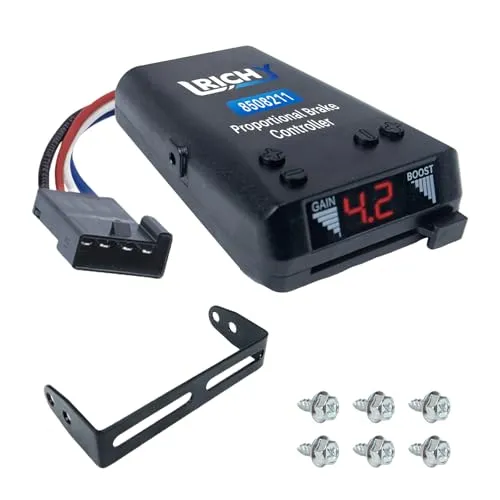
A proportional controller with a digital display and a manual lever at a price where most rivals are still selling you a time delay unit.
What we like
- Proportional braking at well under fifty dollars, which is the cheapest way to avoid a time delay unit
- Handles 1 to 4 axles, so it covers 2, 4, 6 and 8 brake trailers that the compact units cannot
- LED digital display shows settings, live diagnostics and alarms, so a wiring fault shows up as a message instead of a mystery
- Lrichy lists a 2 year warranty and a refund policy for quality faults, which is unusual at this price
What we don't
- The vehicle specific plug and play harness is not included, so you are wiring it yourself or buying the harness separately
- Lrichy is a marketplace brand without the long service history of CURT or REDARC, so parts support in five years is unknown
- The dash bracket puts a visible box under the column, so knee clearance depends on where you can mount it
| Controller type | Proportional, internal sensors read the tow vehicle's braking |
|---|---|
| Axles supported | 4 axles maximum (2, 4, 6 or 8 brakes) |
| Display type | LED digital display showing settings, diagnostics and alarms |
| Manual override | Yes, a side lever applies the preset braking force |
| Wiring harness included | No, the vehicle specific plug and play harness is sold separately |
| Install difficulty | Moderate |
| Price bracket | $$ |
This is the pick that makes the budget argument go away. Proportional braking used to be the expensive option, and time delay was what you settled for. The Lrichy 8508211 is a proportional unit for less than fifty dollars, and it undercuts several time delay controllers sold by bigger names.
The unit replaces the Brake-EVN 8508220 and sits in the same slot as the older 8507111 time delay controller, which Lrichy openly says it brakes more smoothly than. Internal sensors set the braking level and adjust on hills. The LED screen shows your setting, real time diagnostics and alarms, and the lever on the side applies the braking force you already dialled in.
Coverage is the quiet strength. It runs 1 to 4 axles, so 2, 4, 6 or 8 brakes. The REDARC and the CURT Echo both stop at two axles. If you tow a triple axle car hauler or a large fifth wheel, this cheap controller does a job the expensive ones will not.
What you give up is brand history. Lrichy is an Amazon seller brand, not a towing company with decades behind it. The two year warranty is stated on the listing, and it is a real promise, but it is not the same as a company that will still be answering the phone in ten years. It also sells strongly, which at least tells you plenty of units are out on the road.
Buy it if the money matters and you want proportional braking anyway. Step up to the REDARC Tow-Pro Liberty if a hidden install and a long established brand are worth the extra.
Research-based pick: this recommendation is based on product data, owner feedback and comparison with products we have tested, not on direct hands-on testing.
Buy it if: A first time tower who wants proper proportional braking without spending more than the trailer is worth.
Skip it if: You want a name brand with a long track record, or you need the controller out of sight.
Best for Heavy Loads
HRepair Universal Proportional Trailer Brake Controller 90160
by HRepair
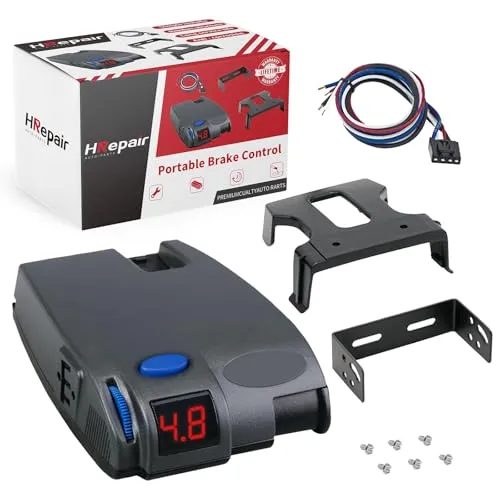
A proportional dash controller with three boost levels, made as a drop-in replacement for the Tekonsha 90160 Primus IQ that many trucks already have.
What we like
- Three boost settings raise initial braking, which is what a heavy loaded trailer needs on the first part of a stop
- Built as a direct replacement for the Tekonsha 90160 Primus IQ, so an existing harness in the truck should plug straight in
- Self-leveling design means the mounting angle does not have to be set by hand
- Snap-in clip and an adjustable bracket give 180 degrees of mounting choice, so you can angle the screen away from glare
What we don't
- The vehicle specific harness is still a separate purchase, despite the plug and play wiring on the controller side
- Boost settings are easy to leave turned up, and too much boost locks trailer wheels on an empty trailer
- HRepair is a marketplace brand, so the lifetime service promise depends on the seller still being there
| Controller type | Proportional, with three boost settings for heavier loads |
|---|---|
| Axles supported | 3 axles maximum (1 to 3 axle trailers) |
| Display type | Digital screen showing brake settings, connection status and continuous diagnostics |
| Mounting style | Snap-in clip or bracket, adjustable through a 180 degree range |
| Manual override | Yes, a manual override lever plus three boost levels |
| Install difficulty | Moderate |
| Price bracket | $$ |
The Tekonsha 90160 Primus IQ has been the default trailer brake controller in a lot of trucks for years, which means a lot of trucks already have the harness for it behind the dash. HRepair builds this unit to slot into that space. If yours died, this is a swap rather than a wiring project.
Boost is the feature that earns it the heavy load spot. On a proportional controller, boost raises how much braking the trailer gets in the first moment of a stop, before the sensor has fully read your deceleration. With a loaded trailer pushing on the hitch, that early bite is what stops the truck feeling shoved. Three levels let you match it to the load.
The screen is the other useful part. It shows the brake setting and whether the trailer is connected, and it runs continuous diagnostics, so a bad ground or a broken trailer wire shows as a fault instead of as a trailer that silently stopped braking.
Two honest warnings. Boost is not free performance, and leaving it on level three with an empty trailer will lock the trailer wheels and flat spot the tires. And HRepair is a marketplace name, so the lifetime replacement promise is only as durable as the seller account.
It is the right pick if you tow heavy and the truck already has 90160 wiring. If you tow light, the Lrichy 8508211 gives you the same proportional braking for less.
Research-based pick: this recommendation is based on product data, owner feedback and comparison with products we have tested, not on direct hands-on testing.
Buy it if: Someone towing near the top of their truck's rating who wants extra bite at the start of every stop.
Skip it if: You tow a light empty utility trailer, where boost mostly means locked trailer wheels.
Best Wireless Option
CURT 51181 Echo Mobile Bluetooth Trailer Brake Controller Kit
by CURT
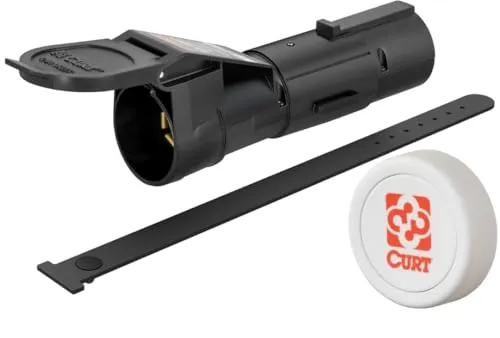
A proportional brake controller that plugs into the 7-way socket and is run from your phone, for people who tow with a borrowed or rented truck.
What we like
- Installs with no tools, no drilling and no wiring, it simply plugs in between the truck and trailer connectors
- Moves between vehicles in under a minute, which suits shared trucks, rentals and work fleets
- Uses a triple-axis accelerometer for proportional braking, and keeps braking even if the phone screen locks or the Bluetooth link drops
- The kit version adds a stick-on dash button for manual trailer braking, which the plain Echo does not have
What we don't
- Costs several times what a wired proportional controller does, and you still need a phone in the truck
- Only handles 1 to 2 axle trailers with 2 to 4 brakes, so heavier rigs are out
- Adjusting settings means picking up your phone, and CURT says to only do that when the vehicle is stopped
- The unit hangs off the back of the truck in road spray and salt, unlike a controller sitting on the dash
| Controller type | Proportional, using a triple-axis accelerometer |
|---|---|
| Axles supported | 2 axles maximum (2 to 4 electric brakes) |
| Display type | Smartphone app on Apple or Android, no fixed screen in the truck |
| Mounting style | Plugs into the 7-way connector, no tools and no drilling |
| Wiring harness included | Not needed, it plugs straight into the vehicle and trailer 7-way plugs |
| Install difficulty | Easy |
| Price bracket | $$$ |
The Echo answers a specific problem. A wired brake controller lives in one truck. If you borrow your brother’s pickup for the boat, or your work truck changes every few months, or the vehicle is leased and you cannot touch the wiring, a permanent install is the wrong shape of solution.
This one plugs into the 7-way socket, with the trailer plug going into the other end. No tools, no extra wires, no bracket. A locking tab and a strap hold it on. CURT says it stores profiles for several vehicle and trailer combinations, so moving it does not mean setting gain from scratch each time.
Braking is proportional, driven by a triple-axis accelerometer rather than by the phone. That matters more than it sounds. The phone is the control panel, not the brain, and CURT states that braking continues if the screen locks, a call comes in, or the Bluetooth connection drops. The kit version, model 51181, adds the dash button so you can apply trailer brakes by hand without touching the phone.
The price is the honest problem. This is the most expensive way to get proportional braking on this list by a wide margin, and it caps out at two axles. It also lives outside in the weather at the back of the truck, and it is small enough to be worth stealing, so it comes off when you park somewhere public.
It earns its money on flexibility, not on braking quality. One truck, one trailer, and the REDARC or the Lrichy do the same job for less.
Research-based pick: this recommendation is based on product data, owner feedback and comparison with products we have tested, not on direct hands-on testing.
Buy it if: Anyone who tows with more than one vehicle, or who cannot cut into a leased or rented truck's wiring.
Skip it if: You tow the same trailer with the same truck every week, where a wired controller costs less and needs no phone.
Best Time Delay Pick
CURT 51116 Venturer Next Electric Trailer Brake Controller
by CURT
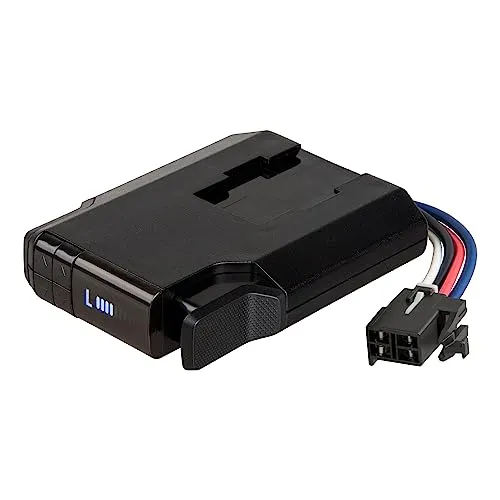
A slim time delay controller from an established towing brand, worth buying only if your budget or your dash space rules out a proportional unit.
What we like
- No internal moving parts and no leveling required, so mounting angle and rough roads do not upset it
- Low profile shape with a bracket built for dash clearance, which fits cabs where a bigger controller will not
- Power and ramp time are both adjustable, so you can tune how fast the trailer brakes come on
- CURT is a long established towing brand with parts support and dealer coverage behind it
What we don't
- Time delay braking applies the same preset force whether you brake gently or hard, so the trailer shoves you at low speed stops
- You have to reset ramp and power by hand when the trailer load changes, which a proportional unit does on its own
- Costs more than the proportional Lrichy 8508211, so you pay extra for the weaker braking method
- No digital diagnostics, so a wiring fault shows up as a trailer that is not braking rather than an error message
| Controller type | Time delay, with adjustable power and ramp time |
|---|---|
| Axles supported | 3 axles maximum (2 to 6 trailer brakes) |
| Mounting style | Low profile bracket built for dash clearance, no leveling required |
| Display type | Simple indicator, no app and no diagnostics screen |
| Manual override | Yes, manual control on the unit |
| Install difficulty | Easy |
| Price bracket | $$ |
Here is the awkward truth about this pick. It is a good version of a design that is worse than the alternative. Time delay controllers do not sense how hard you are braking. You set a power level and a ramp time, and when you touch the pedal the controller ramps the trailer brakes up to that preset level over that fixed time, every single stop.
Roll gently up to a stop sign and the trailer still applies close to full braking. You feel it as a shove from behind, then a lurch as the rig settles. Slam the brakes and the trailer is slow off the mark, because the ramp takes the same time it always does. A proportional controller reads your deceleration and copies it, which is why it feels normal.
So why is the Venturer Next here at all. Because the design has practical upsides. There are no internal moving parts and nothing to level, so the mounting angle does not matter and a washboard road does not confuse it. It is slim, and CURT’s bracket is shaped to keep it out of your knees. Power and ramp time are both adjustable, and it runs 1 to 3 axles. CURT stands behind it, which is more than can be said for some cheap proportional units.
The pricing is the part that should make you pause. This costs more than the proportional Lrichy 8508211 on the same listing page. Paying extra for the older method only makes sense when you specifically want CURT’s support and the slim shape.
Buy it if space or brand loyalty decides it for you. Otherwise buy proportional.
Research-based pick: this recommendation is based on product data, owner feedback and comparison with products we have tested, not on direct hands-on testing.
Buy it if: A driver who needs a compact controller from a known brand and tows a light trailer on quiet roads.
Skip it if: You tow anything heavy, drive in traffic, or have the budget for a proportional controller, which is nearly everyone.
How we chose#
This is a research-based comparison, not a hands-on towing test. We started from the controllers actually selling on Amazon in the United States, then checked each listing for the things that decide whether a controller suits you: the braking method, how many axles it supports, what the display tells you, how it mounts, whether a wiring harness comes with it and whether there is a manual override.
We spread the picks on purpose. One hidden module with a dash dial, one cheap proportional dash unit, one proportional unit with boost for heavy loads, one wireless unit that plugs into the 7-way, and one time delay unit from a known brand. Where a maker does not publish a figure, we left the gap rather than filling it with a guess.
One thing we did not do is rank on customer ratings. The listing data behind this guide did not include ratings or review counts, so nothing here is based on stars. Sales rank was used only as a rough sign that a product is genuinely moving.
What to consider before buying#
Start with the braking method, because it matters more than everything else combined. Proportional controllers sense your deceleration and copy it. Time delay controllers apply a preset force on a fixed ramp. That single choice decides how the rig feels at every stop for as long as you own the trailer.
Then count your axles. A two axle controller is fine for the great majority of campers, boats and utility trailers, but if you tow a triple axle car hauler or a big fifth wheel, that spec quietly rules out half the market. The Lrichy 8508211 handles four axles, the REDARC and the CURT Echo stop at two.
Next, work out how you will wire it. None of these five includes the vehicle specific harness, and that harness is what turns a wiring job into a plug-in job. Check what your truck’s tow package already has behind the dash before you order.
Last, think about where the box goes. A controller mounted where your knee hits it will annoy you every day. The REDARC hides the module and shows only a dial, the CURT Venturer Next is shaped slim on purpose, and the Echo does not sit in the cab at all.
Proportional and time delay, the difference you feel at every stop#
Time delay controllers are cheaper and noticeably worse. They apply close to full trailer braking on gentle stops, because they have no way of knowing the stop was gentle. Buy proportional unless your budget genuinely rules it out.
Here is the mechanism. A time delay unit sees only one input, which is voltage on the brake light wire. The moment you touch the pedal it starts ramping the trailer brakes from zero up to the power level you set, over the ramp time you set. Both settings are fixed until you change them by hand. It cannot tell a slow roll from an emergency stop.
A proportional unit adds an inertia sensor, an accelerometer that measures how fast the vehicle is actually slowing. It sends the trailer brakes an output that tracks that number. Ease off and the trailer eases off. Stand on the pedal and the trailer brakes hard right away. The rig behaves like one vehicle instead of two arguing with each other.
What you feel in the truck is the giveaway. With time delay, a gentle stop in traffic ends with the trailer pushing you the last few feet, then a nod as everything settles. With proportional, the stop just feels like braking. On a long downhill grade the difference gets more serious, because the trailer either helps hold the rig back smoothly or comes on hard and drags.
Cost used to justify the compromise. It no longer does. The proportional Lrichy 8508211 sells for less than the time delay CURT 51116 on the same site. The only real reasons left to buy time delay are a very tight budget, a specific slim shape you need, or wanting the support of a brand like CURT.
Why a vehicle specific harness turns this into a plug-in job#
Every brake controller uses the same four wires. Black to vehicle power, white to ground, red to the stop light signal, blue to the trailer brake output. That is the whole electrical story, and it is why controllers are close to universal.
The hard part is finding those four connections in a modern truck without cutting into a loom. Most tow-package trucks from the last fifteen years already have a factory brake controller plug tucked under the dash, wired to all four points from the factory. A vehicle specific harness plugs into that connector on one end and into the controller on the other. Install time drops to minutes, and no wire gets cut.
None of the five picks includes that harness. REDARC lists the universal TPH-025 pigtail and separate vehicle specific harnesses. Lrichy and HRepair both say plainly that the plug and play harness is not included. Budget for it when you compare prices, because a fifty dollar controller plus a harness is not a fifty dollar job.
The CURT Echo sidesteps all of it. It plugs in between the truck’s 7-way socket and the trailer plug, so there is no harness and no wiring at all. That is the whole reason it exists, and the reason it costs what it costs. If you are also sorting out the connection at the back of the truck, our guide to the best trailer hitches covers the receiver end of the same setup.
Mounting angle, leveling and what modern sensors handle#
Old proportional controllers used a pendulum, and a pendulum only reads deceleration correctly if it hangs at a known angle. That is why older units had a leveling procedure and a strict mounting range, and why people mounted them crooked and then wondered why braking felt wrong.
Modern units use solid state accelerometers and calibrate themselves. The HRepair 90160 lists a self-leveling sensor. REDARC calls its version active calibration. CURT’s Echo uses a triple-axis accelerometer, which is what lets it work while dangling off the back of the truck. The CURT Venturer Next needs no leveling because a time delay unit has no motion sensor to level in the first place.
That does not make mounting angle a non-issue. The screen still has to be readable without leaning over, the manual override lever still has to be reachable with your right hand, and the box still has to stay clear of your knee and the steering column. Most units, including the HRepair, allow a wide mounting range for exactly that reason. Dry fit it, sit in the driver’s seat, and check all three before you screw the bracket down.
Setting gain properly on a loaded trailer#
Gain is the setting almost everyone leaves alone, and it is the one that changes the most. It sets how much braking the trailer gets, and it has to match the weight the trailer is carrying today, not the weight it carried last summer.
The method is simple. Hitch up and load the trailer the way you normally tow. Find a quiet road with no one behind you. Get to about 25 mph, then pull the manual override lever and do not touch the brake pedal. You want the rig to slow firmly and smoothly. Too weak means raise the gain. Any hint of the trailer wheels locking or chirping means lower it.
Redo it when the load changes. An empty trailer at the gain you set when it was loaded will lock its wheels and flat spot the tires. A loaded trailer at empty-trailer gain will push the truck. This is also why the boost feature on the HRepair 90160 is a two edged tool, since more early bite helps a heavy trailer and punishes a light one.
If the trailer still feels unsettled after the gain is right, the problem is probably not the controller. Sway and squat are weight problems, and the fix is at the hitch. Our comparison of weight distribution hitches covers that side, and for heavier rigs the fifth wheel hitch guide picks up where bumper towing runs out.
Final recommendation#
Most people should buy the REDARC Tow-Pro Liberty. It brakes proportionally, the module hides behind the dash, and only a small dial shows in the cab, which is worth a lot when you tow often. If the price is more than you want to spend on a small box, the Lrichy 8508211 gives you the same proportional braking, a digital display, a manual lever and four axle support for a fraction of the money. Tow near your truck’s limit and the HRepair 90160 adds boost for that early bite, and drops straight into a truck already wired for a Tekonsha Primus IQ. Tow with a different truck each time, or with a leased vehicle you cannot wire into, and the CURT 51181 Echo is worth its high price for plugging into the 7-way and moving in a minute. The CURT 51116 Venturer Next is the one to buy only if you need a slim time delay unit from a name brand, and you should know it costs more than the proportional Lrichy while stopping less smoothly.
Frequently asked questions
Do I actually need a brake controller?
You need one if your trailer has electric brakes, and in most states the law requires trailer brakes once the loaded trailer passes a weight limit, often around 3,000 lb. Without a controller, the trailer has brakes that nothing tells to work, so your truck stops the whole load on its own. Look at the trailer axles. Wires running to the hubs mean electric brakes and a controller is required. Surge brakes on a boat trailer are hydraulic and self-acting, so they need no controller at all.
What is the real difference between proportional and time delay?
A proportional controller has a sensor that reads how hard your truck is slowing, then sends the trailer the same amount of braking. Brake gently and the trailer brakes gently. A time delay controller has no such sensor. It ramps the trailer to a preset braking level over a fixed time on every stop, so a slow roll to a stop sign gets close to full trailer braking and feels like a push from behind. The CURT 51116 is the time delay pick here, and the Lrichy 8508211 costs less while braking proportionally.
Will one of these fit my truck?
The controller side is close to universal because trailer brake wiring uses the same four connections in every vehicle, which are power, ground, brake light signal and trailer brake output. What differs is how you connect it. Most trucks built in the last fifteen years have a factory tow plug behind the dash, and a vehicle specific harness turns the job into a plug-in. None of these picks include that harness, so order it for your exact year and model at the same time. The CURT Echo skips this entirely by plugging into the 7-way socket.
Why does my trailer jerk or grab when I brake?
Two usual causes. The gain is set too high, so the trailer brakes harder than the truck and the trailer wheels drag or lock. Turn the gain down until a manual override pull at 25 mph slows the rig firmly without any wheel locking. The other cause is a time delay controller doing what it was built to do, which is apply the same preset force on every stop regardless of how gently you press. No amount of adjusting fixes that behaviour, only a proportional controller like the REDARC Tow-Pro Liberty does.
How do I set the gain?
Load the trailer the way you normally tow it, because gain follows weight. Find an empty road, get to about 25 mph, then pull the manual override lever without touching the brake pedal. If the rig slows firmly and smoothly, the gain is right. If it barely slows, raise the gain a notch and try again. If the trailer wheels lock or skid, lower it. Redo this whenever the load changes noticeably, since a full water tank or a loaded bed changes what the trailer needs.
Is a wireless controller as safe as a wired one?
The CURT Echo brakes with a triple-axis accelerometer inside the unit itself, not with the phone, and CURT states braking continues if the screen locks, a call comes in or Bluetooth drops. So the trailer is not relying on your phone to stop. The trade is cost and exposure. It sits at the 7-way socket in road spray, it is small enough to walk off in a parking lot, and it costs several times a wired proportional unit. Buy it for the flexibility of moving between trucks, not because it stops better.
About the author

Dale Harper Lead Gear Editor
Dale is a longtime truck owner and former accessory-shop tech who builds these guides from manufacturer fit data, aggregated owner feedback and direct spec comparison. Research-based picks are always labelled as such.
Daily driver: 2022 Ford F-150 XLT SuperCrew
- Tonneau covers and bed accessories
- Seat covers and interior protection
- Lift kits and suspension