The Best Microfiber Towels for Cars: 5 Picks Compared
Five real microfiber towels for cars compared, from a 300 GSM 12 pack to an edgeless 420 GSM buffing towel, with honest notes on GSM, edges and colours.

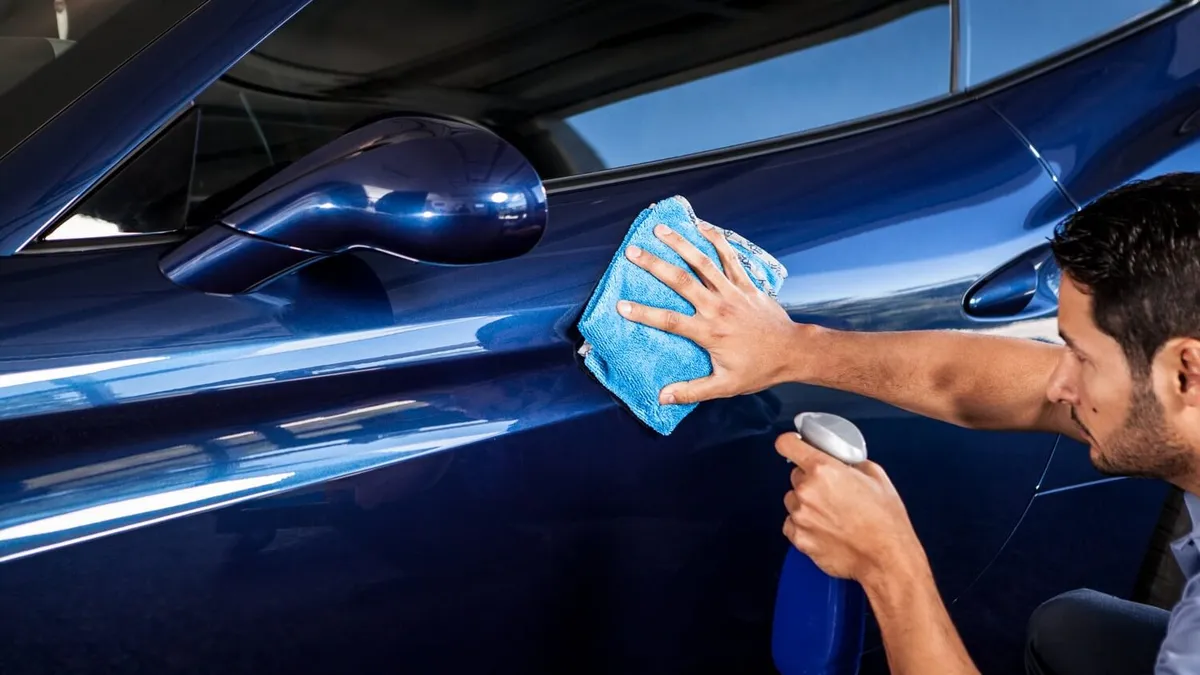
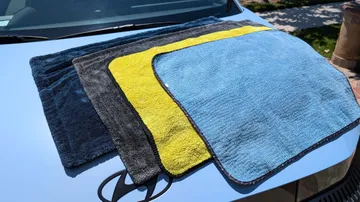
Microfiber towels are the cheapest thing in a garage that can wreck a paint job. The towel itself does not scratch. What scratches is the grit sitting in the pile, the stiff hem on the border, and the habit of using one cloth for everything from wheels to a freshly waxed hood. This guide compares five microfiber towels you can buy today: the thick 300 GSM USANOOKS 12 pack, the edgeless 420 GSM Creature towels from The Rag Company, the short pile Chemical Guys AllSwipe set for interiors and glass, the 50 piece AIDEA value pack, and the cheap black HOMEXCEL cloths for wheels and grease. We compared them on GSM where the maker publishes it, towel size, pack count, edge construction, pile type and the job each one is actually built for. By the end you will know which towels to buy, how many, and which ones should never touch your paint again.
Table of contents
- Quick picks
- How many towels come in each pack
- Comparison table
- Best Overall: USANOOKS Microfiber Cleaning Cloth, 12 Pack, 12.5 x 12.5 in
- Best for Buffing and Polishing: The Rag Company Creature Edgeless Auto Detailing Towels, 10 Pack
- Best for Interiors and Glass: Chemical Guys AllSwipe Multi-Purpose Microfiber Towels, 12 Pack
- Best Value: AIDEA Microfiber Cleaning Cloth, 50 Pack, 12 x 12 in
- Best for Dirty Jobs: HOMEXCEL Black Microfiber Cleaning Cloth, 12 Pack
- How we chose
- What to consider before buying
- GSM, blend ratio and what 70/30 actually means
- Edges, and where the scratches actually come from
- Colour coding towels by job
- Washing microfiber, and when to retire a towel
- Final recommendation
- FAQ
Quick picks
Every pick wins a specific use case. Jump to the full review before you buy.
-
Best Overall
USANOOKS Microfiber Cleaning Cloth, 12 Pack, 12.5 x 12.5 in
A 12 pack of thick 300 GSM cloths that handles most car jobs well and costs little enough that you can retire a dirty one without thinking about it.
-
Best for Buffing and Polishing
The Rag Company Creature Edgeless Auto Detailing Towels, 10 Pack
A 420 GSM edgeless towel with two working sides, made for taking wax and polish off paint without leaving a mark behind.
-
Best for Interiors and Glass
Chemical Guys AllSwipe Multi-Purpose Microfiber Towels, 12 Pack
A short pile, soft banded towel in three neutral colours, built for dashboards, screens and windows where lint is the thing that ruins the job.
-
Best Value
AIDEA Microfiber Cleaning Cloth, 50 Pack, 12 x 12 in
Fifty small microfiber cloths in five colours for around fifteen dollars, which is enough towels to stop you ever reusing a dirty one.
-
Best for Dirty Jobs
HOMEXCEL Black Microfiber Cleaning Cloth, 12 Pack
A cheap 12 pack of black cloths meant for wheels, engine bays and grease, where hiding stains matters more than protecting paint.
Compare every pick
| Product | Award | Towel size | Pack quantity | Edge type | Pile type | Best for | Where to buy |
|---|---|---|---|---|---|---|---|
| USANOOKS Microfiber Cleaning Cloth, 12 Pack, 12.5 x 12.5 in | Best Overall | 12.5 x 12.5 in | 12 towels | Overlock braided stitching | Grip Root weave, 2.5 mm thick | Anyone who needs one box of towels that covers washing, wiping, glass and general garage work. | Check price for USANOOKS Microfiber Cleaning Cloth, 12 Pack, 12.5 x 12.5 in at Amazon (affiliate link) |
| The Rag Company Creature Edgeless Auto Detailing Towels, 10 Pack | Best for Buffing and Polishing | 16 x 16 in | 10 towels | Edgeless, ultrasonic cut | Dual pile plush, 70/30 polyester polyamide blend | Someone removing wax, polish or sealant from paint they have already spent money correcting. | Check price for The Rag Company Creature Edgeless Auto Detailing Towels, 10 Pack at Amazon (affiliate link) |
| Chemical Guys AllSwipe Multi-Purpose Microfiber Towels, 12 Pack | Best for Interiors and Glass | 14 x 12 in | 12 towels | Soft banded edge | Short pile, 100 percent microfiber | Anyone whose main complaint is lint and streaks on interior glass, screens and dashboards. | Check price for Chemical Guys AllSwipe Multi-Purpose Microfiber Towels, 12 Pack at Amazon (affiliate link) |
| AIDEA Microfiber Cleaning Cloth, 50 Pack, 12 x 12 in | Best Value | 12 x 12 in | 50 towels | Stitched hem | Soft non-abrasive all purpose microfiber, five colours | Someone building a colour coded towel system on a budget, or anyone who keeps running out mid job. | Check price for AIDEA Microfiber Cleaning Cloth, 50 Pack, 12 x 12 in at Amazon (affiliate link) |
| HOMEXCEL Black Microfiber Cleaning Cloth, 12 Pack | Best for Dirty Jobs | 11.5 x 11.5 in | 12 towels | Stitched hem | Soft short pile microfiber, black | Wheels, tyres, exhaust tips, engine bays and any job where the towel is going to end up ruined. | Check price for HOMEXCEL Black Microfiber Cleaning Cloth, 12 Pack at Amazon (affiliate link) |
Swipe sideways to compare every column.
Best Overall
USANOOKS Microfiber Cleaning Cloth, 12 Pack, 12.5 x 12.5 in
by USANOOKS
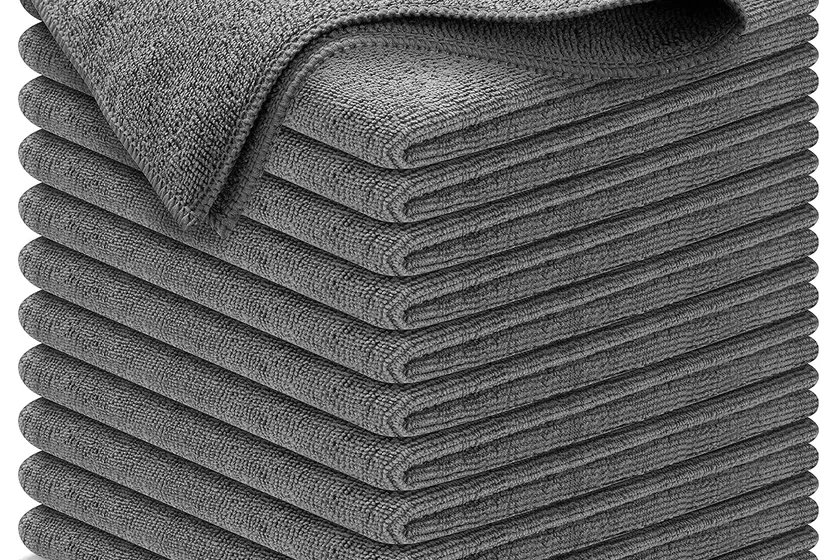
A 12 pack of thick 300 GSM cloths that handles most car jobs well and costs little enough that you can retire a dirty one without thinking about it.
What we like
- 300 GSM at 2.5 mm thick, so it has real body rather than the thin cloth feel of most cheap multi packs
- Twelve towels in the box means you can fold fresh faces all day instead of reusing a loaded one
- Overlock braided stitching on the hem holds up to repeated washing without unravelling
- Sitting at a sales rank of 4 in its category, so it is easy to reorder at a steady price
What we don't
- The 12.5 inch square size is small for buffing a full hood, and you will refold constantly
- It has a sewn border, so the edge is stiffer than the pile and can mark soft clear coat if you press
- Every towel is the same grey, so colour coding by job means marking them yourself
| Gsm weight | 300 GSM |
|---|---|
| Towel size | 12.5 x 12.5 in |
| Pack quantity | 12 towels |
| Edge type | Overlock braided stitching |
| Pile type | Grip Root weave, 2.5 mm thick |
| Price bracket | $ |
Most people do not need five different types of towel. They need one box of decent cloths that will not scratch the car, and enough of them that they never have to reuse a dirty one. That is what this pack is.
The number worth knowing is 300 GSM. GSM means grams per square meter, which is a measure of how much fiber is packed into the cloth. Three hundred is the middle of the road for a general purpose towel. It is not a plush buffing towel, and it is not a stiff shop rag either. USANOOKS also states a 2.5 mm thickness, and you can feel the difference against the paper thin cloths that come in bargain bins.
The other thing that matters here is the count. Twelve towels sounds like a lot until you start folding. Fold one square into quarters and you get eight clean faces. Switch face when one looks dirty, drop the towel in a bucket when all eight are used, pick up the next. That habit stops more scratches than any single premium towel will.
The size is the honest weakness. At 12.5 inches square, this is a wiping cloth, not a panel towel. You will refold a lot on a hood, and it is far too small to dry a whole car, which is a different job with a different towel.
The hem is the other trade-off. It is stitched, and a stitched border is always harder than the pile around it. Keep your hand on the flat of the towel and off the seam, and it is a non issue on normal paint.
USANOOKS claims these last 1200 washes. Treat that as a best case from the marketing team. What is fair to say is that this is a well made cloth at a price where losing one to a dropped towel costs you almost nothing.
Research-based pick: this recommendation is based on product data, owner feedback and comparison with products we have tested, not on direct hands-on testing.
Buy it if: Anyone who needs one box of towels that covers washing, wiping, glass and general garage work.
Skip it if: You are buffing a freshly polished car and want the softest, safest towel you can get on the paint.
Best for Buffing and Polishing
The Rag Company Creature Edgeless Auto Detailing Towels, 10 Pack
by The Rag Company
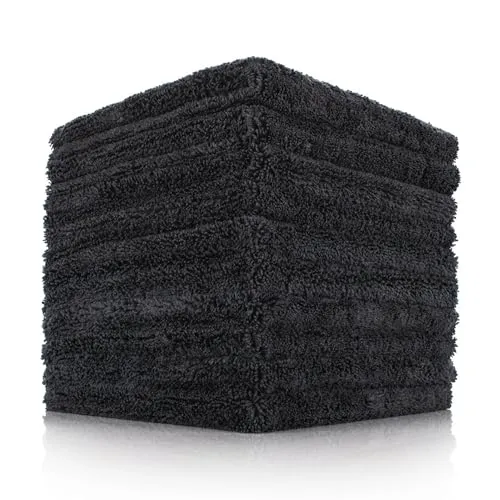
A 420 GSM edgeless towel with two working sides, made for taking wax and polish off paint without leaving a mark behind.
What we like
- Fully edgeless with ultrasonic cut borders, so there is no seam, tag or band to drag across clear coat
- 70/30 polyester to polyamide blend, which is the ratio premium detailing towels use for softness and grab
- Dual pile design gives you a short nap side for breaking residue and a plush side for the final buff
- 16 by 16 inches is big enough to fold into eight faces and still cover a fender panel
What we don't
- Costs roughly four times the USANOOKS pack per towel, which stings when one hits the driveway
- Ten towels is a small stack for a full detail, so most people need a cheaper pack alongside it
- The plush pile traps grit deep and holds it, so a dropped towel really is finished for paint work
| Gsm weight | 420 GSM |
|---|---|
| Towel size | 16 x 16 in |
| Edge type | Edgeless, ultrasonic cut |
| Pile type | Dual pile plush, 70/30 polyester polyamide blend |
| Pack quantity | 10 towels |
| Price bracket | $ |
Buffing is where towel quality actually shows up. When you wipe dried wax off a panel you are pressing a cloth into paint and dragging it, and anything hard in that cloth leaves a line. This towel is built to remove every hard part.
Start with the edge. There is no stitching at all. The Rag Company cuts the border ultrasonically, which fuses the fibers instead of sewing a hem onto them. That means there is no seam, no tag and no polyester band anywhere on the towel, so every square inch of it is the same soft face. On a stitched towel the hem is the single most likely part to mark clear coat, and here that part does not exist.
Then the blend. Microfiber is polyester and polyamide. Polyester does the scrubbing, polyamide does the absorbing and the softness, and polyamide costs more. Cheap towels sit around 90/10 or 87/13. This one is 70/30, which is what serious detailing towels use, and it is the closest thing to a quality marker you can read off a listing.
The 420 GSM figure puts it in plush territory without being a heavy drying towel. That is deliberate. A buffing towel wants enough pile to lift residue and enough control that you can feel the panel through it.
The dual pile is genuinely useful. One side has a shorter nap that breaks down dried product, the other is plusher for the final wipe. Work the short side first, flip, finish.
The cost is real. Ten towels for about thirty two dollars means each one is worth protecting, and that changes how you use them. Keep these for paint only. Nothing else in your garage should touch this stack.
Research-based pick: this recommendation is based on product data, owner feedback and comparison with products we have tested, not on direct hands-on testing.
Buy it if: Someone removing wax, polish or sealant from paint they have already spent money correcting.
Skip it if: You mainly want towels for spills, wheels and general garage wiping, where a cheap pack does the same job.
Best for Interiors and Glass
Chemical Guys AllSwipe Multi-Purpose Microfiber Towels, 12 Pack
by Chemical Guys
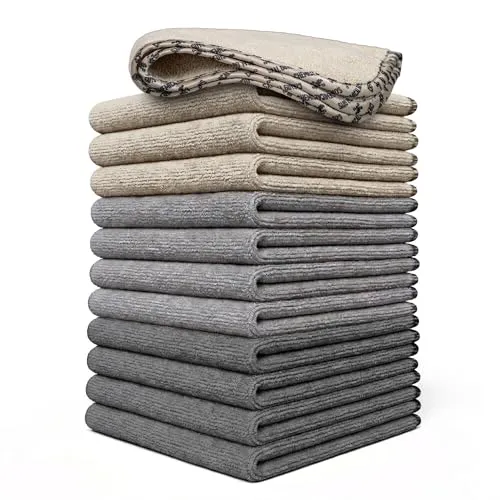
A short pile, soft banded towel in three neutral colours, built for dashboards, screens and windows where lint is the thing that ruins the job.
What we like
- Dense short pile leaves almost no fiber behind, which is exactly what glass and gloss screens need
- Soft banded edge instead of a hard stitched hem, so it will not snag a touchscreen or a trim seam
- Ships in light grey, dark grey and light tan so you can split car, home and garage duty out of one pack
- The 14 by 12 inch size folds down small enough to get into vents and around a centre console
What we don't
- Short pile holds far less liquid than a plush towel, so it is the wrong choice for drying or heavy spills
- Chemical Guys does not publish a GSM figure or a blend ratio for these, so you cannot compare them on paper
- The three colours are all neutral and close in tone, which makes fast sorting harder than a bright colour set
| Towel size | 14 x 12 in |
|---|---|
| Pack quantity | 12 towels |
| Edge type | Soft banded edge |
| Pile type | Short pile, 100 percent microfiber |
| Intended use | Interiors, screens, vents, consoles and glass |
| Price bracket | $ |
Interiors and glass fail in a different way to paint. Paint gets scratched. Glass gets streaked, and a dashboard gets covered in tiny white fuzz you only see when the sun hits it. Both of those come from a towel with too much loose fiber, which is why a plush towel is the wrong tool inside a car.
AllSwipe goes the other way. The pile is short and dense, so the fibers are packed tight and stay put. That structure lifts dust and product residue and traps it in the weave rather than shedding half of it back onto the surface. On a windshield, that is the whole difference between a clear pass and a hazy one.
The edge is a soft band rather than a sewn hem. Chemical Guys does this because interior surfaces snag. A stiff seam catches on trim gaps, phone mounts and the raised bezel around a screen, and on a piano black centre console a hard edge is one of the few things that will actually put a mark in the plastic.
The three colour set is the part most people ignore and then wish they had used. Light grey, dark grey and light tan is enough to run a real system. Pick one colour for glass, one for dash and door cards, one for anything that lives near a door sill. The point is that no towel ever crosses over from a dirty job to a clean one.
Size is sensible at 14 by 12 inches. That is not much smaller than a standard square, but the rectangle folds better around a finger for vents and seams.
The catch is capacity. Short pile means low absorbency by design. Spill a coffee and this towel will disappoint you. Keep it for dry dust, screen wipes, glass cleaner and interior detailer, and it does that job better than anything else here.
Research-based pick: this recommendation is based on product data, owner feedback and comparison with products we have tested, not on direct hands-on testing.
Buy it if: Anyone whose main complaint is lint and streaks on interior glass, screens and dashboards.
Skip it if: You want one towel type for everything, because this one is deliberately bad at soaking up water.
Best Value
AIDEA Microfiber Cleaning Cloth, 50 Pack, 12 x 12 in
by AIDEA
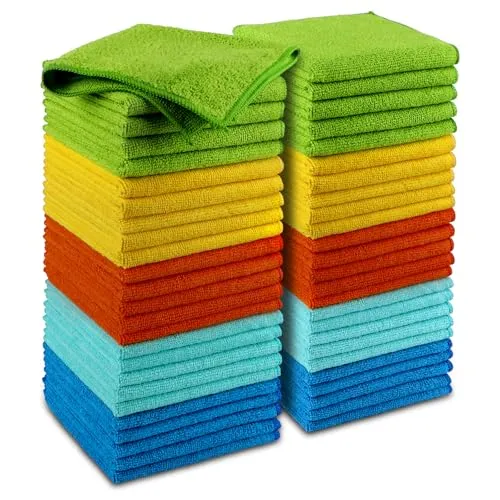
Fifty small microfiber cloths in five colours for around fifteen dollars, which is enough towels to stop you ever reusing a dirty one.
What we like
- Fifty towels for about fifteen dollars works out near thirty cents each, the cheapest per towel here
- Five colours out of the box makes colour coding by job simple with no marking or sorting needed
- AIDEA states these can be washed and reused hundreds of times without falling apart
- Small enough at 12 by 12 inches to keep a few in the glovebox, the boot and the garage at once
What we don't
- No published GSM or blend ratio, so you are buying on price and colour rather than on specification
- Thinner and less plush than the USANOOKS cloths, which shows when you try to buff dried wax with one
- Twelve inches square is too small for panel work, and it saturates quickly on anything wet
| Towel size | 12 x 12 in |
|---|---|
| Pack quantity | 50 towels |
| Edge type | Stitched hem |
| Pile type | Soft non-abrasive all purpose microfiber, five colours |
| Intended use | High volume wiping across car, garage and home |
| Price bracket | $ |
The single biggest upgrade most people can make to their car cleaning is owning more towels. Not better towels, more of them. Running short is what makes you flip a loaded cloth over one more time and drag the dirt you just picked up straight back across the paint.
Fifty towels for around fifteen dollars solves that. It is roughly thirty cents a cloth, which means you can dedicate ten to wheels, ten to interior, ten to glass and still have twenty spare. When one hits the ground, it goes in the bin or the rag box and you feel nothing.
The colours are the quiet reason to pick this pack over a plain grey bulk set. AIDEA ships these in five colours specifically so you can code by task, and that is the one habit that stops a wheel towel finding its way onto a hood six months from now. Doing the same thing with identical grey cloths means marking them with thread or a marker pen, and nobody keeps that up.
Be clear about what you are getting. AIDEA publishes no GSM and no blend ratio. From the listing description and how these are sold, this is a standard thin all purpose cloth rather than a plush detailing towel. It will wipe, dust and clean fine. It will not buff wax off a black hood without leaving you unhappy.
Twelve inches square is also small. That is convenient for tight spots and awkward for anything flat and large.
Used the right way this is the most useful pack in the guide. Buy it as your everyday stack, and keep one good towel for the paint.
Research-based pick: this recommendation is based on product data, owner feedback and comparison with products we have tested, not on direct hands-on testing.
Buy it if: Someone building a colour coded towel system on a budget, or anyone who keeps running out mid job.
Skip it if: You want a small number of high quality towels for paint work rather than a big pile of average ones.
Best for Dirty Jobs
HOMEXCEL Black Microfiber Cleaning Cloth, 12 Pack
by HOMEXCEL
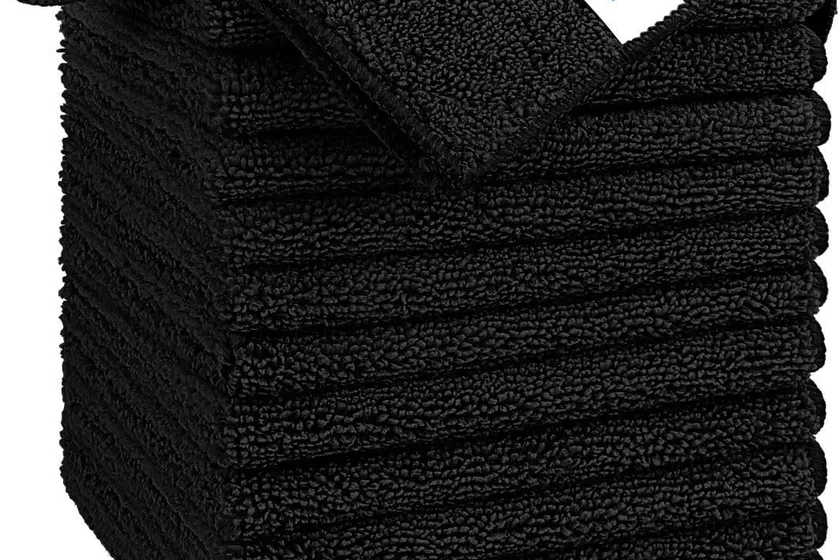
A cheap 12 pack of black cloths meant for wheels, engine bays and grease, where hiding stains matters more than protecting paint.
What we like
- Black fabric hides brake dust, oil and tyre dressing that would make a grey towel look ruined after one use
- Around seven dollars for twelve towels, so a permanently filthy wheel stack costs almost nothing to run
- Absorbs oil as well as water, which is what you want for engine bay wiping and spill cleanup
- Visually obvious against every other towel here, which makes it hard to grab the wrong one by mistake
What we don't
- No published GSM, blend ratio or absorbency figure, so you are buying on price and colour alone
- At 11.5 inches square these are the smallest towels in this guide and hold very little liquid
- Thin enough that dried brake dust can be felt through the cloth, so these should never touch paint
| Towel size | 11.5 x 11.5 in |
|---|---|
| Pack quantity | 12 towels |
| Edge type | Stitched hem |
| Pile type | Soft short pile microfiber, black |
| Intended use | Wheels, engine bay, door jambs and other dirty jobs |
| Price bracket | $ |
Every towel system needs a bottom tier. These are the cloths that get brake dust ground into them, wipe up gear oil, mop a spill off a garage floor and get thrown in a separate wash bin at the end. They are not paint towels and they are not supposed to be.
Black is the point. Brake dust is iron and it stains permanently. Tyre dressing goes brown. Engine oil goes black and stays black. A grey or white towel used on a wheel looks destroyed after one session, and the natural human reaction to a towel that looks destroyed is to throw it away or, worse, quietly promote it back to normal duty because it still feels soft. A black towel looks the same on day one and day two hundred, so it stays where it belongs.
Twelve of them for about seven dollars makes that easy to commit to. There is no moment where you hesitate about using one on something greasy.
What HOMEXCEL does not tell you is a lot. There is no GSM figure, no polyester to polyamide split, no absorbency multiplier. The listing says soft, absorbent and reusable, which is what every listing says. For a wheel towel that genuinely does not matter much, because you are not chasing a swirl free finish on a wheel barrel.
Size is the practical limit. At 11.5 inches square these hold very little, so on a big spill you will burn through several.
Use them, wash them separately from your paint towels, and never let one cross over. A cloth that has been on a wheel has metal particles in the pile. Those particles do not fully wash out, and dragging them over clear coat is how you end up with scratches you cannot explain.
Research-based pick: this recommendation is based on product data, owner feedback and comparison with products we have tested, not on direct hands-on testing.
Buy it if: Wheels, tyres, exhaust tips, engine bays and any job where the towel is going to end up ruined.
Skip it if: You want a towel that can move between dirty work and paint work, because this one never should.
How we chose#
This is a research-based comparison, not a side by side scratch test. We started from the microfiber towels that actually sell on Amazon right now, then checked each listing for the things that predict how a towel behaves on paint: published GSM, the polyester to polyamide ratio, exact dimensions, edge construction, pile type and how many towels come in the box.
Anything sold on marketing language alone was pushed down the list. Where a brand publishes no GSM and no blend ratio, we say so in the review rather than guessing at a number, and we judge that towel on size, price and colour instead.
We also spread the picks by job rather than ranking five near-identical grey cloths. A microfiber towel is a tool, and the tool for buffing wax off a black hood is not the tool for wiping a wheel barrel. So you get one solid general purpose pack, one edgeless plush towel for paint, one short pile set for glass and interiors, one cheap bulk pack for volume, and one black stack for filthy work.
Drying is deliberately left out. That needs a large, high GSM towel of its own, and we cover those separately in the guide to the best car drying towels.
What to consider before buying#
Start with the job, not the price. A towel is a match to a task. Plush pile lifts wax and polish off paint. Short pile leaves no lint on glass. Cheap thin cloth is for volume work where the towel is going to get ruined. Buying one type and using it everywhere is how people end up with swirl marks and streaky windows at the same time.
Count is the next thing, and it matters more than most buyers expect. You need enough towels that you never have to reuse a face. Fold a square towel in quarters and you have eight clean faces. When those are gone the towel goes in a bucket, not back on the car. Owning twelve towels instead of three is a bigger upgrade than owning three expensive ones.
Then look at the edge. Cheap towels have a sewn hem, which is stiffer than the pile beside it. Better towels use a soft band. The best have no edge at all. This is the detail that separates a fifteen dollar pack from a thirty dollar one, and on paint it is worth paying for.
Last, buy for the whole system. A stack of good paint towels is wasted if the same person also uses them on brake dust. Getting the wash right first with a proper car wash soap means there is less grit on the paint before a towel ever touches it.
GSM, blend ratio and what 70/30 actually means#
GSM stands for grams per square meter. It tells you how much fiber is packed into the cloth and nothing else. A 420 GSM towel has more material in it than a 300 GSM towel of the same size, which usually means it is plusher and holds more liquid.
Here is where people go wrong. Higher GSM is not better across the board, it is better at one thing. A deep, heavy pile is excellent at absorbing and at buffing dried product off paint. It is worse on glass, because a long pile has more loose fiber ends and those ends are what leave haze on a windshield. That is why the AllSwipe towels use a short dense pile on purpose, and why they publish no GSM figure at all.
The blend ratio tells you more than GSM does, when a brand bothers to print it. Microfiber is a split fiber made of polyester and polyamide. Polyester is the cheap structural half that does the scrubbing. Polyamide is the soft, absorbent, expensive half. A 70/30 blend, like The Rag Company Creature, means thirty percent of the fiber is the good stuff, and that shows up as a towel that feels different in your hand and glides instead of grabbing.
Budget towels run 90/10 or 87/13. Most of the brands here publish nothing, including USANOOKS, AIDEA and HOMEXCEL. That silence is information. When a ratio is a selling point, a company prints it on the bag.
Edges, and where the scratches actually come from#
A microfiber towel does not scratch paint by being rough. Modern clear coat is harder than polyester. Two other things do the damage.
The first is the edge. A sewn hem is a folded, doubled, stitched band of fabric that sits proud of the pile. When you press the towel onto a panel, that band carries more of the pressure than the soft face around it, and it is far less forgiving. On soft clear coat, common on Japanese and Korean cars, a dragged seam can leave a faint line. Edgeless towels like the Creature set solve this by cutting the border with ultrasound so the fibers fuse rather than needing a hem. Soft banded edges, which is the AllSwipe approach, are the middle option.
The second is grit, and this is the bigger one. Sand, brake dust and road grime hide in the pile. A plush towel is very good at trapping things, which is exactly why it is good at cleaning, and exactly why it is dangerous once it is loaded. When you keep wiping with a full towel, the grit rides on the surface between the fiber and the paint.
Two habits fix most of it. Fold every towel into quarters and change face constantly. And do not circle. Wipe in straight lines, top to bottom, so that if something does go wrong you get one faint straight line rather than a spiral you will see under every streetlight.
Colour coding towels by job#
This is the most useful thing in this article and it costs nothing. Assign a colour to a job and never break the rule.
A simple system looks like this. One colour for paint only, used for wax, sealant and quick detailer. One colour for glass, inside and out. One colour for the interior, dash, doors and seats. One colour for wheels, tyres, jambs and the engine bay. If you want a fifth, keep it for spills and general garage mess.
The AIDEA 50 pack makes this easy because it ships in five colours out of the box. The AllSwipe pack does a smaller version of the same thing with light grey, dark grey and light tan. The black HOMEXCEL cloths are the dirty tier, and their colour is the whole point, since brake dust and oil stain permanently and a black towel that looks filthy still looks like every other black towel.
The reason to bother is contamination. A towel used on a wheel picks up iron particles from brake pads. Those particles do not wash out. Six months later that towel is soft, clean-looking and full of metal, and the person holding it has no idea which stack it came from. Colour is the only system people actually stick to, because it works without thinking.
Wash the groups separately as well. A wheel towel in the same load as your paint towels shares its grit with all of them. If you are also cleaning glass, a dedicated glass cleaner for cars plus a short pile towel does far more for streaks than any amount of extra buffing.
Washing microfiber, and when to retire a towel#
Microfiber dies from laundry more often than from use. Two things kill it.
Fabric softener is the first. It works by coating fibers in a waxy film, which is lovely on a bath towel and fatal on microfiber. That film plugs the gaps that do the absorbing, and one cycle can turn a good buffing towel into a cloth that pushes water around. Dryer sheets do the same thing. Skip both, every single time.
Heat is the second. Microfiber is mostly polyester, which is plastic. High dryer heat softens and fuses the fiber tips, and a fused pile goes stiff and slick. Wash warm at most. Dry on low, or hang the towels up.
Wash microfiber away from cotton. Cotton sheds lint constantly and that lint lodges in microfiber pile permanently, which is how you end up with a towel that leaves fuzz all over a windshield.
Now the part nobody wants to hear. Microfiber is a consumable, not a permanent tool. A towel that has been dropped on the ground, washed with cotton, or used on wheels should never go near your paint again. Grit and iron work into the pile and no wash cycle flushes them out. Demote a dropped towel to wheels or engine bay duty and move on. This is exactly why a cheap pack matters as much as a good one. When a two dollar cloth hits the driveway you retire it without a second thought, and when a thirty dollar towel hits the driveway you will be tempted to keep using it. Do not.
Also watch for the towel going stiff or starting to catch on the panel. That is a fused or clogged pile, and it means the towel is done for paint work even if it looks fine. Keeping the paint protected underneath with a decent car wax gives you a slicker surface that is more forgiving of an average towel.
Final recommendation#
Most people should start with the USANOOKS 12 pack. It is a real 300 GSM cloth rather than a thin bargain rag, twelve towels is enough to work through a whole wash without reusing a face, and it costs little enough that losing one to the driveway does not matter. If you are buffing wax or polish off paint you have already spent money correcting, add The Rag Company Creature towels, because the edgeless build and the 70/30 blend genuinely reduce the risk on soft clear coat. If your real complaint is streaky glass and fuzz on the dash, the Chemical Guys AllSwipe set is built for that and nothing else here comes close on lint. Anyone who keeps running out of towels should buy the AIDEA 50 pack, both for the count and because the five colours make a coding system easy to stick to. And whatever else you buy, get the black HOMEXCEL cloths for wheels, tyres and the engine bay, then never let one of them touch your paint.
Frequently asked questions
How many microfiber towels do I actually need?
More than you think, and more than most people own. A basic home wash burns through six to ten towels once you count paint, glass, door jambs, wheels and the interior. Running short is what makes people reuse a loaded cloth, and that is where scratches come from. A 12 pack like the USANOOKS set is a sensible floor for one car. If you want to stop counting entirely, the 50 piece AIDEA pack costs about fifteen dollars and removes the problem for a couple of years.
What does GSM mean on a microfiber towel?
GSM is grams per square meter. It measures how much fiber is packed into the cloth, so it is a weight figure rather than a quality figure. Around 300 GSM, like the USANOOKS towels, is a normal all purpose cloth. Around 420 GSM, like The Rag Company Creature, is a plush buffing towel. Anything over 1000 GSM is a drying towel. Higher GSM is not automatically better. A high GSM towel is soft and absorbent, but it is also worse at glass, because a deep pile sheds more lint.
What is the 70/30 blend ratio on detailing towels?
Microfiber is made from polyester and polyamide. Polyester does the scrubbing and gives the towel structure. Polyamide is the softer, more absorbent half, and it costs more, so cheap towels use very little of it. A 70/30 blend means 70 percent polyester and 30 percent polyamide, which is what The Rag Company uses on the Creature towels and what serious detailing towels generally run. Budget cloths sit closer to 90/10 or 87/13. When a brand publishes no ratio at all, assume it is not a selling point.
Are edgeless towels really worth the extra money?
For paint work, yes. A stitched hem is harder than the pile beside it, so when you press a towel onto a panel the seam carries more load than the soft part. That is the piece most likely to leave a fine mark on soft clear coat. Edgeless towels like the Creature set are cut ultrasonically so there is no seam at all. For interior and glass work a soft banded edge, which is what the Chemical Guys AllSwipe towels use, is good enough and costs less.
Can I use the same towel on my wheels and my paint?
No, and this is the mistake that undoes everything else. Brake dust is iron. Those particles work down into the pile and no wash cycle flushes all of them out. Drag that towel across a hood and you are pulling metal over clear coat. Keep a separate stack for wheels, tyres and the engine bay, in a colour you will never confuse. The black HOMEXCEL cloths exist for exactly this, and at about seven dollars for twelve there is no excuse to share.
How should I wash microfiber towels?
Wash them on their own, never with cotton, because cotton lint gets caught in microfiber pile and stays there for good. Use a plain detergent or a dedicated microfiber wash. Never use fabric softener or dryer sheets, because both coat the fibers in a waxy film that kills absorbency in a single cycle. Dry on low heat or hang them up, since high heat melts the polyester and leaves a stiff towel that skates over surfaces. Wash paint towels, interior towels and wheel towels in separate loads.
About the author

Dale Harper Lead Gear Editor
Dale is a longtime truck owner and former accessory-shop tech who builds these guides from manufacturer fit data, aggregated owner feedback and direct spec comparison. Research-based picks are always labelled as such.
Daily driver: 2022 Ford F-150 XLT SuperCrew
- Tonneau covers and bed accessories
- Seat covers and interior protection
- Lift kits and suspension